
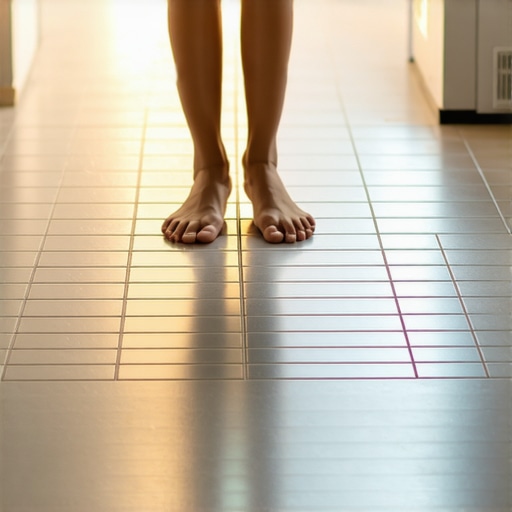
The thermal siphon under your feet
A cold bathroom floor is caused by a phenomenon called thermal bridging where the dense materials of your floor like porcelain tile or stone act as a heat sink, drawing warmth away from your body and into the subfloor. This occurs because materials like tile have high thermal mass but incredibly low R-values, meaning they are excellent at conducting heat rather than resisting its flow. If your subfloor is a concrete slab in direct contact with the earth, or if your crawlspace lacks a proper vapor barrier and insulation, that cold mass will win the battle against your home heating system every single time.
Most guys skip the leveling compound. They think the underlayment will hide the dip. It won’t. I spent three days grinding concrete on a job last month just so the floor wouldn’t click like a castanet, and during that process, I realized the homeowner was complaining about the cold because the previous installer had used a cheap, non-modified thin-set that had crystallized and lost its thermal bond. A floor is a structural system, not a rug. If you don’t account for the thermodynamics of the slab, you are just building a very expensive ice cube. When we talk about bathroom floors, we are talking about a battle against the second law of thermodynamics. Heat moves to cold. Your feet are 98.6 degrees. The tile sitting on a 55 degree slab is the predator in this scenario. It is going to eat your body heat the second you step out of the shower.
The physics of the subfloor and thermal mass
Subfloor materials determine the baseline temperature of your finished floor because they dictate the rate of heat transfer from the living space into the foundation. Concrete is a massive thermal battery, but without a thermal break, it stays at the temperature of the ground below it, which is often significantly lower than the air in your bathroom. This is why even a room at 72 degrees can have a floor that feels like it belongs in a walk-in freezer. The density of the substrate is the primary driver here.
Image_Placeholder
When I look at a subfloor, I am looking for the moisture content and the R-value. Standard 3/4 inch plywood has an R-value of about 0.94, which is not great, but it is a lot better than the 0.1 or less you get from a raw concrete slab. If you are installing tile in showers that wow modern designs for 2025, you have to consider the waterproofing membrane as more than just a leak preventer. It is also a thin layer of separation that can slightly decouple the tile from the cold substrate. However, if you really want to stop the cold, you have to look at uncoupling membranes with integrated heating cables or high-density foam boards. Without a thermal break, you are essentially trying to heat the entire planet through your bathroom floor. The heat goes down into the slab before it ever thinks about radiating up to your toes.
Why your grout is a heat thief
Grout density and moisture retention play a significant role in the temperature of a tile assembly because the mineral composition of the grout allows for rapid thermal conduction. Standard cementitious grout is porous, meaning it can hold microscopic amounts of moisture that increase its ability to transfer cold from the subfloor to the surface. When your grout lines feel even colder than the tiles themselves, it is usually because the grout is acting as a bridge for the cold air trapped in the substrate or the floor joists below.
“A floor is only as good as the subfloor beneath it; deflection is the enemy of every joint.” – Master Flooring Axiom
If you have older grout that has become compromised, you might be looking at how to refresh grout without replacing it to improve the aesthetics, but from a thermal perspective, you should be looking at the density. High-performance epoxy grouts have different thermal properties than standard sanded grout. They are less porous and do not absorb the moisture that can lead to that biting cold sensation. Furthermore, if your grout is cracked, it allows air infiltration from the subfloor, creating a tiny but constant draft right under your feet. This is why grout restoration secrets for long-lasting results often include ensuring a full, dense pack of the joint to eliminate those micro-voids.
The 1/8 inch that ruins everything
Expansion gaps at the perimeter of the room are often the source of cold drafts because they provide a direct path for unconditioned air to enter the room from behind the baseboards. While the National Wood Flooring Association and the Tile Council of North America both mandate perimeter expansion gaps to prevent buckling and tenting, these gaps must be handled with surgical precision. If the gap is open to the wall cavity, your baseboards are basically acting as a chimney for cold air.
I have seen million dollar bathrooms where the floor was cold simply because the installer didn’t use a backer rod or a bit of spray foam in the gap before installing the baseboards. When you look at baseboards makeover ideas to elevate your space, remember that they are more than decorative trim. They are your last line of defense against air infiltration. If the air under your subfloor is 50 degrees and your bathroom is 70 degrees, that pressure difference will pull the cold air through the expansion gap and out from under your chic baseboard designs that transform rooms in 2025. It creates a localized cold zone right where you stand to brush your teeth.
Thermal conductivity comparison of flooring materials
| Material Type | Thermal Conductivity (W/m·K) | Standard Thickness | Thermal Feel Perception |
|---|---|---|---|
| Porcelain Tile | 1.30 | 3/8 inch | Extreme Cold |
| Ceramic Tile | 1.10 | 5/16 inch | Very Cold |
| Natural Marble | 2.50 | 1/2 inch | Ice Cold |
| Luxury Vinyl Plank | 0.20 | 6.5 mm | Neutral |
| Engineered Oak | 0.17 | 5/8 inch | Warm |
| Cork Underlayment | 0.04 | 1/4 inch | Insulating |
The chemistry of the bond and heat transfer
The chemical makeup of your thin-set mortar determines how effectively heat is transferred between the subfloor and the tile. A polymer-modified thin-set creates a dense, plastic-like matrix that is very good at conducting energy. While this is great for radiant heating systems, it is a nightmare if your subfloor is cold. In those cases, the thin-set acts as a high-speed rail for the cold to reach the surface of your tile. I always tell people that the adhesive is the most overlooked part of the floor’s thermal performance.
If you are concerned about sustainability, you might be looking for eco-friendly tile solutions for sustainable homes in 2025. These often involve recycled content in the tiles and low-VOC mortars. But you also have to look at the thermal efficiency. A sustainable home is one that doesn’t waste energy. If your floor is a giant heat sink, you are wasting energy. You need to consider a thermal break membrane. These membranes are usually made of polyethylene or similar polymers that have much lower thermal conductivity than cement. They break the chain of the thermal bridge. It is the difference between touching a metal spoon in a pot of ice water and touching a plastic one.
The moisture meter does not lie
High moisture levels in the subfloor increase the thermal conductivity of the entire floor assembly, making it feel significantly colder than a dry floor. Water is a much better conductor of heat than air. If your concrete slab has a high vapor emission rate, that moisture is saturating the thin-set and the tile from below. This is common in older homes where no vapor barrier was placed under the slab before it was poured. The moisture moves up through the capillary channels in the concrete and sits at the interface between the slab and your flooring.
“Excessive moisture in the substrate is the primary cause of flooring failure and thermal discomfort; a dry floor is a warm floor.” – TCNA Installation Manual Reference
I always pull out my Delmhorst moisture meter before I even think about laying a tile. If I see readings above 4 percent on a concrete slab or 12 percent on a wood subfloor, I know we have a problem. That moisture isn’t just going to rot your subfloor or cause mold, it is going to make the floor feel like an ice skating rink. You have to seal that slab. Using a high-quality moisture vapor barrier can drop the thermal conductivity of the assembly. It keeps the water out and the heat in. If you want a sparkling bathroom, as suggested in these tile cleaning tips for a sparkling bathroom in 2025, you have to start with a dry, stable base.
Troubleshooting your cold bathroom floor
- Check the crawlspace for missing or fallen insulation directly under the bathroom area.
- Inspect the perimeter baseboards for air gaps and seal them with paintable caulk or backer rod.
- Use a non-contact infrared thermometer to find the specific cold spots on the floor.
- Verify that the HVAC register in the bathroom is not being blocked by rugs or furniture.
- Assess the grout joints for cracks or missing material that could be allowing air movement.
- Consider adding a plush, high-pile rug with a rubberized backing as a temporary thermal break.
- If the floor is stone, ensure it is properly sealed to prevent moisture absorption which increases cold.
The ghost in the expansion gap
The air gap between your flooring and the wall studs is a major source of heat loss that most homeowners and even many pros completely overlook. When you pull off your baseboards, you often find a half-inch gap where you can see straight down into the subfloor or into the wall cavity. This is a highway for cold air. In the winter, the stack effect in your house pulls warm air up and out through the attic, which creates a vacuum that sucks cold air in through the lowest points of the house, like your bathroom floor edges.
If you are planning a showers with a style trendy ideas for small bathrooms renovation, this is the time to fix it. Don’t just tile up to the wall. Seal that transition. Use a high-quality silicone or a specialized expansion joint filler that remains flexible but blocks air. This prevents the cold air from the crawlspace or the exterior walls from leaking out across your floor. It is a small detail that makes a massive difference in how the room feels at 6:00 AM in January. If you have questions about specific products for this, you can always contact us for technical advice on professional sealants.
The science of flooring is the science of managing the environment between the earth and your feet. Every layer of the assembly, from the dirt under the slab to the sealer on the grout, plays a role in the temperature you feel. If you ignore the subfloor physics, you are just decorating a problem. Spend the time on the prep. Use the right membranes. Seal your gaps. That is how you build a floor that actually feels like part of a home rather than a cold slab of rock.
Comments
2 responses to “Why Your Bathroom Floor Feels Cold Even With the Heat On”
This post really hits home for me! I experienced a similar issue with my bathroom tiles feeling icy cold despite a good heating system. After reading about the thermal bridging effects, I realized that the concrete slab underneath my tile was acting as a massive heat sink. Installing a foam insulation board and sealing all the gaps around the baseboards made a noticeable difference. One thing I learned is how crucial the moisture level in the subfloor is; I had to use a vapor barrier to prevent moisture from elevating the floor’s thermal conductivity. It’s also easy to overlook the importance of the grout—upgrading to an epoxy grout did wonders in reducing the cold draft. Have any of you tried thermal break membranes or electric underfloor heating? I wonder how effective they are in such scenarios and whether they’re worth the investment for a long-term solution.
This article really nails the core issues affecting cold bathroom floors. I experienced a similar problem in my home where, despite a modern heat system, the floor still felt icy. It turned out that the subfloor was a massive thermal sink due to the concrete slab being directly in contact with the ground and lacking proper insulation. The detailed explanation about the thermal mass and the importance of thermal breaks resonated with me, especially considering I’ve recently added foam board insulation and sealed all perimeter gaps. It’s fascinating how these little details—like grout type and expansion gap sealing—can have such a big impact on temperature retention. I’m curious, has anyone experimented with radiant floor heating? I’ve heard it can be quite effective, especially when combined with proper insulation and vapor barriers. I’d love to hear more about which solutions others have found most successful, especially in retrofit situations where major modifications are limited.