
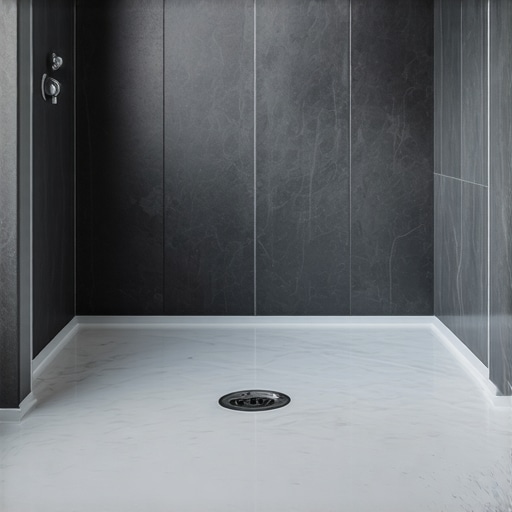
The physics of water and the structural integrity of curbless shower entries
Most guys skip the leveling compound. They think the underlayment will hide the dip. It won’t. I spent three days grinding concrete on a job last month just so the floor wouldn’t click like a castanet and more importantly so the water wouldn’t pool at the threshold. Most installers look at a curbless entry and see a design trend. I see a hydraulic challenge. If your subfloor is out by even an eighth of an inch over ten feet, you are not just looking at a trip hazard. You are looking at a future mold colony. This is the reality of the master flooring architect. We do not just lay tile. We manage fluids and structural loads at the microscopic level.
The 1/8 inch that ruins everything
Waterproofing a curbless shower requires a perfect 2 percent slope toward the drain while maintaining a flat transition at the bathroom floor. This geometric feat relies on the structural floor being recessed or the entire bathroom floor being built up. If the transition is not dead level across the entry point, the surface tension of the water will break and flood your bathroom. Most failures happen because the installer ignored the deflection rating of the joists or the moisture content of the subfloor. You need a L/360 rating for ceramic tile or L/720 for natural stone to prevent the grout from cracking at the first sign of seasonal movement.
The mechanics of water migration are relentless. When you remove the curb, you remove the physical dam that compensates for poor plumbing. A curbless entry demands a linear drain or a perfectly centered point drain with a four-way pitch. I have seen guys try to ‘cheat’ the pitch by using extra thin-set under the tile. That is a recipe for disaster. Thin-set is an adhesive, not a leveling bed. When it cures, it shrinks. If the bed is too thick, the shrinkage pulls at the membrane and can actually create micro-tears that the naked eye cannot see.
“A floor is only as good as the subfloor beneath it; deflection is the enemy of every joint.” – Master Flooring Axiom
Why your subfloor is lying to you
Subfloor preparation for curbless showers involves testing for moisture vapor transmission and ensuring the surface is free of bond breakers. Concrete slabs are never truly dry. They are breathing machines that exhale moisture. If you seal that moisture under a waterproof membrane without checking the relative humidity of the slab, the vapor pressure will eventually cause the membrane to delaminate. I use a calcium chloride test or an in-situ probe because a surface meter is just a guess. You want to see less than three pounds per 1,000 square feet over 24 hours before you even think about the primer.
If you are working on wood joists, the game changes. You cannot just slap down a piece of plywood. You need a double-layer floor system or a specialized structural foam board that replaces the subfloor. I prefer the foam board method because it allows for a lower profile, making the transition to the rest of the home easier. This is where you might consider baseboards makeover ideas to elevate your space as the new floor height will change how your trim interacts with the wall. The physics of wood expansion must be respected. Wood moves. Tile does not. If you do not have an expansion gap at the perimeter, the floor will tent.
The invisible physics of water surface tension
Controlling water at a curbless threshold depends on the capillary break and the specific gravity of the liquid. Water has a tendency to ‘climb’ through small gaps between the tile and the grout. This is known as capillary action. To stop this, the waterproofing membrane must extend at least 18 inches past the shower entry into the main bathroom area. This creates a secondary containment zone. Most people think it is overkill until they see the underside of a subfloor that has been slowly rotting for three years because of a tiny leak at the doorway.
The choice of drain is also a technical decision. Linear drains are the gold standard for curbless designs because they only require a single slope in one direction. This simplifies the tile layout and reduces the number of grout lines where water can sit. For a more modern look, you can explore showers that wow modern designs for 2025 to see how these drains integrate into the overall aesthetic. However, the drain must be sized for the gallons-per-minute output of the showerhead. If you have a high-flow rain head and a standard 2-inch drain, you will have a flooded bathroom regardless of how good your waterproofing is.
The chemistry of a perfect bond
Achieving a waterproof seal requires polymer-modified mortars that can withstand constant hydrostatic pressure and thermal cycling. Not all thin-sets are created equal. When I am installing a curbless entry, I look for mortars that meet ANSI A118.15 standards. These have a higher concentration of polymers that allow the bond to remain flexible. If the mortar is too rigid, the vibration of someone walking across the room can break the bond between the tile and the membrane. This is especially true with large format tiles which are common in showers with a style trendy ideas for small bathrooms.
| Membrane Type | Vapor Permeance | Best Use Case | Cure Time |
|---|---|---|---|
| Liquid Applied | Medium | Complex geometries and niches | 24 Hours |
| Sheet Membrane | Very Low | Large flat floors and steam rooms | Immediate |
| Structural Board | Zero | Complete renovations and rebuilds | Immediate |
Liquid membranes are popular because they are easy to apply with a roller. However, they require a specific mil-thickness to be effective. I always use a wet-film gauge to make sure I am not going too thin. If it is too thin, it is just paint. If it is too thick, it can skin over and trap moisture inside, leading to a ‘rubbery’ failure later. Sheet membranes are more reliable for consistency but require a higher level of skill to install without bubbles or folds. Every fold is a potential leak point.
The tragedy of the clogged weep hole
Traditional shower pans rely on weep holes in the drain assembly to allow moisture that gets behind the tile to escape. If the installer clogs these holes with mortar, the water stays trapped in the mud bed. Eventually, it goes sour. You get that ‘old shower’ smell. In a curbless entry, this is even more dangerous because the water can migrate sideways into the bedroom carpet. This is why I advocate for ‘top-down’ waterproofing systems where the membrane is directly under the tile. This eliminates the mud bed entirely and keeps the water on the surface where it can drain away.
Grout is the first line of defense but it is not waterproof. Even the best grout will eventually absorb some moisture. You should look into grout restoration secrets for long-lasting results to understand how to maintain that barrier. Epoxy grout is an option for total water resistance, but it is a nightmare to work with. It sets up fast and can leave a haze on the tile that is impossible to remove without harsh chemicals. I prefer high-performance cementitious grouts that have built-in sealers.
“Waterproofing is not a layer; it is a system of integrated chemical bonds and mechanical slopes.” – TCNA Handbook Principles
Baseboards and the perimeter breach
The junction where the floor meets the wall is the most common point of failure in any curbless shower installation. You must use a pre-formed corner or a specialized flashing tape to bridge the gap between the floor membrane and the wall board. Water will find the path of least resistance, and that is usually the corner. I always run my floor membrane at least 6 inches up the wall before I install the tile. This creates a bathtub effect. If you are updating your trim, consider chic baseboard designs that transform rooms in 2025 to ensure your new aesthetic matches the high-performance engineering of your floor.
- Check subfloor levelness with a 10-foot straight edge.
- Verify moisture content of concrete or wood using a calibrated meter.
- Apply a primer specifically designed for the chosen membrane.
- Seal all pipe penetrations with expansion-rated collars.
- Perform a 24-hour flood test before laying a single tile.
A flood test is non-negotiable. You plug the drain and fill the area with two inches of water. If the level drops after 24 hours, you have a leak. It is much cheaper to fix a leak in the membrane than to tear out a finished tile floor. Most guys skip the flood test because they are in a hurry. That is how you end up in court. Information gain: while most people want the thickest underlayment, too much cushion actually causes the locking mechanisms on LVP or the grout lines in tile to snap under pressure. This applies to showers too; you want a dense, non-compressible base.
The truth about grout porosity
Maintaining the integrity of a curbless entry involves regular cleaning and monitoring of the grout lines for hairline fractures. Over time, the house will settle. If you see a crack in the grout, that is an indicator of movement. It is also an open door for water. You can learn how to refresh grout without replacing it to stay on top of this. If the grout becomes too porous, it acts like a sponge. For those looking for a more permanent solution, eco-friendly tile solutions for sustainable homes in 2025 often include denser porcelains that naturally resist water absorption better than traditional ceramics.
Cleaning is also technical. Using the wrong acid-based cleaner can eat away at the grout and the waterproofing membrane beneath it. Always use a pH-neutral cleaner. Check out tile cleaning tips for a sparkling bathroom in 2025 for the latest on keeping your surfaces pristine without damaging the engineering underneath. A curbless shower is a high-performance machine. You would not put low-grade oil in a Ferrari, so do not use cheap cleaners on a custom-engineered shower. Every decision, from the grit of the grinding wheel to the chemical makeup of the grout, determines if that floor will last thirty years or three months. If you have questions about a specific layout, you can always contact us for technical guidance.