
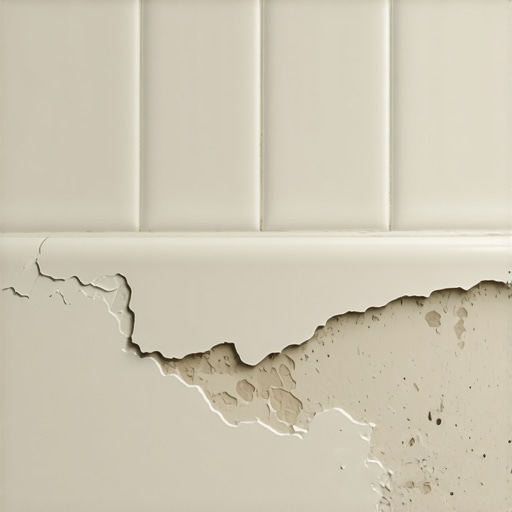
Why Your Bathroom Baseboards Keep Peeling No Matter How Much You Paint
I spent three days grinding concrete on a job last month just so the floor wouldn’t click like a castanet. Most guys skip the leveling compound and they think the underlayment will hide the dip. It won’t. While I was down there on my hands and knees, the homeowner asked me why their baseboards looked like a snake shedding its skin. I put my pin-meter to the wood and it read eighteen percent moisture. That is a death sentence for any coating. You can buy the most expensive paint in the world, but if your subfloor and tile substrate are pushing moisture out, that paint is just a temporary skin on a balloon about to pop. My boots have seen thousands of bathrooms and the story is always the same. People focus on the color of the paint while the physics of the wall are working against them. Smelling like oak dust and WD-40 is part of the job, and my job is telling you that your bathroom is a high-pressure environment that treats wood like a sponge.
The moisture trap behind the paint
Bathroom baseboards peel because of moisture wicking through porous grout, high relative humidity in the air, and hydrostatic pressure from the subfloor. These forces attack the bond between the paint and the substrate from behind, causing the coating to lose adhesion and eventually flake or bubble away. It is a fundamental law of physics that water moves from areas of high concentration to areas of low concentration. In a bathroom, the area behind your baseboard is often a reservoir for trapped vapor. If you are interested in better materials for these spaces, you should look at eco friendly tile solutions for sustainable homes in 2025 to understand how modern materials handle moisture differently.
Physics of the capillary effect in wood fibers
Wood is a bundle of microscopic straws designed by nature to move water. When you install a wood baseboard against a tile floor, you are placing those straws in direct contact with a potential water source. Capillary action occurs when liquid water is drawn into the small pores of the wood. This happens even if you do not see a puddle. If the grout line is damp, the wood will pull that moisture upward. As the wood fibers swell, they expand at a different rate than the paint film. This mechanical stress breaks the chemical bond of the primer. Most people do not realize that the back of the baseboard is usually raw wood. This raw wood acts as an open door for moisture. To fix this, you have to treat the wood before it ever touches the wall. You can find some inspiration for better installs at baseboards makeover ideas to elevate your space which covers how to properly integrate these elements.
“A floor is only as good as the subfloor beneath it; deflection is the enemy of every joint.” – Master Flooring Axiom
Why your grout is a highway for humidity
Grout is essentially a hard sponge. Unless you are using a high-grade epoxy grout, your grout lines are full of microscopic voids. When you take a hot shower, the steam condenses on the floor and seeps into these voids. This water then travels laterally under the baseboard where it cannot evaporate. This creates a permanent damp zone. If you have been neglecting your maintenance, you might need grout restoration secrets for long-lasting results to seal those pathways. Without a proper seal, the water will continue to migrate into the wall cavity, rotting the sill plate and causing the paint on your baseboards to bubble from the inside out. I have seen baseboards that looked perfect on the outside but were nothing but mush on the back because of unsealed grout lines.
The chemistry of failed adhesion
Paint adhesion relies on both a mechanical and a chemical bond. When you apply paint to a damp surface, the water molecules occupy the pores that the paint resins need to penetrate. This prevents the mechanical anchor from forming. Furthermore, many modern paints are water-based latex. While these are great for low-VOC requirements, they have a difficult time competing with the high alkalinity of concrete or the tannins in wood when moisture is present. If the substrate pH is too high because of damp concrete, it will literally saponify the resins in the paint. This turns the paint into a soapy film that slides right off the wood. You might want to explore chic baseboard designs that transform rooms in 2025 to see materials that are less prone to these chemical failures.
Material choice and the MDF disaster
Medium Density Fiberboard or MDF is the most common material used for baseboards today because it is cheap and straight. However, MDF is essentially compressed sawdust and glue. In a bathroom, it acts like a sponge. Once moisture hits the edge of an MDF board, it swells and can never be compressed back to its original size. This swelling causes the paint to crack at the seams. I always tell my clients to avoid MDF in bathrooms at all costs. You are better off using a solid PVC or a finger-jointed pine that has been back-primed. If you are renovating your whole space, check out showers with a style trendy ideas for small bathrooms to ensure your layout keeps water away from your trim as much as possible.
A comparison of trim materials for bathrooms
| Material | Moisture Resistance | Dimensional Stability | Primary Weakness |
|---|---|---|---|
| MDF | Very Low | Poor | Permanent Swelling |
| Pine | Moderate | Fair | Tannin Bleed |
| PVC | High | Excellent | Thermal Expansion |
| Oak | Low | Good | Grain Raising |
The one eighth inch gap that saves your sanity
One of the biggest mistakes I see is baseboards installed tight against the tile. You need a small gap, about the thickness of a nickel, between the bottom of the baseboard and the floor. This gap prevents the wood from sitting in standing water. You then fill this gap with a high-quality 100 percent silicone caulk. Silicone is flexible and waterproof, unlike the wood itself. This creates a gasket that protects the trim. If you are also dealing with tile issues, you may need tile cleaning tips for a sparkling bathroom in 2025 to keep the area free of mold-growing debris. A clean joint is a lasting joint.
Regional climate factors in moisture management
If you live in a place like Houston, the humidity is your constant enemy. The air is so thick with water that the wood never truly dries out. In these environments, you must use a vapor-impermeable primer on all six sides of the board. In a dry climate like Phoenix, the issue is different. The wood shrinks so much that the caulk joints pull apart, allowing the occasional splash from the shower to get behind the trim. You have to account for these regional movements. If your bathroom layout is poor, you might consider showers that wow modern designs for 2025 to see how better drainage reduces the load on your baseboards.
“Moisture is a silent hammer that beats against your finishes until they break.” – Master Flooring Axiom
The checklist for a permanent baseboard finish
- Measure the moisture content of the wood and the subfloor before installation.
- Back-prime all baseboards with an oil-based sealer to block moisture absorption.
- Use a 100 percent silicone sealant at the floor-to-wall junction.
- Seal all grout lines with a penetrating sealer every twelve months.
- Maintain a bathroom humidity level below fifty percent using a high-cfm exhaust fan.
- Ensure the tile substrate has a proper waterproofing membrane like Schulter-Kerdi.
Structural engineering of the bathroom threshold
The transition between your shower and the rest of the floor is a critical failure point. If the curb is not sloped correctly, water will migrate toward the baseboards. I have seen houses where the entire hallway floor was ruined because the bathroom baseboard acted as a wick that pulled water out of the bathroom. If you find your grout is already failing, look into how to refresh grout without replacing it before you worry about the paint. You have to stop the leak at the source before the finish can ever stay put. This is not about aesthetics, it is about the structural integrity of your home. If you have more questions about your specific situation, feel free to contact us for expert guidance. Remember that a bathroom is a machine for managing water. If any part of that machine fails, the paint on your baseboards is the first thing to tell you. Stop blaming the paint brand and start looking at the physics of your floor.
Comments
One response to “Why Your Bathroom Baseboards Keep Peeling No Matter How Much You Paint”
This article really hits home for me. I’ve struggled for years with peeling baseboards in my bathroom, and I never quite understood the root cause until reading this. The part about moisture wicking and capillary action in wood fibers makes a lot of sense — I always thought it was just bad painting. I now realize that sealing all sides of the wood and ensuring proper installation gaps are crucial. What I found interesting is the emphasis on regional climate factors; living in a humid place like Louisiana, I should definitely invest in vapor-impermeable primers and better waterproofing membranes. Has anyone here tried using solid PVC trim instead of MDF? I’ve heard it’s much more durable but have not yet made the switch. Would love to hear some experiences and recommendations on material choices and maintenance routines to keep baseboards looking good in moisture-prone bathrooms.