
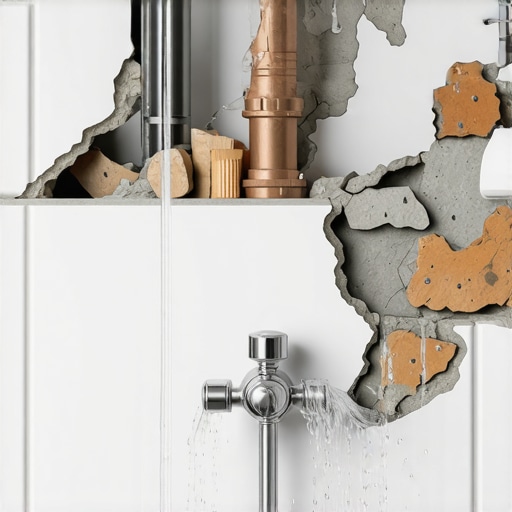
The invisible disaster unfolding behind your bathroom walls
Shower valve leaks behind wall tile occur when internal seals fail, soldered joints crack, or threaded connections loosen due to thermal expansion and vibration. This hydrostatic failure allows pressurized water to penetrate the wall cavity, saturating wood studs and subfloors long before visible water damage appears on baseboards or grout.
I spent three days grinding concrete on a job last month just so the floor wouldn’t click like a castanet, and that was after I had to tell the homeowner their entire master bathroom was a structural hazard. Most guys skip the leveling compound and they definitely skip checking the plumbing integrity before they slap down tile. On that specific job, the homeowner complained about a musty smell and some soft wood near the shower entry. When I pulled the first row of tiles, the drywall behind it turned to gray mush in my hands. The culprit was not the grout. It was a $15 shower valve cartridge that had a microscopic tear in the O-ring. For months, it had been spraying a fine mist against the back of the tile backer board. The moisture traveled down the studs, pooled on the subfloor, and rotted out the bottom plate of the wall. This is the reality of residential construction. It is a system of layers, and if the core layer fails, the decorative layer is just a mask for decay.
The physics of hydrostatic pressure in plumbing cavities
Hydrostatic pressure within a potable water system remains constant at 40 to 80 PSI, meaning any structural breach in a shower valve creates a continuous water jet. This moisture migration exploits capillary action to move through porous insulation and timber framing, bypassing tile surfaces entirely until the saturation point is reached.
When you turn that handle to get a 105-degree shower, you are engaging a complex mechanical interaction. Most modern valves use a cartridge system made of plastic, brass, and rubber. Over time, the minerals in your water, such as calcium and magnesium, create abrasive deposits on these rubber seals. Every time you turn the handle, those deposits act like sandpaper. Eventually, the seal fails. But the water doesn’t always come out of the showerhead. It follows the path of least resistance. Sometimes that path leads straight back into the wall. If your installer didn’t use a proper waterproof membrane like those used in showers that wow, that water is going to find your subfloor. I have seen 3/4 inch plywood turn into something resembling wet cardboard in less than six months because of a slow drip. The chemistry of the water matters too. Acidic water can eat away at copper pipes, leading to pinhole leaks that are nearly impossible to detect without a pressure test. You might think your tile cleaning tips are enough to keep the bathroom fresh, but no amount of scrubbing will stop a leak happening three inches behind the ceramic surface.
“A floor is only as good as the subfloor beneath it; deflection is the enemy of every joint.” – Master Flooring Axiom
Why your subfloor is lying to you
Subfloor integrity is compromised when latent leaks introduce prolonged moisture to OSB or plywood, causing delamination and structural deflection. This vertical movement stresses the tile bond, leading to cracked grout lines and loose tiles that signal a deeper plumbing failure within the wall assembly.
In the flooring world, we talk about deflection. It is the amount of ‘bounce’ in a floor. When water leaks behind a shower valve and hits the floor joists, the wood begins to swell. As it swells, it pushes against the tile above. Then, as it dries slightly, it shrinks. This cycle of expansion and contraction is a death sentence for your grout. You might try how to refresh grout without replacing it, but if the subfloor is moving, that new grout will crack in a week. The physics are simple. You cannot bond a rigid material like tile to a moving target like wet wood. I have seen installers try to hide this with extra thin-set. It never works. The chemical bond of the thin-set is strong, but it cannot overcome the structural failure of a rotted joist. This is why I always carry a moisture meter. If I see a reading above 12 percent in a subfloor near a shower, I stop the job. We are not laying a single tile until the plumber finds that leak. People want the trendy ideas for small bathrooms, but they don’t want to pay for the boring stuff like new shut-off valves or copper re-piping. It is a mistake that costs thousands in the long run.
| Valve Component | Failure Mode | Structural Impact |
|---|---|---|
| Cartridge O-Ring | Abrasive Wear | Slow seepage into wall cavity |
| Solder Joint | Thermal Stress | High-volume flooding of subfloor |
| Threaded Nipple | Galvanic Corrosion | Localized rot behind valve plate |
| PEX Crimp | Installation Error | Intermittent leaks during pressure spikes |
The ghost in the expansion gap
Expansion gaps at the perimeter of tile floors are essential to accommodate hygroscopic movement, yet they often become conduits for water when a shower valve leaks. Water travels along the bottom plate of the wall and emerges at the baseboards, often being mistaken for a surface spill rather than a systemic plumbing failure.
If you see your chic baseboard designs starting to peel or discolor at the bottom, don’t just repaint them. That is the ghost of a leak calling out to you. Wood baseboards are like sponges. They will pull water up through the grain via capillary action. By the time the paint bubbles, the back of the wood is covered in black mold. I have pulled off baseboards in million-dollar homes and found the drywall behind them was just a colony of fungi. This happens because the installer didn’t seal the gap between the shower pan and the floor, or because the valve is leaking and the water is running down the inside of the wall. You can look into baseboards makeover ideas all you want, but if you don’t fix the moisture source, you are just putting a band-aid on a broken leg. The chemistry of mold is aggressive. It feeds on the paper facing of drywall and the starch in wood glue. Once it takes hold in the wall cavity behind your shower tile, it is a nightmare to remediate. You have to cut out the studs, replace the insulation, and start from scratch.
“Impermeability is not a suggestion; it is a requirement for any assembly subjected to pressurized fluids.” – Tile Council of North America Standard
The 1/8 inch that ruins everything
Mechanical tolerances in shower valve installations allow for only 1/8 inch of deviation before the escutcheon plate fails to create a watertight seal against the tile surface. When a valve is recessed too deeply or protrudes too far, shower spray enters the wall opening, bypassing the grout and tile entirely.
Precision is everything. If the plumber sets that valve just a hair too deep in the wall, the trim kit won’t sit flush against the tile. Most ‘handymen’ will just glob a bunch of cheap silicone around it and call it a day. But silicone fails. It shrinks. It pulls away from the tile. And then, every time you take a shower, a small amount of water runs behind that metal plate. It’s not a lot. Maybe a few tablespoons per shower. But over a year, that is gallons of water being dumped directly into your wall. This is why grout restoration secrets often start with checking the plumbing fixtures. If the source of the water isn’t contained, the grout will always look terrible because it is constantly being saturated from the back. Water moving from the back of the tile toward the front will carry mineral salts with it. This creates efflorescence, that white crusty stuff you see on grout lines. It’s not just ugly. It’s a sign that your wall is wet. You should also consider eco-friendly tile solutions that utilize better vapor barriers to prevent this kind of deep-seated moisture damage.
- Check the shower arm connection for signs of scale or moisture.
- Inspect the escutcheon plate for a tight silicone seal around the perimeter.
- Monitor the floor-to-wall transition for darkened grout or soft baseboards.
- Listen for a faint ‘hiss’ behind the wall when the water is turned off.
- Use an infrared camera to detect cold spots that indicate wet insulation.
The structural reality of your home depends on things you can’t see. Don’t be the homeowner who ignores a small damp spot until the floor collapses. I have seen it happen. It starts with a drip. It ends with a demolition crew. Treat your plumbing like the engineering challenge it is. Hire a professional who knows how to use a level and a pressure gauge. Your subfloor will thank you. Your wallet will thank you. And you won’t have to smell WD-40 and mold every time you walk into your bathroom. If you’re ready to fix it right the first time, you know where to go. Contact us to get a pro on the job before the damage spreads further.