
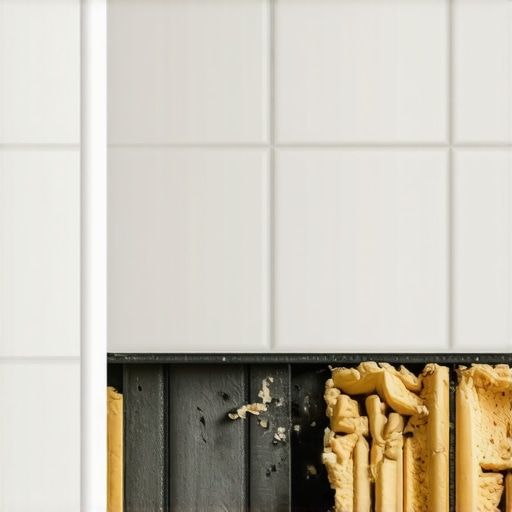
The silent expansion of wet studs
Bowing bathroom walls are primarily caused by moisture intrusion reaching the structural framing, leading to hydrostatic expansion of wood studs or the oxidation of fasteners. This process occurs when water penetrates through cracked grout or failed waterproofing membranes, saturating the porous lumber behind the tile and forcing it to warp. Most guys skip the leveling compound. They think the underlayment will hide the dip. It won’t. I spent three days grinding concrete on a job last month just so the floor wouldn’t click like a castanet. That job was a nightmare, but bathroom walls are even worse because you are fighting gravity. When a wall bows, it is a structural scream for help. You are seeing the physical result of wood fibers absorbing water and expanding at a different rate than the rigid tile. Wood is hygroscopic. It wants to reach equilibrium with its environment. When your shower leak introduces constant moisture, those studs swell. Because they are pinned at the top and bottom plates, they have nowhere to go but out. This creates a convex curve that pops tiles off the wall and cracks grout lines. If you see a bulge, the damage is already done to the skeleton of the room. You can look at showers with a style trendy ideas for small bathrooms to see what a healthy wall looks like, but your current reality is likely a failing vapor barrier.
“A floor is only as good as the subfloor beneath it; deflection is the enemy of every joint.” – Master Flooring Axiom
When thin-set loses the war
Thin-set mortar failures occur when the chemical bond between the tile and the substrate is compromised by persistent moisture re-emulsifying the polymers. In modern installations, we use modified thin-sets that meet ANSI A118.4 standards, which contain latex or acrylic additives to allow for slight movement. However, if water gets behind the tile, these polymers can soften. This is not just a wet wall. It is a chemical breakdown. When the thin-set loses its grip, the tile is no longer a part of the wall. It becomes a heavy, hanging weight. The bow you see might not even be the wood. It might be the entire tile assembly delaminating from the cement board. I have seen 12 by 24 inch porcelain tiles hanging by a thread of grout because the installer used the wrong notch trowel. They did not get 95 percent coverage required for wet areas. Instead, they had ridges of thin-set with air pockets. Those air pockets are like tiny swimming pools for mold and water. Over time, the pressure of the water trapped in those voids pushes the tile outward. If you are worried about the look of your joints during this failure, you might search for grout restoration secrets for long lasting results, but no amount of scrubbing will fix a structural bond failure.
The ghost in the expansion gap
The absence of a perimeter expansion gap at the corners and the floor-to-wall transition causes tiles to pressure-tent as the house shifts. Buildings move. They breathe. They settle. If you butt your wall tile tight against the floor tile or tight into the corners without a 1/8 inch gap filled with 100 percent silicone sealant, you have built a ticking time bomb. When the house settles or the humidity changes, those tiles press against each other with thousands of pounds of force. This is the physics of compression. Something has to give. Usually, the weakest point is the center of the wall, which begins to buckle outward. This is often confused with wood rot, but it is actually a lack of planning for movement. You must use caulk at all change of plane transitions. Grout is rigid; it does not compress. Silicone is flexible; it acts as a shock absorber. Without that shock absorber, your bathroom wall is a rigid sheet that will snap under the slightest pressure from the foundation. Even tile cleaning tips for a sparkling bathroom in 2025 will not help if the grout is pulverized into dust by these compressive forces.
Why your subfloor is lying to you
Subfloor instability often translates into wall bowing when the vertical studs are not properly tied into a level and rigid floor joist system. If your floor is bouncing, your walls are swaying. I have walked into bathrooms where the homeowner complained about the wall tile, only for me to find that the floor was dipping two inches in the corner. That dip pulls the bottom of the wall studs inward, which makes the middle of the wall look like it is bowing out. It is an optical illusion caused by a structural failure at the feet of the wall. You cannot fix the wall without fixing the floor. This often involves sistering joists or installing a new layer of 3/4 inch tongue and groove subfloor. If you are trying to hide the gap at the bottom, you might look into chic baseboard designs that transform rooms in 2025, but remember that baseboards are decorative, not structural. They will not hold a bowing wall in place.
| Material | Water Resistance | Flexural Strength | Best Use |
|---|---|---|---|
| Cement Board | High | High | Shower Walls |
| Greenboard | Low | Medium | Dry Zones |
| Kerdi-Board | Absolute | High | Wet Areas |
The 1/8 inch that ruins everything
Precision in the layout and the inclusion of a proper drainage plane is what separates a 30 year shower from a 3 year shower. If the installer did not leave a gap at the bottom for the tile to breathe, or if they blocked the weep holes in a traditional liner system, the wall will saturate from the bottom up. Capillary action is a beast. Water can climb up the back of a wall substrate like a ladder. This is why we see rot two feet above the floor line. People think water only goes down. They are wrong. Water goes wherever it is dry. If your studs are dry and your shower pan is wet, that water will climb. To prevent this, you need a high quality waterproofing membrane. For those looking for more modern options, showers that wow modern designs for 2025 often use integrated foam board systems that are completely waterproof from the factory. These do not absorb water, so the studs behind them stay dry even if a grout line fails.
“Substrate prepared for thin-set must be clean, dimensionally stable, and free of any substance that could prevent adhesion.” – TCNA Handbook for Ceramic, Glass, and Stone Tile Installation
The baseboard tell and what it hides
Separation between the baseboard and the tile is the first visual indicator that the wall framing is moving or the floor is sinking. When you see a shadow line appearing behind your baseboards, it means the wall is pulling away. In a bathroom, this is usually due to moisture. The wood plate at the bottom of the wall is rotting out, or the studs are twisting as they dry and re-wet. If you are considering baseboards makeover ideas to elevate your space, use that time to inspect the drywall or backer board behind them. If the material is soft or crumbly, stop the project. You have a leak. Replacing the trim without fixing the moisture source is just putting a bandage on a broken leg. You should also check the grout near the floor. If it is cracking, consider how to refresh grout without replacing it only after you have confirmed the wall is not moving anymore.
- Check for plumb studs using a 6 foot level.
- Test moisture content of lumber using a pin meter.
- Verify waterproofing overlap of at least 2 inches at all seams.
- Inspect grout for micro-fissures using a magnifying glass.
- Seal all pipe penetrations with high grade silicone.
If you have questions about your specific situation, you should contact us before the wall collapses. Using eco friendly tile solutions for sustainable homes in 2025 is great, but even the greenest tile will fail if the wall behind it is made of rotting wood. The chemistry of the bond and the physics of the frame must work together. If they do not, you are just waiting for the day the tile falls off and hits you in the foot. Structural integrity is not optional. It is the foundation of every trade. Do not let a small bulge turn into a full bathroom gut job. Address the moisture source, stabilize the framing, and use the right materials for the job.