
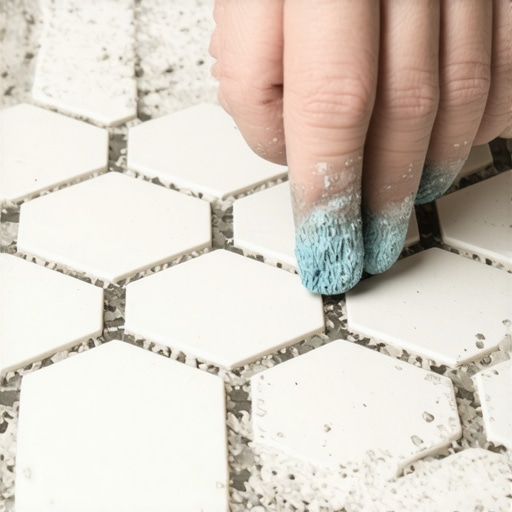
I spent three days grinding concrete on a floor last month just so the floor would not click like a castanet. The homeowner thought I was crazy. They wanted to save money by skipping the self-leveling compound. They thought the thin-set and the mesh backing on those hexagon mosaic tiles would hide the dips in the slab. They were wrong. Hexagons are not like square tiles. If the floor is off by a hair, the grout lines will look like a jagged mountain range instead of a clean honeycomb. I have seen fifteen thousand dollar bathrooms ruined because the installer did not understand the physics of the subfloor. You cannot hide a bad foundation with a pretty pattern. This is about structural engineering. It is not about decoration. I have spent twenty five years with a moisture meter and a level. I know when a floor is lying to me.
The geometric trap of the hexagon mosaic
Hexagon tiles require perfect subfloor flatness because the six sided geometry creates multiple intersecting grout joints that reveal any vertical deflection or surface variation. If the thin-set mortar is uneven, the tiles will lippage, making the grout lines look inconsistent. You need a flatness tolerance of 1/8 inch over 10 feet. When you have three joints meeting at a single point, there is no room for error. A square tile allows you to fudge a little. A hexagon demands absolute precision. Most guys treat mosaic sheets like a sticker. They slap them down and hope for the best. That is how you end up with a floor that feels like a cheese grater under your feet. The mesh backing on these tiles is often the first point of failure. It can expand or contract with moisture. It can trap air. If you do not embed that mesh fully into the mortar, the tile will eventually pop.
Why your subfloor is lying to you
Subfloor preparation determines grout success because moisture vapor transmission and structural deflection will crack cementitious grout in hexagon patterns. You must test the calcium chloride levels in concrete slabs before you even think about mixing thin-set or applying grout.
“A floor is only as good as the subfloor beneath it; deflection is the enemy of every joint.” – Master Flooring Axiom
If your subfloor has too much bounce, your grout will turn into powder within six months. I have seen guys try to use grout to bridge gaps that were actually structural failures. It does not work. You need to look at the L/360 rating of your joists. For natural stone hexagons, you need L/720. That means the floor should not move more than half an inch over a thirty foot span. If it does, your grout lines will snap.
The chemical reality of slaking grout
Proper grout mixing requires slaking to allow the polymers and pigments to chemically hydrate and ensure a uniform color and strength across the hexagon tile network. If you skip the ten minute rest period, the water cement ratio will be off, leading to efflorescence and grout shading issues. You see it all the time. One area is dark and the next is light. That is not a defect in the product. That is a defect in the installer. They used too much water or they did not let the mix sit. When you mix grout, you are starting a chemical reaction. You cannot rush chemistry. You need to use a low speed drill. High speeds introduce air bubbles. Those bubbles become pinholes in your grout. Pinholes trap dirt. Dirt ruins the aesthetic.
Why the sponge is your worst enemy
Excessive water during grout cleanup will wash out the color pigments and weaken the binder, causing grout joints to dip and tiles to lose their bond. You must use a damp, not dripping, sponge and change your wash water every fifty square feet to prevent haze formation on the hexagon tile surface. I have watched apprentices soak a floor like they were washing a car. It makes me want to retire. Every drop of extra water you put on that floor is stealing the strength of the grout. It creates a soft, chalky joint. If you want a floor that lasts, you use the minimum amount of moisture possible. You wipe once and you move on. Do not keep scrubbing the same spot. You are just digging the grout out of the joint.
Technical specifications for mosaic installations
The following table breaks down the technical requirements for different hexagon materials. You cannot treat marble the same way you treat porcelain. The porosity and the expansion rates are completely different.
| Material Type | Janka Hardness / Porosity | Recommended Grout | Acclimation Time |
|---|---|---|---|
| Porcelain Hex | Extremely High / Low | Polymer Modified | 24 Hours |
| Marble Hex | Variable / High | Non-Sanded | 48 Hours |
| Glass Mosaic | Brittle / Zero | Epoxy Grout | 24 Hours |
The perimeter failure and the baseboard myth
Expansion gaps at the floor perimeter are mandatory for hexagon tile installations to accommodate building movement and prevent tented tiles. You should never grout the transition between the floor and the wall; instead, use a color matched siliconized caulk that allows for structural shifting. People think the baseboard is just there to hide the gap. It is not. It is part of the system. If you jam your tiles tight against the wall and grout that joint, the floor has nowhere to go when the house settles or the humidity changes. It will buckle. I always tell people to look at chic baseboard designs that transform rooms in 2025 to see how a proper transition should look. It is about more than just looks. It is about letting the floor breathe. If you are doing showers that wow modern designs for 2025, that perimeter joint is even more vital because of the heat cycles.
The checklist for a perfect hexagon floor
- Verify subfloor flatness within 1/8 inch over 10 feet.
- Check moisture levels in concrete or plywood subfloor.
- Use a 3/16 inch V-notch trowel for most small mosaics.
- Mix grout with a margin trowel or low speed drill to avoid air.
- Let grout slake for exactly 10 minutes before the second stir.
- Wipe tiles with a microfiber cloth to remove final haze.
The ghost in the expansion gap
Movement joints are essential for tile longevity because they prevent stress fractures caused by thermal expansion and hygroscopic movement in the subfloor assembly. According to TCNA EJ171 standards, you need an expansion joint every twenty to twenty five feet in each direction. If you are in a high humidity area like Houston, you need them even closer. The air is thick. The wood subfloor drinks that moisture and grows. If your tile is locked in, something has to give. Usually, it is the grout. It will crack and flake away. Then you are calling someone like me to fix it. If you want to avoid that, learn about grout restoration secrets for long lasting results before you start your project.
Why your cleaning routine is killing your grout
Acidic cleaners destroy cement grout by dissolving the calcium carbonate and stripping the protective sealer, leading to permanent staining and structural erosion. You must use pH neutral cleaners and avoid steam mops, which can de-bond the adhesive from the hexagon tile mesh. I see people using vinegar on their floors. It drives me insane. Vinegar is an acid. It eats grout for breakfast. If you want your bathroom to stay clean, check out tile cleaning tips for a sparkling bathroom in 2025. Stop using harsh chemicals. You are literally melting your floor. If the grout is already far gone, you might need to know how to refresh grout without replacing it to save the installation.
The 1/8 inch that ruins everything
Trowel size selection is the most common error because insufficient mortar coverage leads to hollow tiles and cracked grout lines in hexagon mosaic sheets. You need at least 95 percent coverage in wet areas to prevent water pooling under the tile surface. I have seen guys use a floor trowel on a wall. It creates a mess. The ridges are too big. The tile sinks. The grout becomes an inch thick in some places and paper thin in others. That is how you get cracks.
“Deflection shall not exceed L/360 for ceramic tile or L/720 for natural stone under all live and dead loads.” – TCNA Handbook
If you are looking for eco friendly tile solutions for sustainable homes in 2025, make sure you are also looking at eco friendly subfloor prep. The materials change but the physics do not.
The final word on hexagon transitions
Transitions between different flooring types must be mechanically fastened and de-coupled to avoid transferring stress from hardwood to hexagon tiles. If you are doing a baseboards makeover ideas to elevate your space, ensure your shoe molding does not pin the tile floor down. It needs to float. If you have questions about a specific layout, you can always contact us. For small spaces, consider showers with a style trendy ideas for small bathrooms where the hexagon pattern can really shine if installed correctly. Remember, a floor is a performance surface. Treat it with respect. Check our privacy policy for more information on how we handle your data.