
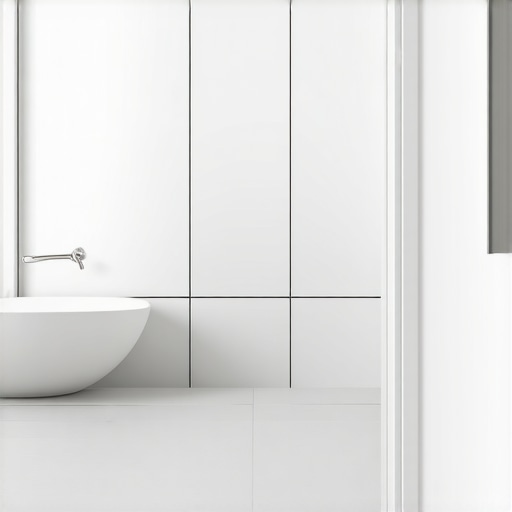
I spent three days grinding concrete on a job last month just so the floor wouldn’t click like a castanet. Most guys skip the leveling compound because they think the underlayment or the tile itself will hide the dip. It won’t. I was in a tight 5 by 8 bathroom in a pre-war building where the floor had a two-inch pitch toward the old cast iron stack. The homeowner wanted 24 by 48 inch porcelain slabs. If I had laid those tiles without addressing the substrate, they would have snapped the moment someone stepped on the center of the plank. I had to use a high-flow self-leveler and a concrete grinder that left me smelling like pulverized lime for a week. But when we finished, that tiny room looked like a palace because the lines were clean and the surface was dead flat. Flooring isn’t about what you see on the surface. It is about the structural integrity of what lies beneath.
The optical trickery of fewer grout lines
Large format tiles expand the visual field of a small bathroom by reducing the frequency of grout lines which often clutter the floor and create a cramped aesthetic. When you use tiles that are 12 by 24 inches or larger, the human eye perceives a continuous surface rather than a fractured grid. This lack of visual interruption trickery makes the square footage feel significantly more expansive than its physical dimensions suggest. Most people think small rooms need small tiles. They are wrong. Small tiles mean more grout. More grout means more visual noise. When you use a 24 by 48 inch slab, you might only have two or three grout lines in the entire room. This creates a sense of flow that is impossible to achieve with standard 12 by 12 squares. I always tell clients to match their grout color to the tile as closely as possible. If the grout disappears, the floor becomes a single monolithic plane. That is how you win the space war. [image_placeholder]
Why your subfloor is lying to you
The subfloor flatness is the most critical factor for large format tile installation because any deviation in the substrate will cause lippage or tile cracking. We are talking about the physics of deflection. If a joist flexes too much, the rigid bond of the thin-set will fail. For tiles where one side is longer than 15 inches, the industry standard requires the floor to be flat within 1/8 inch over a 10-foot span. Most plywood subfloors in residential homes are nowhere near that. They have humps at the joists and valleys in between. You cannot just slap down some cement board and hope for the best. I use a 10-foot straight edge to find the low spots. Then I use a primer and a high-quality self-leveling underlayment. If you are working over concrete, you have to watch out for moisture vapor transmission. A slab might look dry, but it can be exhaling water that will eventually delaminate your mortar. Use a calcium chloride test. Don’t guess. Precision in the prep phase is what separates a master from a hack.
“A floor is only as good as the subfloor beneath it; deflection is the enemy of every joint.” – Master Flooring Axiom
The physics of back buttering and coverage
Mortar coverage for large format porcelain must reach 95 percent in wet areas to ensure structural stability and prevent hollow spots that lead to cracking. You cannot just use a standard notch trowel and walk away. I use the back-buttering method. This involves applying a thin layer of mortar to the back of the tile itself before setting it into the combed mortar on the floor. This collapses the ridges and ensures a full chemical bond. In a small bathroom, you are often dealing with showers and moisture. If you leave a void under a large tile in a bathroom, water can collect there. Over time, that water stagnates and smells. Worse, it can freeze and thaw if you are in a cold climate, or just cause the tile to pop loose. I prefer using a medium-bed mortar specifically designed for heavy tiles. These mortars have higher polymer content and are engineered to hold the weight of the tile without sagging. This prevents the tile from sinking into the mortar as it cures, which is the primary cause of uneven edges between tiles.
Material Comparison for Small Bathroom Slabs
| Tile Size (Inches) | Average Weight (sq. ft.) | Required Mortar Type | Minimum Grout Joint |
|---|---|---|---|
| 12 x 24 | 4.5 lbs | Modified Thin-set | 1/16 inch |
| 24 x 24 | 5.2 lbs | Medium Bed Mortar | 1/8 inch |
| 24 x 48 | 6.1 lbs | LHT (Large Heavy Tile) Mortar | 1/8 inch |
| 48 x 48 | 7.5 lbs | High-Bond C2ES1 Mortar | 3/16 inch |
The 1/8 inch gap that prevents disaster
An expansion gap at the perimeter of the bathroom floor is mandatory to accommodate the thermal expansion and structural shifting of the building. Every house moves. It breathes with the seasons. If you butt your tile tight against the wall, the floor has nowhere to go when it expands. It will tent. It will buckle. I leave a 1/4 inch gap around the entire perimeter. This gap is hidden by the chic baseboard designs you choose later. In a bathroom, this gap also allows for the slight movement of the wall studs due to humidity. I see so many guys fill that perimeter gap with grout. That is a rookie move. Grout is rigid. When the floor moves, the grout will crack and crumble. Use a color-matched silicone caulk instead. It stays flexible and handles the movement without looking like a mess. This is especially true if you are integrating showers with a style that uses the same floor tile for a continuous transition. You need that flexibility at the change of plane.
Installation Checklist for Large Tiles
- Verify substrate deflection is less than L/360 for ceramic or L/720 for stone.
- Grind down high spots and fill low spots with self-leveling compound.
- Apply a liquid-applied waterproofing membrane in wet zones.
- Use a lippage control system with clips and wedges to ensure flat seams.
- Ensure 95 percent mortar coverage through back-buttering.
- Wait 24 hours before grouting to allow moisture to escape the mortar bed.
The chemistry of grout and moisture resistance
Grout selection in a small bathroom impacts the long-term maintenance and the aesthetic longevity of the tile installation. Standard sanded grout is porous. It absorbs water, hair dye, and whatever else falls on the floor. In a small space, those stains become an eyesore quickly. I recommend high-performance epoxy grout or a single-component grout that never needs sealing. These materials are non-porous and resist mold growth. If you are dealing with an old floor, you might look into how to refresh grout without replacing it, but for a new installation with large tiles, you want the best stuff from day one. Because the grout lines are so narrow with large format tiles, you need a grout with very fine aggregates. This allows the material to pack tightly into the 1/8 inch or 1/16 inch joints. If the grout isn’t packed tight, it will pinhole and fail. I spend a lot of time cleaning out the joints before I grout. Any mortar sticking up in the joint will show through the grout and create a dark spot. It is all about the details.
Lighting and the refractive index of porcelain
The glaze quality and light reflectance of large format tiles can double the perceived brightness of a windowless bathroom. When you have a large, smooth surface, light bounces off it with more efficiency than a textured, small-tile surface. This is basic physics. A polished porcelain slab has a high refractive index, meaning it sends light back into the room rather than absorbing it. If you pair this with bright, modern showers that wow, the entire room feels airy. I once did a bath in a basement with no windows. We used 30 by 30 inch white marbled porcelain with a high-gloss finish. We installed recessed LEDs at the ceiling line. The result was so bright the homeowner had to put a dimmer on the switch. If we had used small slate tiles, that room would have felt like a cave. You also have to consider the orientation of the tiles. If you have a long, narrow bathroom, laying the tiles parallel to the long wall can make it feel like a hallway. Laying them perpendicular can push the walls out visually. It is a game of angles.
Maintenance and the lifecycle of the floor
Tile cleaning for large format surfaces is significantly easier because there are fewer joints where bacteria and grime can accumulate. In a high-moisture environment like a bathroom, the grout is always the first thing to fail. By minimizing the grout, you minimize the maintenance. I always give my customers a guide on tile cleaning tips so they don’t ruin my work with harsh acids. You should use a pH-neutral cleaner. Many people think vinegar is great for cleaning, but it is an acid. Over time, it will eat away at the grout and the finish of the tile. If you’ve invested in eco-friendly tile solutions, you want to use cleaners that don’t strip the protective layers. I also suggest using a microfiber mop. Because the tiles are so large, a traditional string mop just moves dirty water into the few grout lines you have. A microfiber system lifts the dirt off the surface. If you ever run into deep-set stains in the future, you might need grout restoration secrets, but with a proper large format install, you are looking at a thirty-year floor. It is a structural investment, not a temporary fix.