
I once stood in a three million dollar penthouse where the charcoal grout looked like a dusty chalkboard. The homeowner had spent a fortune on midnight-slab porcelain, but the cleaning crew had been hitting the floors with a high-acid vinegar solution for six months. They didn’t just clean the floor. They effectively bleached the carbon-black pigment right out of the cement matrix. The owner was devastated. I told him what I tell every client who wants that deep, obsidian look between their tiles. Black grout is a chemical commitment, not just a color choice. It requires an understanding of molecular suspension and pH balance. If you treat it like a standard white grout, you will watch your investment turn into a splotchy, gray mess within a year. I spent two days on that job performing a rescue mission, using specialized colorants because the original pigment was physically gone. It was a lesson in the fragility of aesthetics when they meet the reality of aggressive chemistry.
The science of black pigment suspension
Cleaning black grout requires pH-neutral cleaners, soft-bristled brushes, and distilled water to prevent the white haze known as efflorescence. The pigment in dark grout is often composed of carbon black or iron oxide particles. These particles are suspended within a Portland cement or epoxy resin base. When you use harsh chemicals, you dissolve the binder holding those pigments in place. This leads to a phenomenon where the color appears to fade, but in reality, the surface of the grout is becoming microscopically pitted, changing how light reflects off the material. This structural damage is irreversible without a full re-staining process. To maintain the deep hue, you must protect the density of the grout line from the very first day of installation. This involves understanding how moisture interacts with the minerals in the subfloor and the grout itself.
“A floor is only as good as the subfloor beneath it; deflection is the enemy of every joint.” – Master Flooring Axiom
Why your subfloor is lying to you
Most homeowners assume grout failure is about the soap they use. Often, the problem starts three inches below the tile. If your subfloor has too much deflection, meaning it flexes when you walk on it, the grout develops micro-fissures. These tiny cracks are invisible to the naked eye but act as straws, sucking up dirty mop water and cleaning chemicals deep into the grout bed. When that water evaporates, it leaves behind minerals and soap scum that create a white film over your black grout. This is why a rigid substrate is the foundation of long-lasting color. I always check for a minimum of 1/8 inch of levelness over a ten-foot span before a single tile is set. Without that precision, your black grout is doomed to crack and fade regardless of how carefully you clean it. If you are noticing persistent graying in high-traffic areas, check for floor bounce. You might be fighting a structural battle with a spray bottle.
The myth of the universal cleaner
Standard household cleaners containing bleach or ammonia are too aggressive for dark pigments and will cause immediate mottling. These chemicals are designed to kill mold and strip grease, but they are indiscriminate. They attack the polymers added to modern grouts for flexibility. Once the polymers are degraded, the grout becomes porous and loses its water-repellent properties. You should only use cleaners specifically labeled as pH-neutral. Even some natural cleaners, like lemon juice or vinegar, are acidic enough to eat away at the calcium carbonate in the cement. This creates a rough texture that traps dust, making the grout look lighter than it is. I recommend a specialized enzymatic cleaner that breaks down organic matter without a chemical reaction that affects the pigment. For those looking for broader maintenance strategies, tile cleaning tips can provide a baseline for daily care.
The ghost in the expansion gap
Around the edges of a room, where the tile meets the baseboards, there is often a hidden cause of grout discoloration. Many installers mistakenly fill the expansion gap with hard grout instead of color-matched caulk. As the house shifts, that grout crushes into powder. This powder migrates across the floor, settling into the texture of the healthy grout and making it look faded. If you are seeing white dust near your walls, it is likely your grout failing at the perimeter. Transitioning to high-quality baseboards makeover ideas can help cover these gaps properly while allowing for a flexible silicone bead that won’t turn into dust. A clean perimeter ensures that the central field of your floor remains pristine and dark.
| Cleaner Type | pH Level | Effect on Black Grout |
|---|---|---|
| White Vinegar | 2.5 | Severe etching and pigment loss |
| Bleach | 12.0 | Yellowing and polymer breakdown |
| Dish Soap | 7.0 to 9.0 | Leaves a film that looks like fading |
| pH Neutral Professional | 7.0 | Safe for pigment preservation |
The humidity factor in modern showers
Showers are the most hostile environment for dark grout. The constant cycle of wetting and drying encourages efflorescence, which is the migration of salt to the surface of the grout. These salts are white and perfectly mask the black pigment. To prevent this, you must use a high-quality sealer. However, most people buy the cheap spray-on stuff that lasts a month. You need a penetrating solvent-based sealer that moves into the pores of the grout and blocks water at a molecular level. Designing showers that wow requires thinking about the long-term maintenance of these dark accents. If you don’t manage the humidity and water penetration, your black grout will be gray by the end of the first year. Proper ventilation and a squeegee ritual are mandatory for anyone committed to dark grout in a wet environment.
“Proper cleaning of tile and grout requires pH neutral cleaners to avoid the degradation of the cementitious matrix.” – TCNA Maintenance Guide
The five step ritual for obsidian grout
- Vacuum first to remove all dry particulate that could act as an abrasive.
- Mop with distilled water to prevent mineral buildup from tap water.
- Use a microfiber mop head rather than a string mop to avoid pushing dirty water into the pores.
- Apply a pH-neutral cleaner and let it dwell for five minutes to emulsify oils.
- Dry the grout lines immediately with a clean towel to prevent water spots.
Restoration without replacement
If your grout has already started to look like an old pair of jeans, you don’t necessarily have to rip it out. There are epoxy-based grout colorants that act as a permanent stain and sealer in one. This is a labor-intensive process where you paint every single line with a tiny brush, but it can save a floor. It creates a plastic-like shield over the existing grout that is much easier to clean. Learning grout restoration secrets can give you the tools to fix a botched cleaning history. This is often the only way to return a floor to its original architectural intent once the chemical damage is done. It is a slow process, but for a high-end black tile floor, it is worth every hour spent on your knees.
The danger of over scrubbing
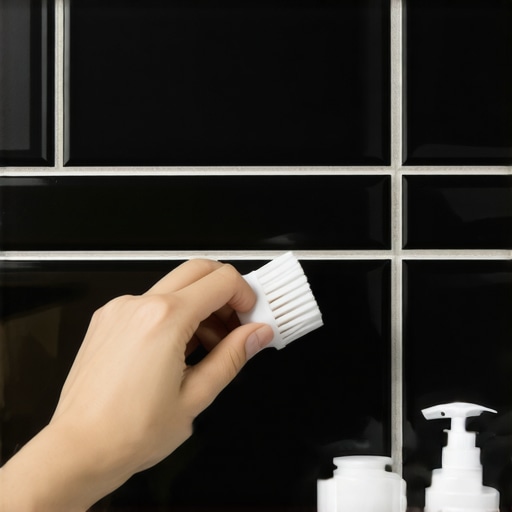
People think that if the grout is dirty, they need to scrub harder. With black grout, heavy scrubbing with a stiff nylon or brass brush will actually polish the aggregate in the grout, making it shiny in some spots and dull in others. This uneven reflection makes the color look inconsistent. You should use a brush with the stiffness of a soft toothbrush. Let the chemistry of the cleaner do the work, not the muscles in your arm. If the stain won’t come out with a soft brush and a neutral cleaner, you are likely looking at a permanent stain or structural damage to the grout itself. At that point, you need to consider how to refresh grout using professional-grade colorants rather than more elbow grease. Consistent, gentle care is always superior to occasional aggressive cleaning.
Final thoughts on pigment longevity
Black grout is the ultimate test of a floor installer and a homeowner. It shows every mistake, every drop of hard water, and every improper cleaning choice. But when it is maintained correctly, it provides a depth and sophistication that white or gray grout simply cannot match. It anchors a room and defines the geometry of the tile. Protect it by respecting the chemistry of the cement. Stay away from the big-box store miracle cleaners and stick to the basics of pH balance and moisture control. Your floor is a structural element of your home. Treat it with the same respect you would a fine engine or a piece of custom furniture. If you keep the acid away and the sealer fresh, that black grout will stay as dark as the day it was mixed. “