
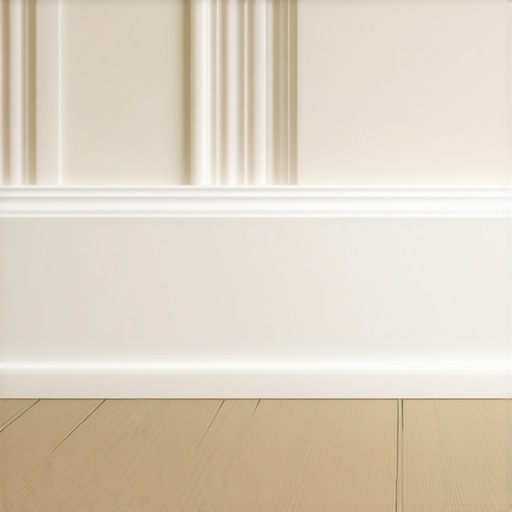
I spent three days grinding concrete on a job last month just so the floor would not click like a castanet. Most guys skip the leveling compound. They think the underlayment will hide the dip. It won’t. I have spent twenty five years with my knees on the subfloor and my hands in the dust. My boots smell like thin-set and my truck smells like fresh cut oak. When a homeowner tells me they want to paint their plastic or PVC baseboards I usually wince. Plastic is a non-porous material designed to repel liquids. Paint is a liquid. You are essentially trying to glue water to a sheet of glass. It does not want to stay. If you do not respect the chemistry of the bond the paint will peel off in long strips the first time a vacuum cleaner bumps into it. This is a structural engineering challenge disguised as a Saturday DIY project. You have to understand the molecular reality of the polymer before you pick up a brush.
The physics of plastic adhesion and surface tension
Painting plastic baseboards requires breaking the surface tension of the polymer to create mechanical and chemical bonds. Standard latex paint cannot penetrate the dense structure of PVC or polystyrene. You must use a specialized high-adhesion primer designed for non-porous surfaces to prevent peeling and bubbling over time. Plastic surfaces have what we call low surface energy. This means the molecules are tightly packed and do not want to interact with anything new. If you just slap a coat of semi-gloss on there it will sit on top like oil on water. You need to create a profile. A profile is the microscopic texture that gives the primer something to grab onto. Without that profile the paint has zero shear strength. You could literally peel it off with your fingernail. This is why prep work is not just a suggestion. It is the entire job. The painting part is just the reward for not being lazy during the sanding phase.
The danger of ignoring manufacturer specifications
I have seen $20,000 flooring installations ruined by $50 worth of bad paint. When you are working around high-end tile or luxury vinyl plank the baseboard serves as the expansion gap cover. It is a functional component. If the paint on that baseboard starts to flake it gets into the grout lines and the textures of the floor. It is a mess to clean up.
“A floor is only as good as the subfloor beneath it; deflection is the enemy of every joint.” – Master Flooring Axiom
This same logic applies to your trim. The paint is only as good as the primer beneath it. If you are renovating showers with a style in a small bathroom the humidity will kill any paint job that was not properly bonded. The moisture gets behind the paint film and expands. Then the whole thing bubbles. It looks like a cheap hotel room within six months.
A technical comparison of baseboard materials
| Material Type | Surface Porosity | Required Grit | Adhesion Difficulty |
|---|---|---|---|
| Solid White Oak | High | 120-150 | Low |
| MDF Composite | Medium | 180-220 | Medium |
| Cellular PVC | Zero | 220-320 | Very High |
| Polystyrene | Zero | 320 | Extreme |
As you can see in the table above the cellular PVC and polystyrene options that most builders use today have zero porosity. This means there are no holes for the paint to soak into. You are strictly relying on a chemical cross-linking of the resins in the primer. If you are looking for baseboards makeover ideas you have to start by identifying exactly what your trim is made of. Most modern plastic trim is a form of expanded PVC. It is lightweight and waterproof but it is chemically resistant to most standard household paints. You need a primer that contains a solvent package capable of slightly softening the top micron of the plastic surface.
The specific checklist for plastic preparation
- De-grease every linear inch with Trisodium Phosphate or a heavy-duty deglosser.
- Scuff sand the entire surface with 220-grit sandpaper to create a mechanical profile.
- Vacuum the dust with a HEPA filter to ensure no particles remain in the grain.
- Wipe down with a tack cloth or denatured alcohol to remove skin oils.
- Apply one thin coat of a modified acrylic urethane bonding primer.
- Wait a full 24 hours for the primer to chemically cure before top coating.
The chemistry of the bonding primer
You cannot use a standard PVA primer. That stuff is for drywall. You need a primer that is labeled specifically for non-porous surfaces. These products usually contain a high concentration of acrylic resins and specialized solvents. When the primer is applied the solvents evaporate and the resins begin to knit together. This forms a hard film that is literally fused to the plastic. I have used these products on jobs where the homeowner wanted to match their trim to chic baseboard designs that they saw in a magazine. It works but only if you give it time to cure. Curing is not the same as drying. Drying is the evaporation of water. Curing is the chemical hardening of the resin. If you paint over the primer too fast you trap the solvents. This leads to a soft finish that will never fully harden. You will be able to dent it with your thumb six months later. Patience is the hardest tool for most people to use.
Why humidity is the silent killer of trim paint
If you are painting baseboards in a bathroom or near tile cleaning tips areas the ambient moisture is your enemy. High humidity slows down the evaporation of the solvents in the paint. This prevents the resins from cross-linking. I once worked a job in a coastal town where the humidity stayed above 80 percent for a week. The painter tried to rush the baseboards. Two weeks later the paint was still tacky. We had to strip the whole house. It was a nightmare. You want a temperature of about 70 degrees and humidity below 50 percent for the best results. If you are working in a damp basement or a bathroom with a shower run a dehumidifier for 24 hours before you start. It makes a massive difference in how the paint lays down. You want a smooth finish that looks like it came from the factory. Not something that looks like it was applied with a butter knife.
The strategy for cutting in against tile and grout
When your plastic baseboard meets a tile floor you have a critical junction. This is where most people fail. They try to tape the floor but the tape pulls the paint off the baseboard. Or the paint bleeds under the tape and ruins the grout restoration secrets you just finished. Use a high-quality sash brush with synthetic filaments. Do not use a cheap brush. A cheap brush has thick bristles that leave deep furrows in the paint. You want a brush that holds a lot of material but releases it smoothly. Hold the brush like a pencil and use your pinky finger as a guide against the floor. This allows you to draw a straight line without needing tape. If you do get paint on the tile wipe it off immediately with a damp rag. Once it dries on the tile it is a pain to remove without scratching the glaze. If you are worried about the grout you can use a very thin bead of color-matched silicone after the paint is fully cured. This creates a waterproof seal that looks professional.
Advanced top coat selection for high traffic areas
Do not use flat paint on baseboards. It is a magnet for scuffs and dirt. You want at least a satin finish but semi-gloss is the standard for a reason. The higher the gloss the higher the resin content. This makes the surface harder and easier to clean. If you are going for a modern look a high-gloss black or deep navy can look incredible against a light colored floor. Just remember that the higher the gloss the more it shows your mistakes. If you did not sand the plastic properly every little scratch will stand out like a sore thumb. I prefer a waterborne alkyd enamel. It behaves like an oil paint but cleans up with water. It levels out beautifully and dries to a very hard finish. This is the best way to ensure your eco-friendly tile solutions are framed by trim that actually lasts. You do not want to be repainting these things every two years.
The final word on durability
Painting plastic baseboards is a test of character. It requires you to do the boring stuff perfectly so the pretty stuff stays put. If you skip the TSP or the sanding you are just wasting your money on paint. I have seen guys try to use those all-in-one paint and primer products on PVC. It never works. Those products are designed for porous wood. Plastic is a different beast entirely. Take your time. Use the right chemicals. Respect the curing process. If you do that your baseboards will look like they were made that color in the factory. They will withstand the vacuum the kids and the wet mop for years to come. That is the difference between a handyman and a master installer. One looks at the surface and the other looks at the chemistry. Stick to the chemistry and you will not have to do the job twice. Proper preparation is the only way to beat the physics of plastic. It is not about the brush. It is about the bond.