
Why your grout choice dictates your brush
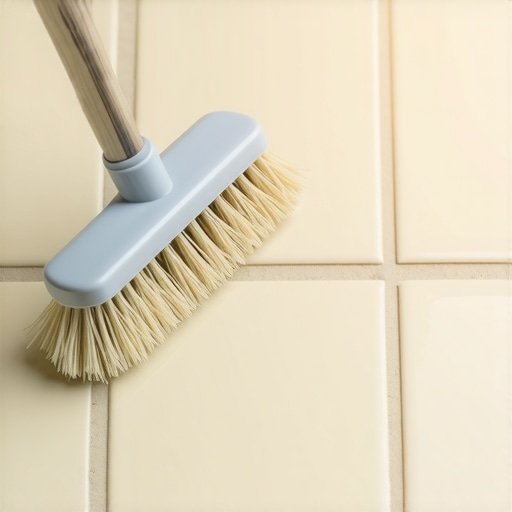
The best stiff bristle brush for deep grout lines must possess a specific bristle density and V-shape geometry to effectively penetrate the porous valleys of sanded grout joints without damaging the surrounding tile glaze. I have spent thirty years on my knees, crawling across every kind of substrate you can imagine, from leveling wet concrete to scraping out moldy grout in a 1920s bungalow. If there is one thing I have learned, it is that people treat their grout like a cosmetic after-thought. It is not. Grout is the mortar-bridge that holds your tile assembly together. Most guys skip the leveling compound. They think the underlayment will hide the dip. It won’t. I spent three days grinding concrete on a job last month just so the floor wouldn’t click like a castanet. Cleaning grout is no different. If you do not have the right tool, you are just moving dirt into the pores. I once saw a $20,000 marble installation ruined because a homeowner used a wire brush that etched every single edge. It was a tragedy of physics and chemistry. You need a tool that respects the Mohs hardness of your surface while being aggressive enough to dislodge the bio-film that accumulates in showers. For more advanced care, you can look at tile cleaning tips for a sparkling bathroom in 2025 to see how the pros handle it.
The structural physics of a stiff bristle
Nylon bristles with a tapered cut are the industry standard for deep grout cleaning because they offer the necessary tensile strength to resist deflection during high-pressure scrubbing. When you are working on showers that wow modern designs for 2025, you are often dealing with recessed grout lines that are 1/8 to 1/4 inch deep. A flat brush will only hit the tile surface. You need the V-shape. This geometry allows the center bristles to reach the bottom of the grout valley while the outer bristles stabilize the brush. It is about the lever effect. If the bristles are too long, they bend. If they are too short, they do not have the reach. I look for a brush with a 1-inch bristle length and a grip that allows me to put the weight of my shoulder into the stroke. This is not about finesse. This is about mechanical agitation. You are trying to break the bond between the grout and the accumulated grime. It is a battle of surface tension.
“A floor is only as good as the subfloor beneath it; deflection is the enemy of every joint.” – Master Flooring Axiom
Why nylon beats metal every time
Synthetic polymers like high-density nylon are superior to brass or steel for maintaining tile integrity because they provide scrubbing power without metal transfer or surface scratching. I have seen guys think they are being smart by using a wire brush on grout. They think they are being efficient. All they are doing is leaving microscopic metal shards behind that will eventually rust and turn the grout orange. Or worse, they scratch the finish on a beautiful porcelain tile. Once that glaze is gone, you are done. The tile will absorb stains like a sponge. When you are looking at grout restoration secrets for long-lasting results, the first rule is always to preserve the existing finish. We are looking for high-flex recovery. When you push that brush into the corner where the floor meets the chic baseboard designs that transform rooms in 2025, you want those bristles to spring back to their original shape immediately. If they stay bent, the brush is trash. Toss it.
| Brush Material | Flex Recovery | Abrasiveness | Best Use Case |
|---|---|---|---|
| Nylon | High | Moderate | Standard grout and porcelain |
| Polypropylene | Medium | Moderate | Budget-friendly general cleaning |
| Brass | Low | High | Industrial concrete only |
| Natural Fiber | None | Low | Polished natural stone |
The secret to cleaning showers and why it matters
Steam-assisted scrubbing combined with a stiff nylon brush is the most effective way to eliminate calcium deposits and soap scum in small bathroom shower stalls. People overlook the corners. They see a bit of pink mold and think a spray-and-wipe will fix it. It will not. That mold is rooted in the grout’s capillary structure. You need a brush with a narrow profile. I prefer a brush that is no wider than half an inch. This allows you to track the grout line precisely. If you have showers with a style trendy ideas for small bathrooms, you likely have tight corners and intricate tile patterns. A bulky brush is useless there. You need something that feels like a heavy-duty toothbrush on steroids. I also suggest checking the perimeter where the tile meets the floor. If you see cracking, no amount of scrubbing will help. You need to look at how to refresh grout without replacing it before the moisture gets into your subfloor. That is where the real damage happens. Moisture is the silent killer of every flooring system.
- Vacuum the area first to remove loose debris that can act as sandpaper.
- Apply a pH-neutral cleaner and let it dwell for 10 minutes to soften the bonds.
- Scrub in a circular motion to hit the grout from all angles.
- Rinse with clean water to prevent dirty suds from drying back into the pores.
- Dry the area immediately with a microfiber towel to inspect the depth of the clean.
The ghost in the expansion gap
Expansion gaps and perimeter joints are the most frequent sites of grout failure because they are often incorrectly filled with rigid grout instead of flexible caulk. I walk into bathrooms all the time where the grout is crumbling along the baseboard. It is because the house is breathing and the grout cannot move. If you are updating your space, check out baseboards makeover ideas to elevate your space. When you install those new boards, make sure you leave that gap. Use your stiff brush to clean out the debris from that gap before you caulk. If you leave dirt in there, the caulk will not stick. It is all about the bond. Whether it is thin-set, adhesive, or caulk, if the surface is not clean at a molecular level, the installation will fail. I have seen $50,000 kitchens fall apart because of an eighth-inch of dust. Do not be that guy. Get the right brush, put in the elbow grease, and treat your floor like the piece of engineering it is. If you have questions about specific materials, you can always contact us for a professional opinion. We have seen it all, from the swampy humidity that warps solid oak to the dry heat that shrinks your baseboards until they show a gap. Details matter. Precision matters. The brush you choose is the first step in that process.
“Grout is not just a filler; it is the structural link that prevents lateral tile movement.” – TCNA Technical Bulletin