
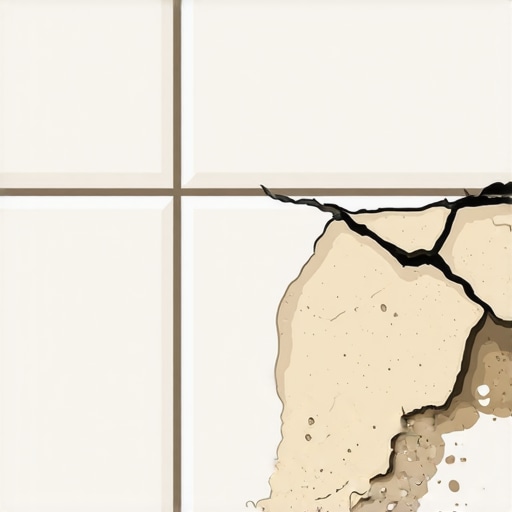
The Real Reason Your Grout Sealant Is Failing
I spent three days grinding concrete on a job last month just so the floor wouldn’t click like a castanet. Most guys skip the leveling compound. They think the underlayment will hide the dip. It won’t. I have seen it a thousand times. When that subfloor flexes, your grout isn’t just sitting there. It is being crushed and pulled apart at the same time. I once walked into a luxury bathroom where the grout was turning to powder after six months. The owner thought they bought a bad sealer. The truth was worse. The installer had mixed the grout with too much water, turning the cement into a brittle sponge that no chemical could save. My hands still smell like the damp concrete of that basement, a reminder that physics does not care about your bathroom budget.
The invisible chemistry of hydration
Grout sealant failure often begins with improper hydration during the initial mixing phase of the cementitious grout. If the water-to-powder ratio is off by even a small percentage, the calcium silicate hydrate crystals fail to form a dense molecular lattice. This leaves behind microscopic voids that act as capillary straw networks, drawing in moisture and contaminants that bypass the surface sealer regardless of its quality. When you mix grout, you are not just making mud. You are triggering a chemical reaction. If you add too much water to make it spread easier, you are essentially creating a city of tiny holes. Once that water evaporates, those holes remain. A sealer is supposed to sit on top or penetrate those pores, but if the pores are too large or too numerous, the sealer just falls into the abyss. It cannot form a continuous barrier. This is why your grout restoration secrets usually involve more than just a new coat of spray. You have to address the structural integrity of the grout itself. You need to understand that grout is a hydraulic cement product. It needs the exact amount of water to reach its designed density. Anything less or more is a recipe for a crumbling joint.
“A floor is only as good as the subfloor beneath it; deflection is the enemy of every joint.” – Master Flooring Axiom
The porous lie of cementitious binders
Cement-based grout is inherently porous and hydrophilic, meaning it naturally attracts water molecules through surface tension and wicking action. Even a high-quality penetrating sealer cannot overcome the structural failure of soft grout caused by over-washing during the installation process. When the installer swipes that big orange sponge across the tile too many times, they are pulling the cement out of the top layer of the grout. This leaves behind nothing but sand. Sand does not hold sealer. The sealer needs a binder to latch onto. Without that binder, the sealer just sits there like a ghost. It looks fine for a week, then the first time you scrub the floor, it disappears. I see this in showers that wow in photos but fail in reality. The moisture gets behind the sealer, hits the sandy grout, and starts the process of mold growth from the inside out. You can’t just keep layering sealer on top of a bad foundation. It’s like painting a rotten fence. The paint might look good, but the wood underneath is still turning to dust. You have to ensure the grout was finished correctly with a damp, not dripping, sponge to keep the portland cement at the surface.
Why your subfloor is lying to you
Subfloor deflection and structural movement create micro-fractures in the grout line that break the sealer bond and allow moisture ingress. Most ceramic tile and porcelain tile installations fail because the joist spacing or subfloor thickness does not meet TCNA standards for stiffness, causing the grout joints to act as stress relief points. If your floor has a bounce, your grout will fail. It is that simple. I have stood on floors where I could feel the subfloor move 1/16 of an inch. That doesn’t sound like much until you realize that grout is rigid. It does not bend. It snaps. When it snaps, it creates a crack so thin you might not see it with the naked eye. But water sees it. Water is a predator. It finds that crack, slides under the sealer, and starts de-bonding the edges. No amount of silicone-based sealer can fix a structural movement issue. You would be better off using a high-performance epoxy grout in those cases, though even that has limits if your house is shifting like a ship at sea. I always tell people to check their crawlspace. If your joists are 24 inches on center and you have a single layer of 5/8 inch plywood, your grout is doomed before you even open the bag.
| Feature | Standard Cement Grout | High-Performance Grout | Epoxy Grout |
|---|---|---|---|
| Porosity Level | High | Medium-Low | Zero |
| Flexural Strength | Low | Medium | High |
| Chemical Resistance | Poor | Moderate | Excellent |
| Sealer Required | Yes | Optional | No |
The humidity trap in modern showers
Shower environments create hydrostatic pressure and vapor transmission issues that can delaminate topical grout sealers from the tile assembly. In high-humidity regions like the Gulf Coast or the Pacific Northwest, the ambient moisture prevents the grout from curing fully before the sealer is applied, trapping water vapor inside the joint. This is a massive problem. People want their shower finished in a day. They grout in the morning and want to seal in the afternoon. That is a disaster. The grout needs at least 48 to 72 hours to off-gas its moisture. If you seal it too early, you are trapping that moisture. The sun hits the bathroom window, the shower heats up, and that trapped water turns into vapor. It wants out. It will push the sealer right off the surface in the form of white flakes or cloudy patches. This is especially true if you are using eco-friendly tile solutions that might be more sensitive to chemical interactions. You have to respect the cure time. In a place like Houston, I might wait a full week before I let a client seal their grout. The air is so thick with water that the grout just can’t get dry enough to accept a sealer bond. If the moisture meter says no, the answer is no.
The 1/8 inch that ruins everything
Grout joint width dictates the surface tension of the liquid sealer and determines if the chemical barrier will remain intact under foot traffic. Joints that are too narrow for sanded grout lead to bridging, where the aggregate prevents the cement paste from filling the void, leaving a hollow shell that cracks under the weight of a person walking. I hate 1/16 inch joints with sanded grout. It is a physical impossibility to get the sand down into that tiny gap properly. You end up with a thin skin of grout on top. You apply your sealer, it looks great, and then three weeks later, you step on it and the whole thing collapses. Now you have a hole. Water goes in the hole. The sealer is now useless because the substrate it was attached to is gone. You need to match your grout type to your joint width perfectly. For joints under 1/8 inch, you use unsanded. For anything larger, you need the sand for structural reinforcement. If you are trying to achieve that chic baseboard design look where the floor meets the wall perfectly, you need to ensure the perimeter joints are also handled correctly. You can’t just cram grout into the expansion gap at the wall. That gap needs to stay open or be filled with a color-matched caulk. If you grout it solid, the floor will expand, hit the wall, and the pressure will shatter your grout joints in the middle of the room. It is simple physics. Something has to give.
- Check subfloor deflection before installation.
- Ensure a minimum 72-hour dry time before sealing.
- Use a pH-neutral cleaner to maintain the sealer.
- Match grout aggregate size to the joint width.
- Never seal grout that shows signs of efflorescence.
Why cheap sealant is a placebo
Inexpensive grout sealers often rely on wax-based or low-grade silicone formulas that provide temporary water beads but fail to repel oils or acidic cleaners. These topical coatings do not chemically bond with the silica in the grout, leading to rapid degradation from abrasion and standard maintenance. I see people buy the $10 bottle of sealer at the big box store and think they are protected. They aren’t. Those sealers are basically just a thin film of plastic. The first time you use a mop with a little bit of vinegar or a harsh detergent, that film dissolves. You want a penetrating sealer, specifically a fluoroploymer. It is more expensive, but it works at a molecular level. It changes the surface tension of the grout particles themselves so they actually repel liquids. Water will sit on top like a bead of mercury. That is what you want. If you are doing tile cleaning tips, the best tip is to start with a sealer that actually exists after the first wash. I’ve gone into homes to do a grout refresh and found that the previous sealer was so cheap it actually attracted dirt by being slightly sticky. It was a magnet for grime. Don’t be that person. Buy the professional-grade solvent-based sealer if you want it to last.
“Grout is not waterproof; it is a porous filter that requires chemical modification to resist saturated transport.” – Master Flooring Axiom
The ghost in the expansion gap
Expansion joints at the perimeter of a tile installation are essential for stress distribution, yet they are often mismanaged by installers who fill them with rigid grout instead of flexible sealant. This mechanical error leads to tented tiles and cracked grout lines as the building envelope reacts to seasonal temperature shifts and humidity fluctuations. You need to look at your baseboards. If the grout is shoved tight against the baseboards, you have a problem. Houses breathe. They expand in the summer and shrink in the winter. If your tile floor is locked into place with no room to move, the pressure has to go somewhere. It goes into the grout joints. The grout crushes into powder. You think the sealer failed. No, the engineering failed. I always leave a 1/4 inch gap around the entire perimeter. I cover it with the baseboard or a piece of shoe molding. That gap is the lungs of your floor. Without it, the floor suffocates and dies. This is especially critical in areas with heavy transitions or small bathrooms where space is tight. The smaller the room, the more people think they can skip the expansion gap. They are wrong. The physics remain the same regardless of the square footage. If you don’t give that floor a place to go, it will make its own space by breaking your grout. You can seal it every day for a year and it won’t stop the cracking. Get the structure right first. Then worry about the chemistry. Contact us at Elegant Floorz if you need a pro who understands the difference between a pretty floor and a permanent one.