
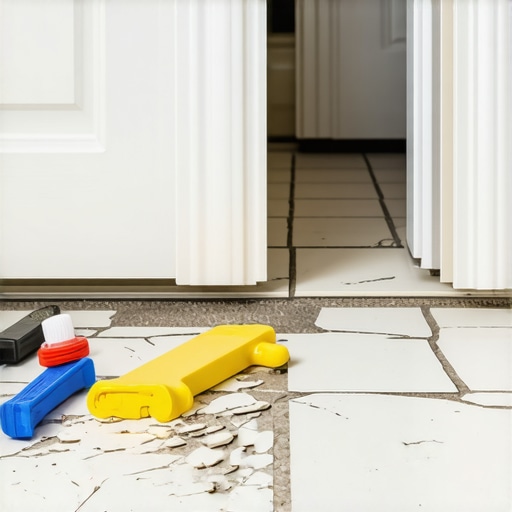
I smell like WD-40 and oak dust most days. My knees tell the story of twenty-five years spent crawling across plywood and concrete. I have seen every way a floor can fail. Most guys skip the leveling compound. They think the underlayment will hide the dip. It won’t. I spent three days grinding concrete on a job last month just so the floor wouldn’t click like a castanet. When you see a tile popping up near a doorway, it is rarely a fluke. It is a structural failure. It is the result of chemistry and physics working against a lazy installation. If you think your waterproof floor is a shield against bad craftsmanship, you are mistaken.
The structural lie at your threshold
Bathroom tiles pop near the doorway because of subfloor deflection and improper bond. This area faces the highest foot traffic and environmental shifts. When the subfloor flexes more than the tile can handle, the bond breaks. The threshold is a high-stress point where different structural members meet, often leading to vertical movement that snaps the thinset bond. Doorways are the transition between two different environments. One room might be a humid bathroom with a heavy porcelain load, while the hallway is a dry, carpeted space. This difference creates a tug-of-war at the subfloor level. Most installers ignore the deflection rating, or the L/360 standard. If your floor joists are spaced too far apart or if your plywood is too thin, the floor will bounce. Tile does not bounce. It is rigid. When the wood moves and the tile stays still, the mortar between them gives up. This is usually the first sign of a larger issue. You might notice the grout cracking first, which is a warning. If you ignore it, the whole tile eventually releases from the bed.
The molecular failure of thinset mortar
Thinset mortar fails when it loses its moisture too quickly or when the polymer chains cannot bridge the gap between the substrate and the tile. In doorways, high airflow often dries out the mortar before it can properly hydrate. This creates a weak, powdery bond that eventually snaps. We need to look at the chemistry of the hydration process. When you mix Portland cement with water, a chemical reaction called hydration begins. This forms crystals that lock into the microscopic pores of the tile and the subfloor. If the doorway has a draft, the water evaporates too fast. The crystals never form correctly. You end up with a mechanical bond that is as strong as dried mud. I always use a polymer-modified thinset, specifically those meeting ANSI A118.11 standards for wood substrates. The polymers act like tiny rubber bands within the cement matrix. They allow for a microscopic amount of movement. Without those polymers, the rigid cement is brittle. It cannot handle the vibration of a door slamming or the heavy footfall of a family. When I see a tile that has popped off clean with no mortar stuck to the back, I know the installer let the thinset skin over. They spread too much at once, and the air at the doorway dried the surface before the tile touched it.
| Material Type | Expansion Coefficient | Typical Deflection Limit | Recommended Mortar |
|---|---|---|---|
| Porcelain Tile | Very Low | L/360 | Modified Thinset |
| Plywood Subfloor | High | L/360 | ANSI A118.11 |
| Concrete Slab | Moderate | L/480 | Unmodified or Modified |
| Natural Stone | Low | L/720 | High-Strength White |
The ghost in the expansion gap
Expansion gaps are required around the perimeter of every tiled room to allow for natural movement. When tiles are wedged tight against a door jamb or a wall, they have no room to expand. This pressure causes them to tent or pop upward. Most people think tile is static. It is not. It expands and contracts with temperature and humidity. In a bathroom, the steam from showers that wow increases the internal temperature of the material. If that tile is pushed tight against a hardwood transition at the door, the pressure has to go somewhere. It goes up. This is the physics of buckling. I always leave at least a quarter-inch gap at the perimeter. This gap is hidden by baseboards makeover ideas or transition strips. If the installer ran the tile tight to the door casing, they built a ticking time bomb. You can check this by trying to slide a thin piece of paper between the tile and the wall. If you cannot, the floor is strangled. It will eventually pop, and it usually happens at the weakest point, which is the doorway where the foot traffic is most intense.
“A floor is only as good as the subfloor beneath it; deflection is the enemy of every joint.” – Master Flooring Axiom
The hidden impact of moisture and humidity
Moisture is the primary enemy of the bond between tile and subfloor. High humidity in bathrooms can seep into the grout and weaken the thinset over time. This is especially true near doorways where water often sits after cleaning. Many homeowners use too much water when maintaining their floors. While you might follow tile cleaning tips, if the grout is not sealed, that water travels down. It reaches the subfloor. If you have a plywood subfloor, the wood swells. When wood swells, it pushes the tile up. If you have a concrete slab, the moisture can lead to efflorescence. This is a process where minerals are carried to the surface, creating a white powder that breaks the bond of the adhesive. Doorways are prone to this because they are often the lowest point or have the most gaps in the sealant. If your grout restoration secrets do not include a high-quality penetrative sealer, you are inviting failure. I have seen beautiful bathrooms ruined because a small leak at the shower door traveled under the tiles all the way to the main doorway.
The contrarian truth about underlayment thickness
While most people want the thickest underlayment, too much cushion actually causes the locking mechanisms on LVP to snap under pressure, and in tile, it leads to excessive mortar shrinkage. I see this mistake constantly. An installer thinks more is better. They use a thick, spongy underlayment under tile. This is a disaster. Tile requires a rigid substrate. If you put a soft mat under a rigid tile, every step causes the tile to tilt. This is called the seesaw effect. Eventually, the grout crumbles and the tile pops. You need a decoupling membrane like Schluter-Ditra. This membrane is thin, but it allows for independent movement between the subfloor and the tile. It is a sandwich of physics that saves your floor. If you are trying to how to refresh grout without fixing the movement issue, you are just painting over a crack in a dam. The doorway is where this movement is most aggressive because your weight shifts as you step from one floor type to another.
- Check subfloor thickness and ensure it meets 1-1/8 inch total requirement.
- Use a moisture meter to verify wood subfloor is within 2 percent of the tile material.
- Ensure 95 percent mortar coverage on the back of the tile in wet areas.
- Leave an expansion gap around all vertical obstructions.
- Apply a high-quality sealer to all grout lines to prevent water intrusion.
The final assessment of doorway failure
If your tiles are popping, do not just glue them back down. You need to investigate the substrate. Is the plywood rotting? Is the concrete slab damp? Use a level to check for high spots. If the floor is not flat within 1/8 inch over 10 feet, the tile is under constant stress. My advice is to pull the loose tiles and check the mortar. If it is dusty, you have a hydration problem. If the wood is black, you have a leak. Fix the structure before you fix the cosmetic layer. A floor is a machine. If one part of the machine is out of alignment, the whole system fails at the doorway. Take the time to do it right. Grind the concrete. Level the joists. Use the right chemistry. Your knees will thank you later because you won’t be back here in two years doing the same job twice. If you need help with the next steps, you can always contact us for professional guidance on structural floor repair.