
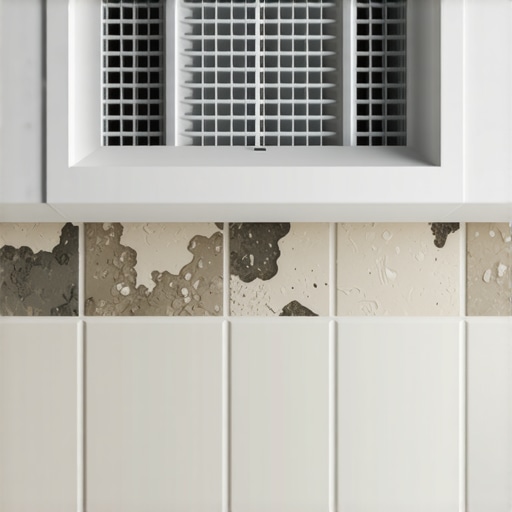
I spent three days grinding concrete on a job last month just so the floor wouldn’t click like a castanet. Most guys skip the leveling compound. They think the underlayment will hide the dip. It won’t. But the most frustrating calls I get are about bathroom mildew. I walk into a beautiful home with custom marble and showers that wow, but the grout is turning a sickly shade of gray. The homeowner is scrubbing with a toothbrush every Sunday. It is a losing battle because the problem isn’t the cleaning. The problem is the physics of air. Most bathroom vent fans are glorified noise machines that do nothing to move actual moisture. They create a false sense of security while the steam sits on your tile like a wet blanket. If your fan isn’t pulling enough cubic feet per minute, that humidity has to go somewhere. It settles into the pores of your grout. It seeps behind your baseboards. It turns your bathroom into a petri dish.
The lie of the silent fan
A silent bathroom fan is often a failing fan because it lacks the static pressure to push moist air through the ductwork. Mildew thrives when the humidity levels stay above 60 percent for extended periods. When fans are undersized or poorly installed, they cannot evacuate the steam. People buy fans based on how quiet they are. That is a mistake. A quiet fan often has a low Sone rating because the motor is weak or the blades aren’t moving enough air. You want to hear the air moving. You need to know that the machine is actually fighting the moisture. If you light a match and blow it out near the fan, the smoke should be sucked up instantly. If it lingers, your fan is lying to you. This lack of airflow keeps your tile wet for hours. That is plenty of time for mold spores to take root in the cementitious matrix of your grout. If you want to keep things clean, you need to understand the mechanical reality of your ventilation system. You can read more about tile cleaning tips for a sparkling bathroom in 2025 to see how much work you are creating for yourself with bad air.
“A floor is only as good as the subfloor beneath it; deflection is the enemy of every joint.” – Master Flooring Axiom
The thermodynamics of steam and grout
Grout is a porous material that acts as a capillary system for stagnant moisture when a vent fan fails to circulate air. High humidity increases the vapor pressure against the tile surface, forcing water deeper into the grout lines. This creates a hidden reservoir for microbial growth. Most people think of tile as a waterproof shield. It isn’t. The tile itself might be impervious, but the grout is essentially a hard sponge. When you take a hot shower, you are filling the room with water vapor. If the vent fan isn’t pulling that vapor out, it undergoes a phase change. It hits the cold tile and turns back into liquid. Gravity and capillary action pull that liquid into the grout. Once it is in there, it is trapped. The fan needs to run for at least twenty minutes after the shower to dry out those pores. If the fan is weak, the grout stays damp until the next shower. This creates a cycle of permanent saturation. This is why you see grout restoration secrets for long lasting results focusing so much on sealing. A good sealer helps, but it cannot overcome a room that never dries out. You are basically asking a thin chemical layer to fight an ocean of steam.
Why your baseboards are drinking water
Baseboards act as a secondary moisture sink in poorly ventilated bathrooms, absorbing humidity through the bottom edge where the floor meets the wall. This leads to swelling, paint peeling, and hidden mold behind the wood. Proper airflow prevents condensation from pooling at these critical junctions. I have pulled up enough baseboards to know that the worst rot is always at the floor line. When the air is thick with steam, the water runs down the walls. It pools right at the top of the baseboard. If you have MDF baseboards, they will swell up like a balloon. Even solid wood will start to rot if it stays wet. This moisture then travels behind the board and into the drywall. This is where the real mildew smell comes from. It isn’t just on the surface. It is structural. If you are looking to fix this, check out baseboards makeover ideas to elevate your space, but don’t install new ones until you fix that fan. You are just throwing money away if you don’t address the root cause. The intersection of the floor and wall is the most vulnerable part of the room. It needs to stay dry. Without a strong fan, that corner is a swamp.
| Bathroom Size (Sq Ft) | Required CFM (Cubic Feet Per Minute) | Recommended Sone Level | Minimum Run Time Post-Shower |
|---|---|---|---|
| Under 50 | 50 CFM | 1.5 to 2.0 | 20 Minutes |
| 50 to 80 | 80 CFM | 1.0 to 1.5 | 25 Minutes |
| 80 to 100 | 100 CFM | 0.5 to 1.0 | 30 Minutes |
| Over 100 | 1.0 CFM per Sq Ft | 0.3 to 0.8 | 40 Minutes |
Measuring Cubic Feet per Minute like a pro
CFM measurement determines the actual volume of air a fan moves per minute, which is the only metric that matters for preventing mildew. An undersized fan cannot overcome the static pressure of a long duct run. Professional installers use an anemometer to verify real world performance. Don’t trust the box. The box says 110 CFM, but that assumes a straight, short run of rigid pipe. If your contractor used a flexible dryer vent hose and snaked it through the attic with three 90 degree turns, that 110 CFM fan is actually moving about 40 CFM. It will not clear the room. You can have the most showers with a style trendy ideas for small bathrooms, but if they are constantly foggy, the style won’t last. The air needs to move. If you feel like your bathroom is a sauna ten minutes after you turn the water off, your fan is failing. You need to calculate the volume of the room. Length times width times height divided by 7.5 gives you a rough idea of what you need. But really, just overbuy. Get a fan rated for a much larger room. It is the only way to be sure.
“Ventilation is not merely a comfort feature; it is a structural necessity for the preservation of ceramic and stone assemblies.” – Tile Council Standards Guide
The structural rot behind the ceramic
Hidden moisture behind tiles is a direct result of inadequate ventilation, leading to the failure of the bond between the thin-set and the substrate. When steam remains in the room, it finds micro-cracks in the grout and bypasses the tile entirely. This causes the wall to soften. This is the nightmare scenario. I have seen entire shower walls come off in one piece because the studs behind them were turned to mush. The homeowner thought the fan was working because it was making noise. It wasn’t. The steam was penetrating the grout, condensing behind the tile, and rotting the backer board. This is especially common in showers that wow modern designs for 2025 where people use large format tiles with tiny grout lines. They think less grout means less water. It actually means the water that does get in has no way to evaporate. It gets trapped. You need a fan that can pull the moisture out of those tiny gaps before it reaches the structure. If you see your tiles starting to bulge or the grout is cracking, you have a major problem. It is likely that the moisture has already won.
- Check the fan damper to ensure it opens and closes freely without sticking.
- Inspect the ductwork in the attic for kinks, disconnected joints, or heavy dust buildup.
- Verify that the fan exhausts to the exterior of the house and not just into the attic space.
- Clean the fan grill every six months to maintain maximum airflow and motor efficiency.
- Install a timer switch to ensure the fan runs long enough after you leave the room.
Grout porosity and the bacterial bloom
Porosity in cement based grout allows water to dwell within the material, creating an ideal habitat for Serratia marcescens and other common bathroom molds. High airflow accelerates the evaporation process, denying bacteria the moisture needed for colonization. That pink stuff you see in your shower isn’t actually mold. It is a bacteria called Serratia marcescens. It loves fatty substances like soap scum and it loves damp surfaces. If your fan is weak, the grout stays wet. The bacteria eats the soap residue and lives in the water-filled pores of the grout. If you want to stop it, you have to dry out the room. This is why how to refresh grout without replacing it is such a popular topic. People are tired of the pink stains. But if you refresh the grout and don’t fix the fan, the pink will be back in a month. You are fighting biology. Biology needs water. Remove the water, and the bacteria dies. It is that simple. Use a fan with a high CFM rating and keep the door cracked if you have to. Anything to get the humidity down below the threshold where life can thrive.
Fixing the airflow for good
Permanent solutions for bathroom mildew involve upgrading to a high efficiency fan with a humidity sensor that activates automatically. Replacing flexible ducting with smooth rigid metal pipes reduces air resistance and increases moisture evacuation. If you are tired of scrubbing, stop buying cleaners and start buying mechanical equipment. A humidity sensing fan is a game changer. It stays on until the room is actually dry, not just until you remember to flick the switch. This is especially important for eco friendly tile solutions for sustainable homes in 2025 because it prevents the waste of materials through premature rot. While you are at it, look at your chic baseboard designs that transform rooms in 2025 and make sure they are installed with a small gap at the bottom, sealed with high quality 100 percent silicone caulk. This prevents them from sucking up any stray water that the fan hasn’t grabbed yet. It is a system. The fan, the grout, the tile, and the baseboards all have to work together to handle the water. If one part of that system fails, the whole room suffers. Don’t let a twenty dollar fan ruin a ten thousand dollar bathroom. Fix the air, and the tile will take care of itself. If you have questions about your specific layout, you can always contact us for advice on structural flooring and moisture control.