
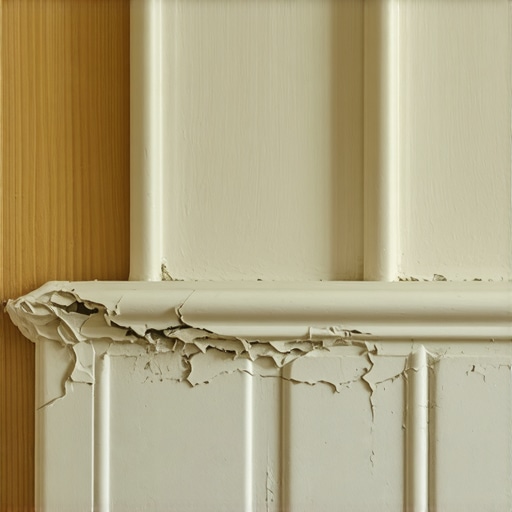
I spent three days grinding concrete on a job last month just so the floor wouldn’t click like a castanet. Most guys skip the leveling compound. They think the underlayment will hide the dip. It won’t. I had my dust extractor humming and my knees on the pads. As I peeled back the old trim, the smell hit me. It was the sharp, musty odor of wet cellulose. The baseboards looked fine on the painted surface, but the back was black with mold. The subfloor was a mess of moisture and failed intentions. If you think your baseboards are just decorative wood strips, you are wrong. They are the frontline of your home’s moisture defense system. When they rot from the inside out, it means the structural integrity of your flooring environment has already collapsed. This is not about aesthetics. This is about the physics of water migration and the chemical failure of cheap building materials.
The invisible physics of capillary action
Baseboards rot from the inside out because moisture is trapped between the drywall and the trim where airflow is non-existent. Capillary action pulls liquid through the microscopic pores of your subfloor and into the thirsty fibers of the baseboard backing. This happens most frequently when the expansion gap is improperly sealed or when the subfloor moisture vapor emission rate exceeds the limits of the material. I have seen countless homes where the homeowner blamed a leak, but the real culprit was a concrete slab that was never properly tested with an in-situ RH probe. Concrete is a sponge. It looks solid, but it is a network of capillaries. If that moisture has nowhere to go because you installed a vapor-impermeable floor, it will find the perimeter. It will climb the walls. It will eat your baseboards from the back where you cannot see it until the wood softens and the paint starts to bubble. This is why understanding chic baseboard designs that transform rooms in 2025 requires more than just picking a profile. It requires an engineering mindset.
The ghost in the expansion gap
An expansion gap is a mandatory void between your flooring and the wall that allows for the natural movement of materials. If this gap is stuffed with debris or if the flooring is pushed tight against the plate, the pressure will buckle the floor and compress the baseboard. More importantly, this gap often acts as a collection point for moisture. In bathrooms and kitchens, water spills migrate toward the edges. If the grout at the perimeter of your tile is cracked or missing, water seeps into that gap. Once water gets behind the baseboard, the lack of ventilation prevents evaporation. The dark, damp environment becomes a breeding ground for fungi.
“A floor is only as good as the subfloor beneath it; deflection is the enemy of every joint.” – Master Flooring Axiom
Why your shower perimeter is a liability
Shower perimeters fail when the waterproofing membrane does not extend properly to the transition or when grout loses its structural density. If you have a walk-in shower, the baseboards in the adjacent area are at high risk. Water does not just sit on top of tile. It moves through it. Most people do not realize that grout is porous. Standard cementitious grout will absorb water and move it into the substrate. If the installer did not use a high-quality sealant or a performance grout, that moisture will travel laterally until it hits the baseboard. I recommend looking into showers that wow modern designs for 2025 but you must ensure the curb and the floor transition are waterproofed as a single unit. If the baseboard sits against a tile floor that is constantly damp, the rot is inevitable. You can find more on this in my guide on grout restoration secrets for long lasting results.
The chemical failure of medium density fiberboard
MDF baseboards rot faster than solid wood because they are composed of compressed wood fibers and resin that react violently to water. When MDF gets wet, the fibers swell and the resin bonds break. The material does not just get wet. It expands and loses all structural capacity. It becomes a soggy paste. Solid wood baseboards like pine or oak will eventually rot, but they can withstand occasional moisture cycles much better than MDF. If you are installing flooring in a high-humidity area or on a concrete slab, using MDF is a gamble you will eventually lose. The price point is attractive, but the replacement cost after three years of moisture exposure is astronomical.
The moisture vapor emission rate reality
Moisture vapor emission rate or MVER measures the amount of water vapor escaping from a concrete slab over a specific period. High MVER is the number one cause of baseboard rot in new construction. Builders are in a hurry. They pour the slab and install the trim before the concrete has reached its equilibrium relative humidity. The moisture is still moving out of the slab. When the floor is installed, that vapor is blocked. It moves to the edges, hits the baseboard, and condenses. This condensation is constant. It is a slow-motion flood that happens every hour of every day. You need to verify that your installer is using a moisture meter. If they aren’t, show them the door.
Subfloor material performance comparison
| Subfloor Type | Moisture Sensitivity | Rot Risk Factor | Recommended Barrier |
|---|---|---|---|
| Plywood (CDX) | Moderate | Medium | 15lb Felt or Aquabar |
| OSB (Oriented Strand Board) | High | High | Synthetic Vapor Barrier |
| Concrete Slab | Very High | Extreme | 6-mil Polyethylene |
| Self-Leveling Underlayment | Low | Low | Epoxy Primer |
A checklist for rot prevention
- Verify subfloor moisture levels using ASTM F2170 standards before installation.
- Leave a minimum 1/4 inch expansion gap at all vertical obstructions.
- Seal the bottom edge of baseboards with a high-quality silicone in wet areas.
- Avoid using MDF baseboards in bathrooms or on basement concrete slabs.
- Inspect grout lines annually for cracks that allow water penetration.
- Ensure the HVAC system is operational for 72 hours before flooring acclimation.
The role of grout and sealant in trim longevity
Grout is not a waterproof barrier but a structural filler that requires maintenance to prevent moisture migration. When grout cracks at the floor-to-wall transition, it creates a direct path for mop water and spills to reach the baseboard. This is why I tell people to how to refresh grout without replacing it before the damage reaches the walls. Using a color-matched 100 percent silicone sealant at the base of the trim instead of caulk or grout provides a flexible, waterproof seal that can handle the movement of the house without breaking.
“The most expensive floor is the one you have to install twice because you ignored the moisture meter.” – NWFA Technical Manual Reference
The atmospheric impact of regional humidity
Regional humidity levels dictate the specific type of underlayment and trim materials required to prevent systemic rot. If you are in a high-humidity area like Florida, the vapor pressure is pushed from the outside in. In drier climates, the heating system can pull moisture from the slab, creating a different type of pressure. I have worked in areas where the baseboards were literally dripping with condensation because the homeowner kept the AC too low and the humid air hit the cold trim. This is physics. You cannot argue with it.
How to identify early signs of hidden rot
Early signs of baseboard rot include localized paint discoloration, a soft texture when pressed with a screwdriver, or a persistent earthy smell. By the time the front of the board looks bad, the back is already gone. You should pull a small section of trim in a corner near a plumbing fixture to inspect the state of the drywall and the back of the wood. If you see black spots or white fuzzy growth, you have a moisture problem that must be addressed at the source. It is not enough to just replace the trim. You have to stop the vapor.
The structural consequences of ignoring the perimeter
Ignoring rotting baseboards can lead to the degradation of the wall studs and the bottom plate of your home’s framing. Water does not stay in the trim. It moves into the wood framing. Termites and other pests are attracted to damp wood. What starts as a small cosmetic issue with a piece of trim can turn into a five-figure structural repair. You need to be proactive. This is why I am a stickler for the details. I have seen the damage. I have felt the mushy wood of a bottom plate that was destroyed by a simple failure to seal a shower transition correctly.
The final word on installation integrity
The secret to a floor that lasts fifty years is not the finish on top but the preparation of the surface below. You must treat the installation as an engineering project. This means testing the slab, choosing the right materials, and understanding how water moves through a building. Baseboards are the finishing touch, but they are also the most vulnerable component of your flooring system. Protect them. Seal them. And for the love of all that is holy, stop using cheap MDF in bathrooms. If you need help with your specific project, do not hesitate to contact us for a professional consultation. Proper planning is the only thing that stands between you and a rotten house.