
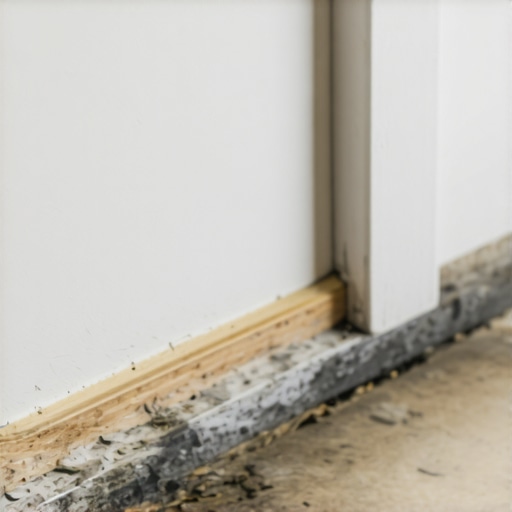
The invisible moisture siphon under your trim
Bathroom baseboards swell because they absorb liquid water or high-density water vapor through their unfinished bottom edges via capillary action. This phenomenon occurs when the porous fibers of the trim material, usually MDF or pine, act like microscopic straws that pull moisture upward. When you see that telltale bubbling or expansion at the floor line, it is rarely just a splash from the tub. It is a structural warning sign that the moisture management system of your bathroom has failed. I have spent twenty five years with my knees on a subfloor and my hands covered in sawdust, and I can tell you that a swelling baseboard is just the tip of the iceberg. Most guys skip the leveling compound. They think the underlayment will hide the dip. It won’t. I spent three days grinding concrete on a job last month just so the floor wouldn’t click like a castanet, only to find the previous installer had ignored a moisture reading of seven percent. That negligence is exactly why your trim is rotting from the inside out. You might be looking for chic baseboard designs that transform rooms in 2025, but no design can save a board that is drowning in subfloor humidity.
The microscopic reality of MDF expansion
Medium Density Fiberboard or MDF is a composite material made of wood fibers glued together under heat and pressure. It is the most common material for modern baseboards because it is cheap and easy to paint, but it is essentially a compressed sponge. When moisture hits the raw, unpainted bottom of an MDF board, the urea-formaldehyde resins or other binders begin to break down. The wood fibers then absorb the water and expand in volume. This expansion is permanent. Unlike solid wood, which might shrink back slightly when it dries, MDF stays blown out once the fibers have separated. This is why you see the paint cracking and peeling away from the surface. The internal pressure of the swelling wood is stronger than the adhesive bond of the paint. If you are considering baseboards makeover ideas to elevate your space, you must understand that MDF is a liability in any room with a shower. Solid wood is slightly better, but even oak or pine will cup and rot if the moisture levels are not controlled at the structural level.
“Wood is hygroscopic, meaning it acts like a sponge, constantly exchanging moisture with the surrounding environment.” – NWFA Technical Publication
Why your subfloor is lying to you
Subfloors often hold latent moisture that is not visible to the naked eye but causes baseboard swelling through vapor emission. Even if your tile looks dry, the concrete slab or plywood underneath could be saturated. In a bathroom, this is often caused by a failing waterproof membrane under the tile. Many installers treat tile cleaning tips for a sparkling bathroom in 2025 as the solution, but no amount of cleaning fixes a porous grout line that is feeding water into the mud bed. When water gets under the tile, it travels to the edges of the room. Since the baseboards are nailed through the drywall and sit right on top of the tile or the subfloor, they become the primary exit point for that trapped moisture. The physics of hydrostatic pressure dictate that the water will move from areas of high concentration to low concentration. Your dry baseboard is the low concentration zone. It will suck that water up until the cellular structure of the wood collapses. I always tell homeowners that if their baseboards are swelling, we need to pull a few tiles and check the thin-set. If the thin-set is dark and damp, you have a shower pan or a plumbing leak that is migrating across the floor.
The ghost in the expansion gap
The expansion gap required for flooring is often the direct path for moisture to reach the baseboards. Every floor needs a gap of at least one quarter inch at the perimeter to allow for natural movement. However, this gap creates a void where water from a leaky toilet or a splashing shower can collect. Once water enters that gap, it is trapped. It cannot evaporate easily because the baseboard covers it. It sits there and feeds the bottom of the trim. This is where most people make a mistake by caulking the bottom of the baseboard to the floor. While it seems like a good idea to seal the gap, you are often just trapping moisture behind the board. If water gets behind the wall from a leaky pipe or poor showers with a style installation, it will run down the back of the drywall and pool at the bottom. Without a way to escape, the baseboard absorbs it all. A professional knows that the real fix is not more caulk. It is ensuring the floor is level and the wet areas are truly tanked with a waterproof membrane like Kerdi or Wedi.
Grout is not a waterproof barrier
Cementitious grout is a porous material that allows water to pass through it via capillary action. Many homeowners assume that because a floor is tiled, it is waterproof. This is a dangerous misconception. Grout is essentially a hard filter. It stops large debris but allows moisture to seep through. Over time, as you scrub your floors or deal with shower overspray, water migrates through the grout lines into the subfloor. This is why grout restoration secrets for long-lasting results often emphasize sealing the grout. However, even sealed grout is only water resistant, not waterproof. If the slope of your shower is wrong or if the grout has hairline cracks, water will find its way to the baseboards. I have seen 2025 modern designs where the homeowner wanted a zero-entry shower, but the installer didn’t account for the splash zone. The result was a bathroom where the baseboards three feet away from the shower were swollen. You need to understand the chemistry of your tile installation. Use epoxy grout if you want a real barrier, otherwise, you are just waiting for the wood to rot.
“Grout is not a waterproof material; it is a cementitious product that allows for the passage of moisture vapor.” – TCNA Handbook
The 1/8 inch that ruins everything
A discrepancy of just one eighth of an inch in floor levelness can lead to water pooling and baseboard damage. If the floor dips toward the wall, every drop of water from your morning shower will gravitate toward the baseboards. Most people ignore these small tolerances. They think the underlayment will cushion the difference. But water is patient. It will find the lowest point and sit there. In my experience, if you don’t grind the high spots of your concrete or shim the low spots of your joists, you are building a reservoir for mold. I always check the levelness of the subfloor before I even think about trim. If you are looking to how to refresh grout without replacing it, you should also check if the tile is tenting or if there are hollow spots. Hollow spots under tile often collect water that eventually wicks into the walls. It is a chain reaction of structural failure that starts with a bad subfloor and ends with a trip to the hardware store for new baseboards.
| Material Type | Moisture Resistance | Typical Swell Rate | Best Use Case |
|---|---|---|---|
| MDF | Very Low | 25% or more | Dry Bedrooms |
| Finger-Jointed Pine | Moderate | 10-15% | Living Areas |
| PVC (Solid Plastic) | Waterproof | 0% | Bathrooms and Mudrooms |
| Tile Base | Waterproof | 0% | Showers and Commercial |
Troubleshooting your swelling trim
To fix swollen baseboards you must first identify the source of moisture and then replace the damaged material. You cannot sand down swollen MDF. It is a dead material once it expands. Follow this checklist to diagnose your bathroom issues.
- Check the wax ring on the toilet for slow leaks that travel under the flooring.
- Inspect the shower door seals and the height of the curb.
- Use a moisture meter to check the drywall behind the baseboard.
- Verify if the grout lines are cracked or if the sealant has failed.
- Look for showers that wow modern designs for 2025 that use integrated waterproofing systems.
If the moisture is coming from the subfloor, you have a much bigger problem than just trim. You might be looking at a full tear-out of the tile. This is why I always advocate for using PVC baseboards in bathrooms. They look like wood once they are painted, but they can sit in a puddle for a week and never change shape. It is the only way to truly bulletproof a bathroom. If you must use wood, you have to paint every single side of that board including the back and the bottom edge before you install it. Most installers are too lazy to do that. They just slap it on and let the homeowner deal with the swelling two years later. Do not be that person. Protect your investment by understanding the physics of your home. If you have more questions about sustainable materials, check out eco-friendly tile solutions for sustainable homes in 2025 to see how modern materials are evolving to handle these issues.