
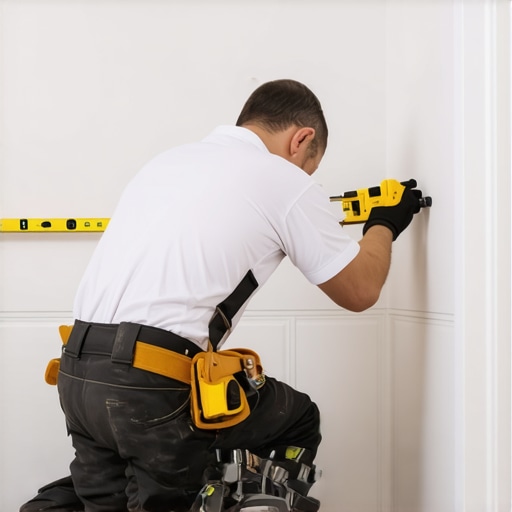
The physics of scribing baseboards to a crooked bathroom wall
Most guys skip the leveling compound. They think the underlayment will hide the dip. It won’t. I spent three days grinding concrete on a job last month just so the floor wouldn’t click like a castanet. That is the truth about floor prep. If you ignore the subfloor, everything else fails. When you get to the baseboards, especially in a bathroom where showers pump out steam all day, you are dealing with a dynamic environment. A bowed wall is not just an eyesore. It is a structural gap that allows moisture to seep behind your trim, rotting the drywall and the plate from the inside out. I smell oak dust and WD-40 every morning, and I can tell you that a tight fit is the only thing standing between a professional job and a mold factory.
The 1/8 inch that ruins everything
Scribing baseboards to a bowed wall requires a precision compass to transfer the wall’s irregular profile onto the back of the trim piece. This process ensures that the wood or PVC follows every hump and dip in the framing. In a city like Houston, where the humidity stays around 80 percent, wood will move. If you do not account for the wall’s curvature, your gaps will open up by a quarter inch before the first year is over. You need to understand the cellular structure of the material you are using. Wood fibers expand across the grain. If you wedge a board into a tight spot without a proper scribe, it will cup or bow the drywall. You can find more baseboards makeover ideas to elevate your space but the installation mechanics remain the same. The goal is a zero-tolerance fit against the vertical plane.
“A floor is only as good as the subfloor beneath it; deflection is the enemy of every joint.” – Master Flooring Axiom
The ghost in the expansion gap
Moisture management in the bathroom is the primary reason why scribing is a mandatory skill for any installer who cares about their reputation. When you install tile, you leave an expansion gap at the perimeter. This gap is usually covered by the baseboard. However, if the wall is bowed and the baseboard is straight, you have a massive void. This void acts as a chimney for moisture. I have seen grout lines crack because the wall behind the baseboard was sweating. You need to use a compass with a hardened steel point. Set the compass to the width of the largest gap between the board and the wall. Keep the compass perfectly level as you drag it along the wall surface. The pencil mark on the board is your cut line. Use a jigsaw with a fine tooth blade to back-cut the board at a 5 degree angle. This back-cut allows the front edge of the trim to sit flush against the wall even if the drywall has thick layers of mud. For more on keeping things tidy, check tile cleaning tips for a sparkling bathroom in 2025.
Materials that withstand the Houston swamp
Choosing the right material for bathroom trim depends entirely on the proximity to wet areas like showers and the expected humidity levels. MDF is a sponge. Do not use it. If you put MDF in a bathroom with high-end showers, you are asking for a callback. PVC trim is the safest bet for moisture resistance, but it has a high expansion coefficient. It grows when it gets warm. Solid wood like poplar or pine is decent if back-primed. If you do not prime the back of the board, the raw wood will suck moisture out of the air. This causes the wood to curl. I have seen $20,000 bathrooms ruined because the installer used cheap hemlock and did not seal the bottom edge. When you look at showers that wow modern designs for 2025, notice the trim is always tight and sealed.
| Material Type | Moisture Resistance | Flexibility Rating | Best Environment |
|---|---|---|---|
| PVC Trim | 100% | High | High Humidity Baths |
| Solid Poplar | 65% | Medium | Master Bathrooms |
| Primed Pine | 50% | Low | Powder Rooms |
| MDF | 10% | Very Low | Never in Bathrooms |
Why your grout lines matter for trim height
The intersection of the floor tile and the baseboard is where most installers fail to maintain a level line. If your floor is out of level, you cannot just follow the floor. You have to find the high point. I have spent hours with a laser level just to find where the tile peaks. If you have old grout that is crumbling, you need to address that before the trim goes on. Look into grout restoration secrets for long-lasting results to fix the foundation. Once the floor is stable, scribe the bottom of the baseboard to the floor first. Then scribe the back to the wall. It is a double scribe. It takes time. It is tedious. It is what separates a mechanic from a handyman. A floor that clicks like a castanet is usually the result of a dip in the subfloor that was never filled with self-leveler. The baseboard should never be used to pin down a floating floor. It needs to float under the trim with a 1/4 inch gap.
“Moisture content in a concrete slab must not exceed three pounds per one thousand square feet over twenty four hours when using a calcium chloride test.” – NWFA Protocol
The surgical approach to the perfect cut
Executing the cut on a scribed line requires a steady hand and a jigsaw blade designed for scrolling. I prefer a T-shank blade with 20 teeth per inch. You must cut on the waste side of the line. If you touch the line, you have gone too far. After the cut, use a rasp or a block plane to clean up the edge. The chemistry of the caulk you use at the end is also vital. Do not use cheap painter’s caulk. Use a high-quality siliconized acrylic that can handle 25 percent joint movement. In the dry heat of Phoenix, things shrink. In Houston, they swell. Your caulk bead is the flexible bridge that keeps the system together. It should be a thin line, not a massive glob of white paste. The physics of the bond depend on clean surfaces. If there is dust on the wall, the caulk will peel in six months.
Toolbox requirements for scribing
- Precision metal wing compass
- Sharp 2H pencil for fine lines
- Jigsaw with Bosch Clean for Wood blades
- Block plane for micro-adjustments
- Digital moisture meter
- Laser level for horizontal datum lines
- Pneumatic 18 gauge brad nailer
The final word on precision
If you take the time to scribe, you are building a floor that will last decades. You are preventing the air leaks and moisture traps that destroy homes. It is about the 1/8 inch. It is about the slope of the tile and the integrity of the grout. Stop looking for shortcuts. Put your knees on a pad, grab your compass, and do the work correctly. A bathroom is a machine. Every part needs to fit. If you are struggling with a complex layout, you can always contact us for professional guidance. The sawdust under my nails is there because I do not skip steps. Neither should you.