
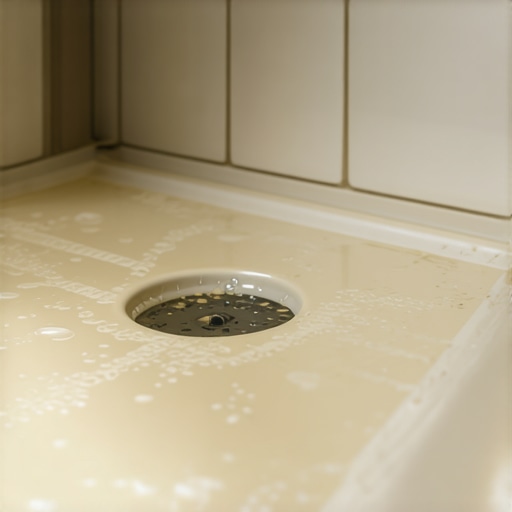
I spent three days grinding concrete on a job last month just so the floor wouldn’t click like a castanet. Most guys skip the leveling compound. They think the underlayment will hide the dip. It won’t. I have seen homeowners ignore a spongy feel in their shower until the grout cracks and the joists rot through the ceiling below. You walk into the bathroom and feel that slight give under your heel. It is not just a nuisance. It is the sound of a thousand dollar failure. When a shower pan loses its rigidity, the entire assembly begins to act like a piston, pumping water into the structural members of your home with every step you take.
The physics of a sinking shower floor
A soft shower pan indicates a failure in structural support or an active leak that has compromised the subfloor integrity beneath the tile. When the mortar bed or the pre-fabricated pan deflects, it causes the grout to crack and the waterproof membrane to stretch beyond its elastic limit. This movement is usually the result of improper joist spacing or the use of non-rated plywood in a high-moisture environment. The Tile Council of North America states that deflection must not exceed L/360 for ceramic and L/720 for stone. When you feel softness, you have already bypassed those limits by a factor of ten. The physics are simple. Tile is a rigid material with high compressive strength but nearly zero tensile flexibility. If the surface beneath the tile moves, the tile cannot. Instead, the bond between the thin-set and the substrate shears off. This creates a void where water sits, stagnates, and eventually breeds mold that eats through your house. I have seen 2×10 joists turned into the consistency of wet cardboard because a homeowner thought the softness was just a quirk of the house settling.
Why your subfloor is lying to you
The subfloor is the foundation of your tile installation and any moisture that penetrates the surface will cause wood fibers to swell and delaminate. Standard OSB should never be used under a shower pan because the resins cannot withstand the constant vapor pressure present in a bathroom. Many builders use 5/8 inch plywood when 3/4 inch tongue and groove is the actual requirement for a stable floor. When the wood absorbs water, the lignin bonds break down. This is why the floor feels soft. It is not the tile moving. It is the wood becoming mush. You might think your tile cleaning routine is enough to keep things fresh, but if the wood is wet, no amount of scrubbing will stop the smell of rot. The wood acts like a sponge, drawing water away from the drain and into the wall cavities. This is where you start to see the bottom of your baseboards turning black or peeling away from the wall. If you ignore this, the next step is a structural collapse. I once pulled up a pan where the only thing holding the person up was a layer of old wire lath and sheer luck.
“A floor is only as good as the subfloor beneath it; deflection is the enemy of every joint.” – Master Flooring Axiom
The chemical failure of saturated thin set
Thin set mortar is designed to be water resistant but it is not waterproof and constant saturation leads to a process called leaching. This occurs when minerals are pulled out of the cement matrix, leaving behind a brittle and chalky substance that no longer holds tile. People assume that because mortar is used in pools, it can stay wet forever. That is a mistake. In a shower, the mortar must be allowed to dry between uses. If your weep holes in the drain are clogged, the mortar bed stays in a state of perpetual saturation. This creates hydrostatic pressure. Every time you step on the pan, you are forcing that water out of the mortar and against the back of the tile. This is why your grout restoration efforts often fail within months. You are trying to patch a surface that is being pushed from behind by water pressure. The chemistry of the bond is destroyed. Once the polymer chains in a modified thin-set are broken by constant water immersion, they cannot be repaired. You have to rip it out.
Structural standards for wet area installations
| Substrate Type | Required Thickness | Max Deflection | Water Sensitivity |
|---|---|---|---|
| Exterior Glue Plywood | 3/4 Inch | L/360 | Medium |
| Cement Backer Board | 1/2 Inch | N/A | Low |
| OSB (Oriented Strand Board) | Not Recommended | L/360 | Extreme |
| Concrete Slab | 4 Inches | Minimal | Very Low |
The ghost in the expansion gap
Expansion gaps are required at every change of plane in a shower to allow for the natural movement of the house without cracking the tile. If your installer filled the corners with grout instead of a 100 percent silicone sealant, the pan will eventually feel soft. This happens because the grout acts as a rigid wedge. When the house moves, the grout does not give. It transfers that force into the shower pan, often cracking the waterproof liner beneath. This is a common failure point in modern shower designs where people want a clean, minimalist look. They skip the thick silicone beads because they look bulky. But that silicone is what keeps the system waterproof. Without it, you are just waiting for a leak. If you see cracks in the vertical corners of your shower or where the floor meets the wall, you have a movement problem. That movement eventually fatigues the subfloor, leading to that soft, bouncy feeling underfoot.
Signs your shower pan is failing
- Cracked or missing grout lines on the floor
- A musty smell that persists after cleaning
- Springy or bouncy movement when stepping near the drain
- Water stains on the ceiling in the room below
- Baseboards that are warping or showing signs of mold
- Tile that sounds hollow when tapped with a plastic mallet
The 1/8 inch that ruins everything
A shower pan must have a minimum slope of 1/4 inch per foot toward the drain to ensure that water moves off the surface and out of the mortar bed. If the slope is less than 1/8 inch, water will pool in the corners and saturate the system. I have seen dozens of pans where the installer got lazy with the level. They think the tile will cover the mistake. It does not. Standing water is the primary cause of subfloor rot. In places with high humidity like Houston or Miami, a poorly sloped pan will never dry out. The humidity prevents evaporation, and the lack of slope prevents drainage. It is a perfect storm for structural failure. You might think you have trendy ideas for small bathrooms that will save the space, but if the plumbing and slope are wrong, the aesthetics are irrelevant. You need to ensure the pre-pitch, the layer under the liner, is also sloped. Most guys skip the pre-pitch and put the liner flat on the floor. That means the water that gets through the grout just sits on the liner and rots the wood from the outside in.
How to handle a spongy pan diagnosis
If you detect softness, the first step is to stop using the shower immediately to prevent further water damage to the joists. You must perform a flood test to see if the liner is actually leaking or if the softness is purely structural. Block the drain and fill the pan with two inches of water. Mark the water line. If it drops after twenty four hours, your liner is gone. If the water stays but the floor still feels soft, the subfloor is likely compromised from an old leak or improper support. This is not a situation where you can just apply a new layer of grout or a topical sealer. You have to address the rot. If you are looking for eco-friendly tile solutions, consider that the most sustainable thing you can do is build a floor that lasts fifty years instead of five. Fixing a soft pan usually involves removing the bottom two rows of wall tile and the entire floor. It is a messy, expensive job, but it is cheaper than replacing your entire floor frame. Contact a professional through our contact page if you suspect your subfloor is giving way. It is better to know the truth now than to fall through the floor later.
“Water is a patient thief; it will find the smallest gap in your defense and take your home piece by piece.” – TCNA Installation Manual Insight