
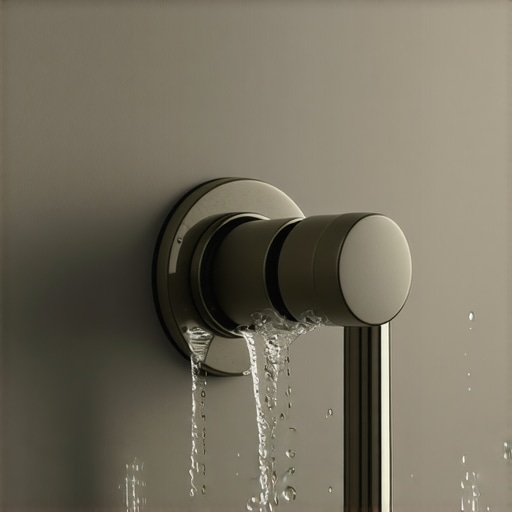
I have spent twenty five years on my knees with a moisture meter and a level. My hands are stained with grout and my lungs have tasted more oak dust than fresh air. I smell like WD-40 and old copper pipe. People think flooring and tile are about the look, but it is all about the physics of the water that wants to destroy your home. I once spent three days grinding concrete on a job last month just so the floor would not click like a castanet, only to find the real disaster was the wall. The client had a slow drip behind their shower plate. It had been weeping for months, unnoticed, until the mold started climbing up the baseboards. By the time I got there, the subfloor was the consistency of wet oatmeal. This is the reality of the shower handle leak. It is not just an annoying drip. It is a structural engineering failure in progress. If you ignore that plate, you are inviting the rot to eat your house from the inside out.
The physics of a failing cartridge
A shower handle leak behind the escutcheon plate usually signifies a compromised pressure balance valve or a worn cartridge. These mechanical components use rubber O-rings and silicone gaskets to maintain a watertight seal against the hydrostatic pressure of your home plumbing system. When these elastomeric seals undergo thermal degradation or mineral calcification, they allow pressurized water to bypass the valve body and enter the wall cavity. This water does not always come out of the tub spout. It often travels backward, following the valve stem, and drips down the plaster guard onto the subfloor. You are looking at a molecular breakdown of the polymer seals. Over time, the chlorine and minerals in your water supply eat away at the durometer of the rubber, making it brittle and prone to micro-fissures. When the seal loses its compression set, it can no longer hold back the 60 PSI of water pressure pushing against it. This is why you need to understand the mechanical limits of your fixtures before they fail. You can see better options for your bathroom at showers that wow modern designs for 2025 to avoid these old hardware headaches.
“A floor is only as good as the subfloor beneath it; deflection is the enemy of every joint.” – Master Flooring Axiom
Why the escutcheon plate fails to protect
The escutcheon plate is the large metal trim behind your shower handle designed to hide the valve hole in the tile. Its primary function is to provide a cosmetic finish, but it should also act as a secondary moisture barrier when combined with RTV silicone or a closed-cell foam gasket. Most installers fail because they do not understand surface tension. If the caulk bead around the top of the plate is broken, gravity will pull water runoff behind the plate and directly into the unsealed tile edges. This water then migrates into the cement backer board. Even if you have the best tile cleaning tips for a sparkling bathroom in 2025, they will not save you if the water is behind the ceramic surface. The plate needs a bead of silicone around the top and sides, leaving a small weep hole at the very bottom. This weep hole allows any condensation or minor internal leakage to drain into the shower pan rather than trapping it against the drywall. Without that exit point, the moisture builds up, creating a humid micro-climate that breeds stachybotrys and weakens the thin-set bond.
Water migration through porous grout lines
Your cementitious grout is a porous material with a high water absorption rate that can reach up to 10 percent by weight. When the shower handle leaks from the plate, the water is not just sitting on the surface, it is wicking through the grout channels via capillary action. This moisture transmission eventually reaches the tile substrate, which is often gypsum-based in older homes. Once the wallboard gets wet, it loses its structural integrity and the tile begins to delaminate. You might notice the grout changing color or efflorescence appearing as calcium salts are pushed to the surface. If you see these signs, you need to learn how to refresh grout without replacing it before the structural damage becomes irreversible. Water is a patient destroyer. It will find a microscopic crack and expand it through hydrostatic force. In a high-moisture environment, the alkalinity of the thin-set can even be compromised, leading to a complete bond failure between the porcelain and the wall.
| Component | Failure Mode | Impact Level |
|---|---|---|
| O-ring | Cracking | High |
| Bonnet Nut | Loosening | Medium |
| Sealant | Desiccation | High |
| Grout | Cracking | Low |
The structural cost of ignoring the drip
Ignoring a leaking shower handle is an expensive mistake because the gravity-fed water will eventually reach the bottom plate of your stud wall and the rim joist. This is where the molecular zooming gets ugly. Wood is hygroscopic, meaning it absorbs water vapor from the air. When liquid water contacts your subfloor, the cellulose fibers expand, leading to buckling and warping. This deflection causes the tile floor to crack as the joists shift. You will see the evidence first in your trim. If you notice your baseboards swelling or the paint peeling at the floor line, the leak has already traveled down the wall. You may find inspiration for a repair at chic baseboard designs that transform rooms in 2025, but no amount of molding can hide a rotted sill plate. The shear strength of your framing is at stake. When the moisture content of the wood exceeds 20 percent, fungal decay begins. This is not just a plumbing issue, it is a structural emergency. I have seen heavy cast iron tubs literally sink into the crawlspace because a shower valve was allowed to drip for three years.
- Turn off the main water valve to the house.
- Remove the handle set screw with a hex key.
- Pry off the index button to access the center screw.
- Unscrew the escutcheon plate and check the gasket.
- Inspect the plaster guard for signs of water tracks.
- Test the cartridge for lateral play and mineral buildup.
- Replace the cartridge if the O-rings show flat spots.
The microscopic reality of O ring failure
The O-ring inside your shower cartridge is a precision-engineered seal designed to provide a leak-proof interface between the moving cartridge and the static valve body. These seals are usually made of EPDM or Nitrile rubber. Over time, friction from turning the handle wears down the outer diameter of the O-ring. This is mechanical wear on a microscopic scale. As the rubber thins, the sealing pressure drops. Eventually, the water pressure overcomes the frictional seal, and a leak begins. People often try to over-tighten the bonnet nut to stop the leak, but this just increases the stress on the brass threads and can lead to a catastrophic failure. You must replace the elastomer. If the valve body itself is pitted from corrosion, even a new cartridge will not seat properly. This is common in hard water areas where calcium carbonate deposits act like sandpaper against the seals. You can read more about sustainable material choices at eco-friendly tile solutions for sustainable homes in 2025 to see how modern materials resist these mineral attacks.
“Water follows the path of least resistance; your job is to make that path lead to the drain and nowhere else.” – Master Flooring Axiom
Reclaiming the dry subfloor reality
To fix the leak from the plate, you must address the root cause at the valve and then re-seal the interface between the plumbing and the tile. Start by cleaning the valve housing with white vinegar to remove scale. Lubricate new O-rings with plumber’s grease, which is pure silicone. This reduces friction and prevents oxidation of the rubber. When you reinstall the escutcheon plate, use a high-quality neutral-cure silicone. Unlike acetoxy silicone, it will not corrode the metal finish of your fixture. Make sure the tile surface is perfectly clean and dry before applying the sealant. If there is moisture trapped behind the tile, the silicone will fail to bond, and the leak will return. This is the difference between a professional installation and a DIY patch job. I have seen master plumbers fail because they were too lazy to wipe the soap scum off the grout before caulking. If the tile is too damaged, check showers with a style trendy ideas for small bathrooms for replacement options that utilize modern waterproofing membranes like Schluter-Kerdi. These systems are impermeable and provide a bonded waterproof barrier that traditional mud beds simply cannot match. You are building a system, not just a shower. Every layer must work together to repel moisture and protect the framing. When you do it right, you can sleep at night knowing the water is staying in the pipes and not in your floor joists. This is the structural integrity your home deserves. It is about precision, chemistry, and the patience to do the job once. I have seen too many beautiful floors ruined by a tiny drip. Do not let your bathroom be the next statistic in the war against water.