
Most guys skip the leveling compound. They think the underlayment will hide the dip. It won’t. I spent three days grinding concrete on a job last month just so the floor wouldn’t click like a castanet. I have seen the same laziness in tile work. People love the look of penny tiles in showers and on bathroom floors because they want that vintage aesthetic, but they fail to realize that a mosaic of small circles means your surface area is roughly thirty percent grout. If you do not have a strategy for the maintenance of that grout matrix, you are going to be staring at a grid of mold and mineral scale within six months. This is not a job for the faint of heart. It is a job for someone who understands the chemistry of tile and grout. If you want a floor that lasts, you need to understand that the subfloor determines the stability of the grout line, but your cleaning technique determines the survival of the bond itself. Penny tiles are a structural challenge disguised as a design choice. Let us talk about how to keep them from becoming a maintenance disaster.
The geometric nightmare of small format circles
Cleaning penny tile grout requires a low-pH phosphoric acid cleaner or a neutral pH balanced detergent paired with a stiff nylon brush to penetrate the high density of grout lines. Unlike large format tiles, penny tiles have a higher grout-to-tile ratio that traps biofilm and calcium deposits at every circular junction. When you have a standard twelve inch tile, you have four linear feet of grout. With penny tiles, you have hundreds of linear feet in the same square footage. The physics of the scrub change here. You are not just cleaning a flat surface. You are cleaning a series of interconnected valleys. If your subfloor had any deflection, those valleys are already micro-cracking, which creates pockets for bacteria to thrive. You need to identify if you have sanded or unsanded grout. Most penny tiles use unsanded grout because the joints are tight, usually 1/16 of an inch or less. This means the grout is softer and more prone to chemical erosion if you use the wrong products. Refer to tile cleaning tips for a sparkling bathroom in 2025 for a breakdown of modern chemical interactions.
“A floor is only as good as the subfloor beneath it; deflection is the enemy of every joint.” – Master Flooring Axiom
Chemical warfare against soap scum and hard water
Removing soap scum and hard water minerals from penny tile grout requires acidic surfactants that can dissolve calcium carbonate without etching the ceramic or glass tile surface. People think bleach is the answer. It is not. Bleach is a disinfectant, not a cleaner. It will kill the mold, but it will not remove the mineral shelf that the mold lives on. Even worse, high concentrations of bleach can degrade the polymer modifiers found in high-performance grouts. You need a dedicated grout cleaner that utilizes phosphoric acid or sulfamic acid at a controlled concentration. You apply the solution and let it sit. This is called dwell time. Without dwell time, you are just moving dirt around. The chemicals need time to break the ionic bond between the mineral scale and the grout pore. In regions like the Southwest, where the water is basically liquid rock, this step is non-negotiable. If you live in a high humidity area like Florida, your primary enemy is organic growth, which requires an alkaline pre-spray followed by an acidic rinse to reset the pH balance of the floor.
The mechanics of the scrub
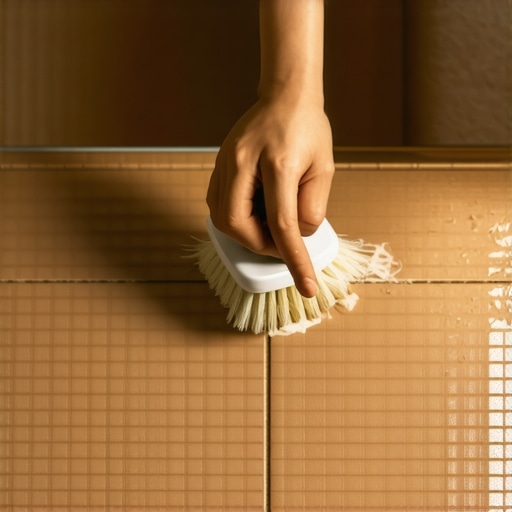
The mechanical agitation of grout lines must be performed with a tapered grout brush or an oscillating power scrubber to ensure the bristles reach the bottom of the 1/16 inch joints. You cannot use a flat mop and expect results. A flat mop only cleans the high points of the penny tiles, leaving the grout lines to collect the dirty water. Think of it like a squeegee effect. Every time you wipe a damp cloth over the tile, you are depositing microscopic amounts of soil into the grout valleys. This is why grout turns dark over time. To fix this, you must scrub in a circular motion to match the geometry of the tile. I recommend a brush with crimped polypropylene bristles. They have a memory for their shape and can wedge into the tight radius of the penny tile better than nylon. If you find the grout is too far gone, you might need to look at grout restoration secrets for long-lasting results to see if a colorant or sealer is necessary.
| Cleaner Type | pH Level | Best Use Case | Risk Factor |
|---|---|---|---|
| Phosphoric Acid | 1.0 – 2.0 | Heavy mineral scale | Can etch stone |
| Neutral Cleaner | 7.0 | Daily maintenance | Low cleaning power |
| Alkaline Degreaser | 11.0 – 12.0 | Body oils and grease | Residue buildup |
| Oxygen Bleach | 10.0 – 11.0 | Organic stains | Slow acting |
Why your grout choice determines your cleaning fate
The porosity of cementitious grout is the primary reason for staining, whereas epoxy grout provides a non-porous surface that resists chemical penetration and moisture absorption. If you are currently building a shower and choosing penny tiles, use epoxy. It is a nightmare to install because it is sticky and sets fast, but it will save you a hundred hours of scrubbing over its lifetime. Cement grout is essentially a hard sponge. It has capillary pathways that pull dirty water deep into the structure. Once a stain is in the capillaries, you are not cleaning it; you are trying to bleach it out, which weakens the integrity of the grout. If you are stuck with existing cement grout, you must seal it. But do not use a cheap hardware store sealer. You need a penetrating solvent-based fluorochemical sealer. This creates a hydrophobic barrier at the molecular level, forcing water to bead on the surface rather than soaking in. Check out how to refresh grout without replacing it if your sealer has already failed.
“Proper grout maintenance begins with the selection of low-absorption materials and the elimination of acidic residues.” – TCNA Handbook Standards
The hidden impact of water quality on grout longevity
Water with high TDS (Total Dissolved Solids) will lead to efflorescence, a process where calcium hydroxide migrates to the surface of the grout and reacts with carbon dioxide to form a white, crusty film. This is often mistaken for mold or dirt, but it is actually a structural byproduct of the grout’s hydration process. If you scrub this with a base, nothing happens. You need a mild acid to dissolve the salt. This is especially prevalent in new installations where the subfloor or the thin-set was too wet during the curing phase. The moisture escapes through the grout lines, carrying minerals with it. If you have baseboards near your tiled area, watch for wicking. Moisture trapped behind the tile can rot out the drywall and the back of your trim if the grout is not properly maintained. For design ideas that mitigate these risks, look at showers that wow modern designs for 2025.
- Vacuum the floor first to remove dry particulate soil that turns into mud when wet.
- Apply the cleaning solution in small sections to prevent it from drying on the tile.
- Use a wet-vacuum to suck up the dirty slurry instead of mopping it.
- Rinse with distilled water in high-mineral areas to prevent new spotting.
- Dry the grout lines with a microfiber towel to remove any remaining film.
Regional humidity and the battle against mildew
In the humid climate of the Gulf Coast, penny tile grout is a breeding ground for pink mold and black mildew due to the constant evaporation cycles in unventilated bathrooms. In these environments, you cannot rely on occasional cleaning. You need a preventative approach. This includes increasing the CFM of your exhaust fan and using a squeegee after every shower. Conversely, in dry climates like Phoenix, the grout can become brittle and dusty. The low humidity causes the cement to lose moisture too fast, which can lead to shrinking. If your penny tile grout is cracking in a dry climate, it is likely because the installer did not damp-cure the grout or the subfloor was too thirsty and sucked the water out of the mix. This leaves the grout crumbly and impossible to clean because it just disintegrates under the brush. If your bathroom looks dated due to these issues, consider showers with a style trendy ideas for small bathrooms to rethink your layout. A floor is a structural system. Treat it with the same respect you would give your foundation, or it will fail you when you need it most.