
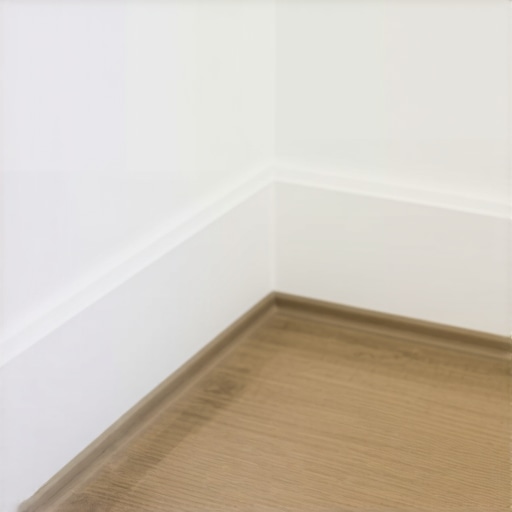
The subfloor secret that ruins every bathroom
Subfloor flatness and deflection are the primary reasons bathroom baseboards show gaps. If the plywood substrate or concrete slab deviates more than 3/16 of an inch over 10 feet, the trim cannot sit flush. Fixing the structural level is the only way to avoid aesthetic failure. Most guys skip the leveling compound. They think the underlayment will hide the dip. It won’t. I spent three days grinding concrete on a job last month just so the floor wouldn’t click like a castanet. When you are dealing with a bathroom where the floor drops half an inch over three feet, you cannot just nail a piece of MDF and hope for the best. The tile will look okay, but that baseboard will look like a rollercoaster. You smell the oak dust and the floor wax in a shop like mine and you realize that precision is not optional. It is the requirement. If you are looking for baseboards makeover ideas to elevate your space, you have to start with the floor beneath your feet. A slanted floor is a structural reality in many older homes where the joists have settled or the original builder was more interested in speed than quality. You see the gaps and your first instinct is to reach for a tube of acrylic. Stop. That is the path to a moldy, peeling mess. You need a mechanical solution for a mechanical problem.
Why caulk is a lazy mans band aid
Caulking baseboards is often used to hide poor carpentry and uneven tile installation. In a wet environment like a bathroom, silicone caulk eventually separates from the baseboard material because of moisture expansion and structural movement. True professionals use scribing techniques to achieve a perfect fit. When you walk into a bathroom and see a thick bead of caulk between the floor and the wall, you are looking at a failure. Over time, the humidity from showers causes the wood to expand. The tile stays static. This difference in movement, known as the coefficient of linear thermal expansion, tears the caulk away. It leaves a jagged line that collects dirt and hair. It looks terrible. If you want chic baseboard designs that transform rooms in 2025, you have to master the art of the scribe. I have seen guys try to mask a half inch gap with grout too. Grout is not a glue. It is a filler meant for tile joints. When it is smashed under a piece of wood, it cracks into dust within months. The vibration of people walking on the floor is enough to shatter the bond. You need to cut the wood to the shape of the floor. It is the only way that lasts decades instead of weeks.
“A floor is only as good as the subfloor beneath it; deflection is the enemy of every joint.” – Master Flooring Axiom
The scribe method for precision fit
Scribing baseboards involves using a carpenter compass to transfer the floor’s contour onto the trim material. This technique allows for a gap-free fit on slanted bathroom floors without using any silicone caulk. By cutting the bottom of the wood to match the tile slope, the joint becomes tight. You start by setting your baseboard against the wall and leveling it with shims. You don’t push it down to the floor. You hold it perfectly level. Then you take your compass and set the gap to match the largest distance between the floor and the board. You drag the compass along the floor while the pencil side marks the wood. This creates a line that perfectly mimics the hills and valleys of your tile. When you cut along that line with a jigsaw or a power planer, the board drops down and fits like a glove. This is the difference between a handyman and an architect of floors. You are dealing with the physics of the space. It takes time. It takes patience. But the result is a line so clean you couldn’t slide a razor blade through it. This is especially important when you are working around showers with a style that features intricate tile work. A bad baseboard line will distract the eye from the beautiful stone or ceramic you just spent thousands of dollars installing. You have to respect the materials.
Material choice and moisture resistance
PVC baseboards and solid pine trim react differently to the high relative humidity found in modern showers. Choosing the right hygroscopic material prevents warping that creates new gaps over time. Medium-density fiberboard often fails in wet environments because it swells when exposed to standing water. I have seen MDF swell to twice its size because someone left a wet towel on the floor for a day. It acts like a sponge. For a bathroom, I always recommend solid wood or a high-quality composite that is rated for moisture. Solid poplar is a favorite of mine because it takes paint well and is stable enough to hold a scribe line without splintering. If you are going for a natural look, white oak is the king. It has a high tannin content which makes it naturally resistant to rot. When you are cleaning up after a job, you want to make sure the homeowner knows about tile cleaning tips for a sparkling bathroom in 2025 so they don’t use harsh chemicals that might eat away at the finish of your custom-scribed wood. The chemistry of the finish is just as important as the physics of the cut.
| Material | Moisture Resistance | Scribe Ease | Janka Hardness |
|---|---|---|---|
| MDF | Low | Medium | 700 |
| Solid Pine | Medium | High | 380 |
| Poplar | Medium | High | 540 |
| PVC Composite | High | Medium | N/A |
| White Oak | High | Low | 1360 |
The physics of the wood and tile junction
Wood trim and ceramic tile have different rates of contraction and expansion based on temperature and humidity changes. A mechanical fit achieved through scribing is superior to any flexible filler because it allows for micro-movements without showing a visible gap. When the humidity in the room spikes after a hot shower, the wood fibers absorb water. They expand. If the board is tightly scribed and fastened with the right gauge of nails, it will expand against the floor. This creates a compression seal. If you used caulk, that expansion would crush the bead and then, when the room dries out, the wood shrinks and the caulk is left hanging. It is basic thermodynamics. You also have to consider the grout. If the tile was laid poorly and the grout lines are uneven, the scribe must account for those tiny bumps. You are essentially creating a negative image of the floor on the bottom of your trim. This is why you need a sharp pencil and a steady hand. If you have old grout that is causing issues, you might need how to refresh grout without replacing it techniques before you even think about the baseboards. A clean, flat surface is the starting point for any high-end installation. You can’t build a palace on a swamp, and you can’t scribe a board to a floor covered in old, crumbling mortar.
- Check subfloor levelness with a 6-foot or 10-foot straight edge.
- Select a moisture-resistant wood species like Poplar or White Oak.
- Acclimate the trim to the bathroom humidity for at least 72 hours.
- Use a compass with a locking mechanism to ensure the scribe line remains consistent.
- Back-cut the scribe line at a 5-degree angle to ensure the front edge sits flush.
- Fasten the baseboard into the wall studs, not just the drywall.
The 1/8 inch that ruins everything
Precision carpentry in a bathroom requires measuring to the nearest 1/32 of an inch to ensure the transition is visually perfect. A gap of just 1/8 of an inch is enough to catch the light and create a dark shadow that ruins the aesthetic flow of the room. When you are looking at a slanted floor, that 1/8 inch can appear and disappear over a three foot span. It makes the floor look even more crooked than it actually is. By scribing, you hide the slope from the human eye. The top of the baseboard remains perfectly level while the bottom follows the chaos of the floor. It is an optical illusion that creates the feeling of a square, level room. I tell my apprentices all the time that we are not just installers, we are magicians. We hide the mistakes of the framers and the concrete finishers. If you find your grout is the problem, look into grout restoration secrets for long-lasting results to get the floor prepped correctly. You cannot expect a baseboard to look good if the tile beneath it is a mess. The floor is the foundation. Every layer you add on top of it depends on the one below. If the tile is level, the scribe is easy. If the tile is slanted, the scribe is mandatory. There is no middle ground in high-end flooring. You either do it right or you do it again. And doing it again is how you go out of business.
“Wood and tile are distinct elements that require a mechanical bridge when the architecture fails to be level.” – NWFA Installation Guide
Structural integrity versus cosmetic masking
Structural fixes like self-leveling underlayment should be prioritized over cosmetic trim work whenever the budget allows. However, in remodeling projects where the tile is already set, scribing baseboards remains the gold standard for finishing a slanted bathroom floor. You have to understand that once the tile is down, your options are limited. You can’t go back and fix the joists. You have to work with what you have. This is where the skill of the installer shines. You use a jigsaw with a fine-tooth blade to follow that scribe line. You sand it down with 80-grit then 120-grit. You test the fit. You take it back to the saw and trim another hair off if you have to. It is a process of refinement. It is about pride in the craft. When you smell that fresh cut wood and see it slide into place against the tile, you know it is right. You don’t need a tube of goop to hide your work. You are a craftsman. You are an architect of the finish line. And that is why your clients hire you instead of the guy from the big box store who just wants to nail it and bail it. You are building something that lasts. Every cut, every measurement, every scribe line is a testament to that commitment. That is the master flooring architect engine at work. No shortcuts. No caulk. Just wood, tools, and talent. If you are concerned about the environmental impact of your materials, check out eco-friendly tile solutions for sustainable homes in 2025 to pair with your precision carpentry. Your bathroom will thank you for the extra effort. The house will thank you. And your knees, even though they hurt from twenty-five years on the floor, will thank you for doing a job you can stand behind.