
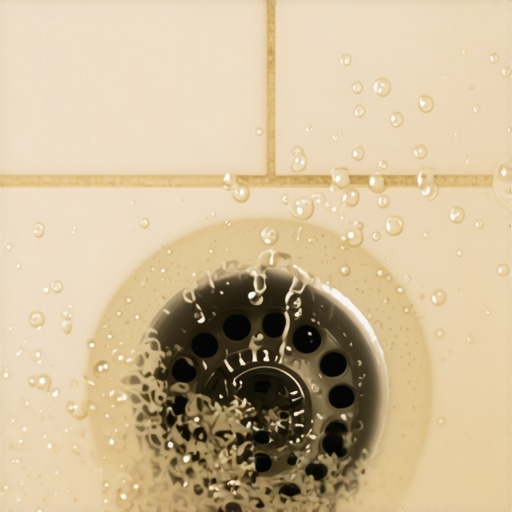
The quiet death of your master suite drainage
A grout clog in your shower drain manifests as a persistent slowing of water flow, a white mineral crust forming around the drain grate, and a distinct lack of response to traditional plunging or chemical cleaners. Unlike hair or soap scum, grout is a cementitious product that undergoes a chemical reaction to become stone underwater. This hardening process creates a permanent obstruction that narrows the pipe diameter and requires mechanical intervention to resolve effectively. I spent three days grinding concrete on a job last month just so the floor wouldn’t click like a castanet, but that was nothing compared to the homeowner who called me because their new walk-in shower was suddenly a foot-bath. The installer had used the drain as a trash can for his bucket wash-water. This is the reality of the trade. You think you are getting a beautiful tile job, but underneath the surface, your plumbing is being choked by liquidated stone. Grout is not just mud. It is a complex mixture of Portland cement, graded aggregates, and chemical polymers designed to stay put forever. When that mixture hits a P-trap, it settles in the lowest point of the curve and begins to hydrate. Once it hydrates, it is no longer a clog. It is a part of the house. You need to understand the physics of this failure before you spend thousands on a plumber who will just tell you to rip out the pan. This is about the structural integrity of your waste lines and the chemistry of the bond. If you see water lingering after you turn off the tap, the clock is already ticking on your pipes.
The water vortex slows to a crawl
A slowing drain is the primary indicator that grout sediment has begun to settle and harden within the internal curvature of your shower plumbing. When the drainage rate drops below three gallons per minute, you are likely dealing with a significant reduction in the pipe’s internal diameter caused by cementitious buildup. This is not a soft clog that will move with gravity. It is a rigid barrier. Most people think they can just wait it out. They think the water will eventually wash the debris away. It won’t. In fact, every time you run the water, you are providing more moisture for the unhydrated cement particles to bond together. This is a molecular process. The calcium silicate hydrate crystals grow and interlock, bridging the gap between individual sand grains. If you have installed showers with a style that features heavy tile work, the volume of grout used is immense. Any excess that finds its way into the drain will sit in the trap. The trap is designed to hold water to block sewer gases, but that same water becomes the curing agent for the grout. You are essentially pouring liquid rock into a bucket and wondering why it won’t pour back out. I have seen pipes where the opening was no wider than a pencil. The pressure required to push water through that tiny hole is immense. This leads to leaks at the joints behind your walls.
“A floor is only as good as the subfloor beneath it; deflection is the enemy of every joint.” – Master Flooring Axiom
White residue appears around the drain grate
The presence of a white, chalky substance around your drain cover, known as efflorescence, indicates that grout minerals are leaching back up from a clog. When water sits on top of a grout obstruction, it becomes saturated with calcium hydroxide and other soluble salts which then migrate to the surface as the water evaporates. This is a visual warning that the pipe is not clearing. You might try tile cleaning tips to scrub it away, but the source is deep in the stack. Efflorescence is a sign of a deeper moisture problem. It tells you that there is stagnant water where there should be air. This is especially dangerous for your chic baseboard designs because stagnant water in a clogged drain can wick into the subfloor and migrate toward the walls. I have seen baseboards swell and rot because a grout clog caused a slow, invisible backup through the weep holes of the drain assembly. The chemistry here is simple. Salt follows water. If the water cannot go down the pipe, it stays in the grout bed and the thin-set. It eventually finds a way out, often damaging your expensive trim. You are looking at a systemic failure caused by a few pounds of misplaced Portland cement.
The sound of air gasping through the pipes
Gurgling sounds coming from the drain or nearby fixtures indicate that a grout clog is restricting airflow and creating a vacuum within the plumbing vent system. When a solid mass of grout occupies 70 percent of the pipe’s volume, the remaining space is insufficient for both water and air to pass simultaneously, leading to a glugging noise. This is the sound of a system under stress. It is not normal. Plumbers call this a wet vent issue, but in a new tile job, it is usually a grout issue. The air is trying to get past the obstruction and it creates a siphon effect. This can actually pull the water out of your toilet bowl or other nearby traps. It is a chain reaction. The mass of the grout acts like a dam. Water hits the dam, creates turbulence, and traps air bubbles. This is why you hear that rhythmic thumping or gasping after the shower is turned off. It is the pipe trying to breathe through a throat full of sand and cement. If you ignore this, the next stage is a total backup. I have seen it happen a hundred times. People think it’s just a quirk of the new house. It’s not a quirk. It’s a mistake. You need to address the obstruction before the bond becomes so strong that the only solution is a jackhammer and a prayer.
The plunger fails to move the needle
If a heavy-duty plunger or a standard plumbing snake provides zero relief, you are likely facing a cured grout obstruction rather than a soft organic clog. Grout does not compress and it does not break apart easily under the low-pressure pulses generated by a hand plunger, which is designed for flexible debris. You are fighting stone. A standard snake will often just glide over the top of a grout mass or get stuck in it. This is where the physics of the material matters. Sanded grout is particularly nasty. The sand acts as a friction agent, gripping the walls of the PVC pipe. When the plunger creates a vacuum, the grout mass stays put because it is physically bonded or wedged into the pipe’s geometry. This is the moment most homeowners realize they are in trouble. They have tried the chemicals. They have tried the plunger. Nothing. This is because grout is alkaline and most drain cleaners are acid-based. While acid can dissolve some cement, the concentrations available to consumers are rarely enough to eat through a two-inch thick plug of cured grout. You are just pouring money down a drain that is already full of rock. You might need grout restoration secrets for the surface, but for the pipes, you need a professional with a hydro-jet or a specialized mechanical auger.
Visual evidence of cement in the P-trap
Using a borescope or removing the drain grate to see visible clumps of gray or white hardened material is the definitive proof of a grout clog. A visual inspection will reveal the rough, jagged surface of the grout mass which looks significantly different from the slimy, dark accumulation of hair and soap. I tell my clients to get a cheap inspection camera. It saves so much guesswork. When you look down that pipe, you should see smooth plastic. If you see something that looks like the surface of the moon, that’s grout. That material is capturing every hair and every bit of skin cell that goes down that drain. It is building a composite structure of stone and organic waste. It is a biological and mineral nightmare. If you are planning showers that wow, you have to ensure the installer is using a 3-bucket wash system. They should never, ever pour that third bucket down the drain. If they do, the silt settles. It stays. It hardens. This is why I am so hard on my crews. One mistake with a wash bucket can cost five thousand dollars in plumbing repairs. It is about the mil-thickness of the sediment. Even a 1/8 inch layer of grout on the bottom of a pipe can reduce flow enough to cause a permanent problem.
| Grout Type | Clog Risk Level | Curing Time in Pipe | Detection Difficulty |
|---|---|---|---|
| Sanded Grout | High | 24 to 48 hours | Moderate |
| Unsanded Grout | Medium | 24 to 72 hours | High |
| Epoxy Grout | Extreme | 4 to 8 hours | Very High |
| Acrylic Premixed | Low | 7 to 10 days | Low |
- Check the drain immediately after the tile crew leaves the site.
- Run water for twenty minutes to test for slow drainage.
- Inspect the P-trap with a high-intensity flashlight for sediment.
- Look for grout smears on the drain flange or grate.
- Listen for gurgling in the adjacent toilet or sink.
If you find yourself in this situation, do not panic. Do not reach for the hardware store chemicals first. They often do more harm than good by heating up the PVC pipes and causing them to warp. Instead, consider how to refresh grout on the surface while hiring a plumber to mechanically clear the lines. If the grout is still relatively soft, a wet-dry vac can sometimes pull the sediment out before it fully cures. This is a race against time. Once the Portland cement reaches its final set, it has a compressive strength that can exceed 3,000 PSI. That is stronger than the plastic pipe holding it. You are dealing with a structural engineering challenge inside your plumbing. Be meticulous. Be aggressive. Do not let a lazy installer ruin your home. If you have questions about your installation, you can always contact us for a second opinion. Remember that a shower is more than just a pretty face. It is a complex system of water management that relies on every component working in harmony. From the baseboards makeover ideas to the very bottom of the drain, every detail matters. If the subfloor is the foundation, the plumbing is the lifeblood. Keep it clear.
“Proper drainage is the silent partner of every waterproof installation; without it, the system fails from within.” – TCNA Standard Observation