
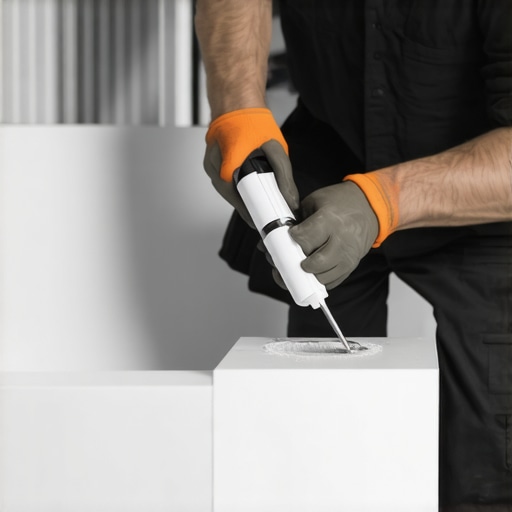
Most guys skip the leveling compound. They think the underlayment will hide the dip. It won’t. I spent three days grinding concrete on a job last month just so the floor wouldn’t click like a castanet because the subfloor was a mess of high spots and valleys. That job taught me that the smallest details, the ones you cannot even see once the baseboards are on, are the ones that determine if a room lasts ten years or ten months. One of those details is the silicone bead. People think they can just run a tube of cheap caulk along a tub or a baseboard and call it a day. They are wrong. They use their finger. They use a wet rag. They leave a smeary, thin mess that peels away the moment the house settles or the humidity hits 80 percent. I have seen fifteen thousand dollar bathroom remodels ruined because the installer did not understand the physics of the change of plane or the chemical requirements of a 100 percent silicone bond. This is why I carry a five dollar plastic profiling tool in my pocket. It is the only way to get a consistent, structural seal that actually moves with the building.
The myth of the wet finger technique
The $5 tool for perfect silicone caulking is a plastic or rubber profiling kit with specific radii and 45 degree angles designed to compress sealant into a joint while removing excess material. Using a finger introduces skin oils, saliva bacteria, and inconsistent pressure into the wet silicone which inevitably leads to premature bond failure. When you are finishing showers with a style trendy ideas for small bathrooms, you are dealing with constant moisture and thermal expansion. Your finger is not a precision instrument. It leaves the edges of the silicone bead too thin. This thinness, often called feathering, is where the silicone will first start to curl and peel. A profiling tool, however, creates a uniform thickness across the entire bead. It forces the silicone into the micro-pores of the tile and the grout. It ensures that the bond is mechanical as much as it is chemical. If you want a seal that resists mold and stays flexible for decades, you have to stop using your hands to shape the bead. The tool does the work that your anatomy cannot. It provides a clean, professional finish that looks like a factory edge every single time.
“Movement joints are not optional; they are a structural necessity in any tiled assembly where change of plane occurs.” – Master Flooring Axiom
The molecular reality of silicone adhesion
Silicone sealants function through a process of cross linking that occurs once the material is exposed to atmospheric moisture. Unlike water based acrylic caulks that shrink as they dry, 100 percent silicone remains stable and maintains its volume while forming a rubberized matrix. This is critical when you are sealing around baseboards makeover ideas to elevate your space because wood and tile expand at different rates. If the sealant cannot handle the 25 percent movement of a standard joint, it will rip away from the substrate. We call this cohesive failure or adhesive failure. Cohesive failure is when the silicone itself tears. Adhesive failure is when it lets go of the wall or the floor. Most people face adhesive failure because they did not clean the surface with 99 percent isopropyl alcohol. They left behind dust from the grout or oils from their hands. The $5 tool allows you to apply the correct amount of pressure to maximize the contact area. This contact area is what determines the longevity of the seal. It is a game of surface tension and molecular attraction. If you leave gaps at the microscopic level, water will find them. Once water gets behind a bead in a shower, it is only a matter of time before the wall board begins to rot.
Why your subfloor is lying to you
The intersection of a floor and a wall is the most active part of a room because the subfloor flexes under foot traffic and the wall studs shift with the seasons. You might think your floor is solid, but every time you walk across it, there is a minute amount of deflection. This deflection puts immense stress on the perimeter joint. If you have used grout in this corner, it will crack. Grout has zero tensile strength and cannot handle movement. This is why every professional knows that you never put grout in a change of plane. You must leave a gap and fill that gap with a high quality sealant. This is especially true for chic baseboard designs that transform rooms in 2025 where the gap might be larger to accommodate thicker materials. Using the profiling tool ensures that the silicone is thick enough to bridge this gap while remaining flexible enough to act as a shock absorber. It is a structural component of the installation. A good installer does not just look at the top of the tile. They look at the density of the thin-set and the moisture content of the plywood. They understand that a floor is a living, moving system. If you treat it like a static object, you are setting yourself up for a callback.
| Sealant Type | Elasticity | Lifespan | Best Use Case |
|---|---|---|---|
| 100% Silicone | High (25-50%) | 20+ Years | Showers, Wet Areas, Tile Joints |
| Siliconized Acrylic | Medium (10-15%) | 5-10 Years | Interior Baseboards, Dry Areas |
| Polyurethane | Very High | 30+ Years | Exterior, High Movement Joints |
| Standard Caulk | Low | 2-3 Years | Temporary Cosmetic Fixes |
The ghost in the expansion gap
Expansion gaps are the spaces left at the perimeter of a flooring installation to allow for the natural growth of wood or the movement of tile slabs. If you crowd these gaps or fill them with hard materials like grout or cheap caulk, the floor will eventually buckle. This is a common issue in humid climates like the Southeast where moisture levels fluctuate wildly. In a place like Houston or Miami, a solid oak floor can expand by nearly half an inch across a twenty foot room. If that wood hits the wall, it has nowhere to go but up. This creates a hump in the middle of the floor that is nearly impossible to fix without pulling everything up. When you use the $5 tool to seal the baseboard to the floor, you are creating a flexible bridge. It covers the gap aesthetically while allowing the material underneath to slide and move as needed. It is a invisible safety valve. Most DIYers want to shove as much caulk into the hole as possible. Professionals know that you only want the silicone to bond to two surfaces, not three. This is called three point bonding and it is the enemy of flexibility. If the silicone sticks to the bottom of the gap as well as the floor and wall, it cannot stretch. It just snaps.
- Clean all surfaces with isopropyl alcohol to remove dust and oils.
- Ensure the joint is completely dry before applying any sealant.
- Cut the tube nozzle at a 45 degree angle to match the joint width.
- Apply a steady, continuous bead without stopping mid-run.
- Use the profiling tool immediately before the silicone skins over.
- Pull the tool toward you with consistent pressure and speed.
- Wipe the tool clean after every single pass with a lint free rag.
The 1/8 inch that ruins everything
A single eighth of an inch of missing sealant can allow enough moisture to bypass a waterproof barrier to trigger a mold colony behind a shower wall. When you are working on tile cleaning tips for a sparkling bathroom in 2025, you will notice that the areas with the most failure are always the corners. This is because the sealant was likely applied too thin. The profiling tool ensures a minimum thickness that can withstand the scrubbing and chemicals used in modern cleaning. If the bead is too thin, the friction of a brush will eventually tear it. I have seen countless showers where the homeowner used a harsh bleach and a stiff brush, only to find that they had ripped the silicone right out of the corner. This leads to water seeping into the grout and eventually the subfloor. If you are dealing with grout restoration secrets for long lasting results, you must address the silicone first. You cannot have a clean, long lasting shower if the perimeter seals are compromised. The $5 tool gives you a beefy, industrial strength bead that can take a beating. It is the difference between a decorative line and a functional gasket. Do not cheap out on the prep or the tools. A professional finish is about discipline and physics.
“A floor is only as good as the subfloor beneath it; deflection is the enemy of every joint.” – Master Flooring Axiom
The three stage cleaning protocol before the bead hits
Effective caulking requires a surface that is chemically neutral and physically clear of all debris and old material. First, you must mechanicaly remove every trace of old silicone or grout. Silicone will not bond to old silicone. It is one of the few materials that is almost entirely non-reactive to itself once cured. If you leave a thin film of the old stuff, the new bead will just sit on top of it like a piece of tape on a greasy pan. Second, you must vacuum the joint. Even a single grain of sand or a hair will create a breach in the seal. Third, you must use a solvent. Alcohol is the standard because it evaporates quickly and leaves no residue. Acetone is too aggressive for some plastics and finishes. If you skip these steps, it does not matter how good your $5 tool is. The bond will fail within months. This is particularly important in how to refresh grout without replacing it projects where the surrounding tile may have years of soap scum buildup. You have to get down to the raw material of the tile or the wood. Only then can the silicone do its job. It is a lot of work on your knees, but it is the only way to do it right. I have seen guys try to shortcut this by just wiping with a damp rag. Those are the same guys who are out of business two years later because they spent all their time on unpaid callbacks fixing leaks.
The secret geometry of the smoothing profile
Selecting the right radius on your profiling tool determines how the sealant will distribute the stress of movement across the joint. A larger radius provides more material and therefore more elasticity, which is ideal for large format tiles or heavy timber baseboards. A smaller 45 degree bevel is better for tight corners in kitchen backsplashes or where aesthetics are the primary concern. When you pull the tool, it creates a slight concave shape. This shape is engineered to guide water away from the wall and back toward the drain or the floor surface. It prevents water from pooling on top of the seal. Standing water is the primary cause of silicone discoloration and mold growth. If the water cannot sit there, the mold cannot grow. This is why the $5 tool is superior to a finger. A finger often leaves a convex or irregular shape that creates little shelves for water and soap scum to collect. You want a clean, fast shedding surface. If you are using eco-friendly tile solutions for sustainable homes in 2025, you should also look for low VOC silicone that matches the durability of your materials. The tool works just as well with these high end formulas. It is about the geometry, not just the chemistry. Every pass with the tool should be one smooth motion. If you stutter or stop, you leave a mark. That mark is a weak point. Keep your pressure steady and your eye on the bead. That is how you get a result that looks like a machine did it. It takes practice, but once you master the tool, you will never go back to the old way. Your back and your customers will thank you for the extra effort.