
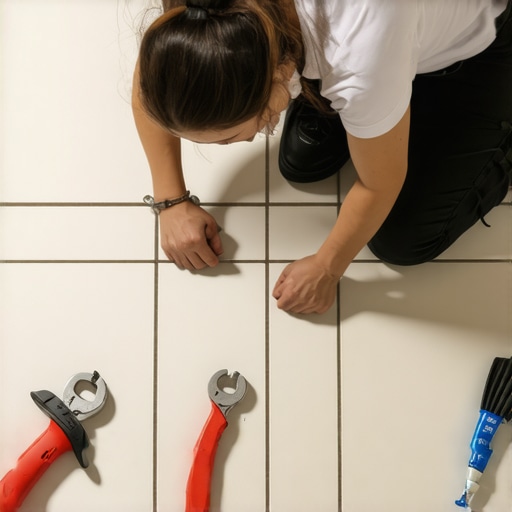
The subfloor secret no one tells you
A squeaky tile floor indicates subfloor deflection or fastener friction. To fix it, you must address the structural movement between the plywood and the joists. Thin-set cannot bridge a 1/8 inch dip without cracking. Total silence requires a rigid substrate that meets L/360 deflection standards for ceramic installations.
Most guys skip the leveling compound. They think the underlayment will hide the dip. It won’t. I spent three days grinding concrete on a job last month just so the floor wouldn’t click like a castanet. That experience taught me that what happens under the tile matters more than the ceramic itself. When you walk across a bathroom and hear that high-pitched chirp, you are hearing the sound of wood rubbing against wood or a nail rubbing against a joist. It is a mechanical failure. The bond between the tile and the floor has already begun to vibrate loose. If you ignore it, you will eventually find cracked grout lines or, worse, shattered tiles. This is not about aesthetics. This is about structural engineering at the feet of the homeowner. I have seen fifteen thousand dollar bathroom remodels ruined because an installer was too lazy to add a few more screws to the subfloor. You cannot hide a bad foundation with expensive Italian marble. It just makes the failure more expensive.
The mechanical failure of deflection limits
Deflection is the distance a floor bends under a specific load. For tile, the industry standard is L/360, meaning the floor should not bend more than the span length divided by 360. If your floor spans ten feet, it must not deflect more than one third of an inch under pressure.
When we talk about deflection, we are talking about the physics of the joist system. If your joists are spaced at 24 inches on center instead of the standard 16 inches, the plywood between those joists acts like a trampoline. Every time you step, the tile bends. But tile is a rigid material. It does not want to bend. It wants to stay flat. When the plywood bows, the thin-set mortar is stressed to its breaking point. Eventually, the bond shears off. This is where the squeak begins. The tile is now floating, held in place only by the surrounding grout. As you walk, the loose tile rubs against the mortar bed, creating a grinding noise. To prevent this, you need to calculate your joist span and the thickness of your subfloor. You might need to sister the joists or add a second layer of plywood. This second layer must be staggered and glued with a high-quality subfloor adhesive to create a monolithic structure. I prefer using screws every six inches on the perimeter and every eight inches in the field. This prevents the plywood from lifting and rubbing against the fasteners, which is the primary source of the squeak in timber-framed homes.
“A floor is only as good as the subfloor beneath it; deflection is the enemy of every joint.” – Master Flooring Axiom
Why thinset chemistry matters for silence
Modified thin-set mortars contain polymers that increase the bond strength and provide a slight amount of flexibility. This chemistry is vital for absorbing the micro-vibrations that cause squeaks. Using an unmodified mortar on a wooden subfloor is a recipe for catastrophic bond failure and persistent noise.
The science of thin-set has changed dramatically in the last two decades. We used to just mix sand and cement. Now, we use high-performance polymers that create a chemical bridge between the tile and the substrate. This is important in bathrooms where moisture levels fluctuate. If the thin-set is too brittle, it will crack under the weight of a person or the shifting of the house. I always look for mortars that meet or exceed ANSI A118.4 standards. This ensures that the mortar has the shear strength to hold the tile while the wood beneath it expands and contracts. If you are hearing a clicking sound, it is likely that the mortar has separated from the back of the tile. This often happens if the installer didn’t back-butter the tile. Back-buttering is the process of applying a thin layer of mortar to the back of the tile before setting it into the notched bed on the floor. It ensures 100 percent coverage. Without this, you get air pockets. Air pockets are echo chambers for squeaks. They allow the tile to vibrate like the skin of a drum.
The role of joist friction in bathroom noise
Joist friction occurs when the subfloor nails have loosened over time, allowing the plywood to slide up and down the shaft of the nail. This friction creates the classic squeak. Replacing nails with structural screws and using subfloor adhesive is the only permanent solution for this mechanical noise.
I have spent hours in crawlspaces looking for the source of a squeak while someone walks above me. It is almost always a nail that has missed the joist or a nail that has pulled loose. In the humid environment of a bathroom, the wood swells and shrinks. This movement eventually pushes the nail out. When you step on the floor, the plywood moves down, and the nail stays still. The sound of the wood sliding against the metal is that piercing squeak. To fix this from above, you have to find the joists and drive screws through the subfloor into the framing. If the tile is already down, this is difficult. This is why the preparation phase is so vital. You have to ensure the subfloor is rock solid before a single drop of mortar is mixed. I recommend a screw-and-glue method. Use a polyurethane-based adhesive between the joist and the plywood, then secure it with 2.5-inch deck screws. This creates a bond that will not break even as the house settles.
Grout as a diagnostic tool for movement
Cracked or crumbling grout is a visual indicator of underlying movement in the subfloor. If you see cracks following the lines of your tiles, it means the floor is deflecting beyond its limit. Grout cannot hold a floor together; it can only fill the gaps between stable tiles.
When I walk into a bathroom and see hairline cracks in the grout, I know exactly what I am going to find underneath. It is usually a lack of thin-set coverage or a subfloor that is too thin. Grout is essentially just colored cement and sand. It has very little structural strength. If you are dealing with persistent grout issues, you might need to check out grout restoration secrets for long-lasting results to see if the problem can be mitigated. However, if the squeak remains, the grout will just crack again. Many people try to fix a squeak by shoving more grout into the crack. This is a waste of time. You are treating the symptom, not the disease. The disease is the movement. If you want a floor that stays quiet, you have to eliminate the movement. Once the floor is stabilized, you can use how to refresh grout without replacing it techniques to make it look new again. But never assume grout will stop a squeak. It is too brittle for that job.
A technical guide to plywood thickness
| Joist Spacing | Minimum Subfloor Thickness | Tile Type Compatibility |
|---|---|---|
| 12 Inches OC | 5/8 Inch Exterior Grade | Ceramic, Porcelain, Stone |
| 16 Inches OC | 3/4 Inch Exterior Grade | Ceramic, Porcelain |
| 19.2 Inches OC | 7/8 Inch Exterior Grade | Ceramic Only (Requires sistering) |
| 24 Inches OC | 1 1/8 Inch Exterior Grade | Not recommended without extra layer |
The table above shows the reality of floor physics. Most modern homes are built with 16-inch spacing. If your builder used 5/8 inch plywood, your floor is already at the limit. For a bathroom, where you have the weight of a tub and the vibration of plumbing, this is not enough. I always add a second layer of 1/2 inch cement backer board or a specialized uncoupling membrane. This adds the rigidity needed to kill the noise. If you are planning a renovation, look at showers with a style trendy ideas for small bathrooms to see how to integrate these structural changes into your design. A thicker floor might mean you need to adjust your thresholds, but it is worth it for a floor that doesn’t sound like a haunted house every time you go to the sink.
How showers affect subfloor integrity
Moisture from poorly sealed showers can seep into the subfloor, causing the wood to rot and fasteners to fail. Once the wood loses its structural density, it can no longer hold screws tightly, leading to massive squeaks and floor failure.
Water is the enemy of a quiet floor. In the bathroom, the area around the shower is the most common spot for squeaks. This is because the high humidity and occasional leaks soften the plywood. When the wood gets soft, the screws lose their bite. The floor begins to move, and the squeaks begin. If you are noticing noise near your shower, you need to check for leaks immediately. You should look into tile cleaning tips for a sparkling bathroom in 2025 to keep your surfaces sealed and protected. A well-maintained shower prevents the moisture migration that destroys subfloors. I have seen subfloors that were so rotted from a small shower leak that I could put my screwdriver through them with one hand. No amount of screws will fix a rotted floor. You have to cut out the bad wood and replace it with fresh, dry plywood before you can even think about laying tile.
Baseboard transitions and perimeter relief
An expansion gap at the perimeter is mandatory for all tile installations. If the tile is jammed tight against the wall, it has no room to expand. This pressure causes the floor to tent and squeak as it rubs against the baseboards or the wall studs.
I always leave a 1/4 inch gap around the edge of the room. This gap is hidden by the baseboards. If you skip this, the house will move, and your floor will have nowhere to go. It will push against the walls, creating internal stress that eventually manifests as noise or cracked grout. When you are finishing your room, you can explore baseboards makeover ideas to elevate your space to find a style that covers this expansion gap while looking great. The baseboard should be nailed to the wall, not the floor. If you nail the baseboard into the floor, you are pinning the floor down and preventing its natural movement. This often results in a squeak right at the edge of the room. It is a small detail, but it is the difference between a professional job and an amateur one. The perimeter is the relief valve for the entire flooring system.
The ultimate checklist for silent tiles
- Verify joist spacing and plywood thickness before starting.
- Apply subfloor adhesive to joists before laying plywood.
- Use structural screws every 6 inches on the perimeter.
- Install a 1/4 inch expansion gap at all walls.
- Back-butter every tile to ensure 100 percent mortar coverage.
- Use a polymer-modified thin-set for better bond flexibility.
- Ensure the subfloor moisture content is below 12 percent before tiling.
- Never nail baseboards into the floor surface.
The 1/8 inch that ruins everything is usually a small dip in the subfloor that was ignored. While most people want the thickest underlayment, too much cushion actually causes the locking mechanisms on modern tile-simulating floors to snap under pressure, or in the case of real tile, it causes the grout to pulverize. You want a rigid system. You want a system that acts as one solid unit. If you follow these steps, you will have a bathroom that stays quiet for decades. It takes more work and more material. It requires you to spend more time on your knees with a level and a drill. But the result is a floor that doesn’t talk back when you walk on it. That is the mark of a master installer. It is the invisible quality that defines a truly professional job.