
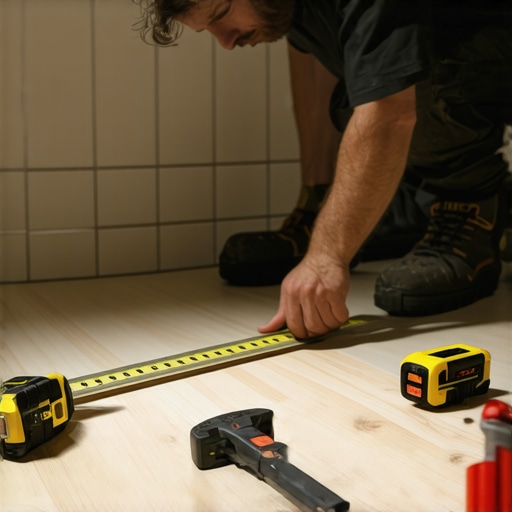
The lie of the level subfloor
Scribing baseboards to a wonky bathroom floor involves transferring the exact profile of the uneven floor onto the wood using a compass or scriber. This technique eliminates gaps by cutting the bottom of the trim to mirror the floor’s hills and valleys. It is a fundamental skill for high-end carpentry. Most guys skip the leveling compound. They think the underlayment will hide the dip. It won’t. I spent three days grinding concrete on a job last month just so the floor wouldn’t click like a castanet. I once walked into a house where a expensive wide-plank walnut floor was cupping so bad it looked like a potato chip because the installer didn’t check the crawlspace humidity. Most people treat baseboards as an afterthought, but in a bathroom, where showers and grout lines create a rigid grid, a gap under a baseboard looks like a canyon. You smell the sawdust and the WD-40 on my hands, and you know I have seen it all. I have seen tile jobs ruined by a single sixteenth of an inch. When you are dealing with a bathroom, you are dealing with moisture, shifting slabs, and the inevitable settling of a home. If you want chic baseboard designs that transform rooms in 2025, you have to master the scribe. It is not about beauty. It is about engineering. A floor is a performance surface. If the baseboard does not sit flush, moisture from the shower will find its way under the wall. That leads to mold, rot, and a phone call I do not want to take.
Why your subfloor is lying to you
Subfloor deflection and slab settlement occur over decades, creating a surface that is rarely as flat as it appears to the naked eye. In bathrooms, the weight of heavy tile and the constant presence of moisture through grout joints can exacerbate these minor dips. Most homeowners assume that a new tile installation will fix a wonky floor. It actually highlights it. When I walk onto a site, I do not trust my eyes. I trust a ten-foot straightedge and a laser level. Wood is a living material. Even in baseboards makeover ideas to elevate your space, you must account for the hygroscopic nature of the material. Wood expands and contracts. Concrete breathes moisture. If your baseboard is a straight line sitting on a curved floor, you have a structural failure in the making. The gap is not just an eyesore. It is a vacuum for dust and a highway for silverfish. You need to understand the physics of the house. Is the joist spacing correct? Is there a mid-span support that is pushing up a single point in the floor? I have seen floors that looked like a motocross track. You cannot fix that with caulk. Caulk is for amateurs who want to hide their mistakes. Scribing is for mechanics who want to eliminate them.
“A floor is only as good as the subfloor beneath it; deflection is the enemy of every joint.” – Master Flooring Axiom
The gear that makes the pro
Professional scribing tools range from simple school compasses to specialized offset gauges designed for the high-end carpenter. To get a perfect fit against tile, you need a tool that can lock its position and not flex under pressure. I prefer a solid brass scriber with a locking nut. The lead needs to be a 2H or harder. If the lead is too soft, the line gets thick, and a thick line is a guess. In the world of flooring, a guess is a mistake. You also need a jigsaw with a scroll blade. A standard wood blade will chew up the fibers and leave a ragged edge. I use a 20-tooth-per-inch blade to ensure the cut is as smooth as a planed edge. Before you even touch the wood, you should be looking at tile cleaning tips for a sparkling bathroom in 2025 to ensure the surface you are scribing against is free of debris. A single grain of sand under your compass will throw the whole line off by a thirty-second of an inch. That is the difference between a tight fit and a visible gap. Here is how the tools stack up in a real world scenario.
| Tool Type | Precision Level | Best Use Case | Durability |
|---|---|---|---|
| School Compass | Medium | Softwood trim | Low |
| Brass Pro Scriber | High | Hardwood and Tile | High |
| Log Scriber | Extreme | Heavy timber and logs | Very High |
| AccuScribe Gauge | High | Universal applications | Medium |
The 1/8 inch that ruins everything
Expansion gaps and perimeter tolerances are required by every flooring manufacturer to prevent buckling and tenting as temperatures change. However, people often confuse an expansion gap with a sloppy install. In a bathroom, you are often working around showers that wow, where the tile meets the wall in a complex transition. If your grout is thick, the baseboard might sit on a high point. If you do not scribe, the baseboard will teeter. It will rock back and forth. Every time someone steps near the wall, that baseboard will move. Eventually, the nails will pull out of the studs. The physics of leverage are not on your side. You must ensure the baseboard is making continuous contact with the floor along its entire length while still allowing the floor to expand underneath it. This is why we back-bevel the cut. When you cut the bottom of the baseboard, you do not cut it at a ninety-degree angle. You tilt the jigsaw to about five degrees. This creates a sharp point at the front of the board that makes contact with the floor, while the back is hollowed out. This makes it much easier to fine-tune the fit with a block plane or a rasp. It is about creating a microscopic point of contact that defies the imperfections of the subfloor.
The physics of the compass and the line
Mastering the scribe line requires a steady hand and a deep understanding of geometry. You start by leveling the baseboard. You do not just drop it on the floor. You hold it against the wall and put a level on the top edge. If the floor is dipping to the left, you lift the left side until the board is level. Then, you set your compass to the widest gap between the floor and the bottom of the board. This is where the magic happens. You drag the compass along the floor, and the pencil mimics every hump and dip on the surface of the wood. If you are dealing with showers with a style that involves textured stone, this process is even more demanding. The pencil will jump and skip on the stone texture. You have to be firm. You have to be precise. Once the line is drawn, you have a map of the floor’s failures. Your job is to carve the wood to fit that map. I have seen guys try to do this with a belt sander. They end up with a wavy mess. You need a jigsaw and a steady eye. You follow the line like a surgeon. If you veer off by a hair, you start over with a new piece of trim. There are no shortcuts in high-end carpentry. You either do it right, or you do it twice.
“Modern tile standards require a surface variation of no more than 1/8 inch over 10 feet; the baseboard is the final judge of that standard.” – TCNA Installation Handbook Paraphrase
The chemistry of moisture and wood movement
Wood fiber saturation and cellular expansion are the silent killers of bathroom trim. Even if you scribe the board perfectly, if you do not seal the bottom of that cut, the wood will suck up moisture like a straw. Bathrooms are high-humidity environments. Every time someone takes a shower, the air is saturated. If that moisture gets into the end grain of your baseboard, it will swell. When it swells, your perfect scribe job will distort. I always use a high-quality primer or a clear sealer on the bottom edge of the board after I have made my cut. It is a mandatory step. You are creating a moisture barrier at the molecular level. This is especially vital if you have grout restoration secrets in play, as new grout can release moisture as it cures. You also need to consider the adhesive. I do not just nail baseboards. I use a bead of polyurethane adhesive on the back. It has a higher shear strength than standard PVA glues and it resists moisture better. It binds the wood to the drywall in a way that mechanical fasteners alone cannot. It is about creating a unified structural assembly that can withstand the rigors of a damp environment.
Scribing step by step with zero room for error
Achieving a gap-free installation requires a disciplined workflow that prioritizes accuracy over speed. Follow this checklist to ensure your bathroom baseboards are installed to professional standards. These steps are what separate a master from a handyman. Most people want to rush to the finish, but the finish is only as good as the preparation. If you find your grout is uneven, you might need to address that before you even start the scribe. Use how to refresh grout without replacing it techniques to ensure a smooth transition area. Once the floor is ready, proceed with the mechanical execution of the scribe.
- Inspect the subfloor for major humps and use a grinder or leveling compound if the variation exceeds 1/4 inch.
- Place the baseboard against the wall and use shims to get the top edge perfectly level.
- Set your scribing tool to the maximum gap height and lock the adjustment nut tightly.
- Draw the scribe line with a sharp 2H pencil, keeping the tool perpendicular to the wall at all times.
- Cut the board with a jigsaw, using a back-bevel of 5 degrees to ensure the front edge makes first contact.
- Test fit the board and use a block plane or 80-grit sandpaper to remove high spots for a vacuum-tight fit.
- Seal the freshly cut bottom edge with a waterproof primer to prevent moisture wicking.
- Apply a bead of polyurethane adhesive to the back and nail into the wall studs with 2-inch finish nails.
The final fit and finishing touch
Evaluating the finished scribe is the moment of truth for any flooring mechanic. When you drop that board into place, it should snap into position. There should be no visible light under the board. If you see light, you have failed. I do not care if it is a bathroom in a basement or a penthouse. The standard is the same. Perfection is the only acceptable outcome. After the board is nailed, you may need a tiny bead of color-matched caulk if the tile has a heavy texture, but the goal is to use as little as possible. You want the wood to look like it grew out of the floor. If you have followed eco-friendly tile solutions for sustainable homes in 2025, you probably have a high-quality surface that deserves a high-quality finish. My hands might be rough and my knees might ache, but when I stand up and look at a baseboard that is perfectly flush against a wonky floor, I know I have done my job. It is not just about aesthetics. It is about the integrity of the home. It is about knowing that the moisture will stay where it belongs and the wood will stay where I put it. That is what it means to be a Master Floor Installer. You do the hard work that no one sees so that the final result is something they can never forget. Check our privacy policy or contact us if you have more questions about high-end installations. Stay sharp and keep your pencil sharper.