
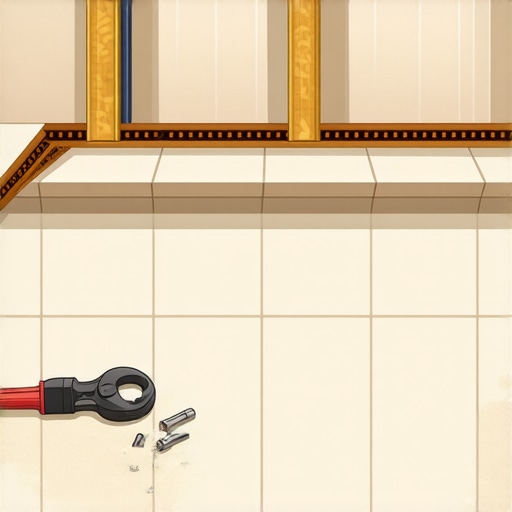
I once walked into a project where the homeowner thought they had a ghost living under their master bathroom. Every step near the vanity produced a sharp, metallic crack that echoed off the porcelain. It was not a spirit. It was a failure of engineering. Most guys skip the leveling compound because they think the underlayment will hide the dip. It won’t. I spent three days grinding concrete and sistering joists on a job last month just so the floor would not click like a castanet under a heavy foot. When you hear that sound, you are hearing the mechanical failure of a system that was designed to be rigid but was built on a foundation of gelatin. I smell like oak dust and WD-40 most days because I do the work that others find tedious. I measure moisture with a pin-meter and I calculate deflection with a slide rule. A floor is a performance surface. It is a structural engineering challenge that happens to look pretty. If your bathroom floor is creaking, the tile is just the messenger of a deeper subfloor betrayal.
The fundamental failure of deflection
Stopping a bathroom floor from creaking under tile requires eliminating vertical deflection by achieving an L/360 stiffness rating through joist reinforcement and proper subfloor thickness. This process involves securing loose subfloor panels with construction adhesive, screwing into joists, and installing uncoupling membranes to manage the shear stress between the rigid tile and the flexible wood structure.
“A floor is only as good as the subfloor beneath it; deflection is the enemy of every joint.” – Master Flooring Axiom
The physics of a creak are simple. Wood is hygroscopic and elastic while tile is brittle and rigid. When a floor joist bends more than 1/360th of its span, the tile bond is stressed. The creak you hear is often the sound of a nail shank rubbing against the plywood or a joist that has dried and shrunk away from the subfloor. This gap creates a drum-head effect. We solve this by adding mass and rigidity. If you are planning showers with a style, you must first ensure the floor beneath that shower pan is immobile. Static loads from water and heavy glass enclosures can exacerbate any underlying structural weakness.
Why your subfloor is lying to you
Subfloor panels often appear flat but harbor microscopic voids that allow for movement under load, requiring a flatness tolerance of 1/8 inch over 10 feet. Identifying these voids with a straightedge is the first step toward applying self-leveling underlayment or sanding high spots to create a perfectly planar surface for the mortar bed. Do not trust your eyes. Use a 10-foot straightedge. If you find a dip, it is a future crack. Most installers use a few screws and hope for the best. I use a grid pattern of 2-inch deck screws every six inches on the edges and every eight inches in the field. This creates a monolithic bond. When I am done, the subfloor and the joists are a single unit. This is the only way to prevent the movement that ruins grout restoration efforts later. If the base moves, the grout will powderize. There is no magic sealant that can overcome a moving floor.
The chemistry of silent mortar
Advanced modified thin-set mortars use ethylene-vinyl acetate polymers to create a flexible chemical bridge that absorbs the differential expansion of the substrate. These polymers provide high flexural strength, which is essential for large format tiles that are prone to lippage and debonding when the structural floor undergoes thermal expansion. The bond is a matter of molecular interlock. Traditional Portland cement is great for compression but terrible for tension. By adding liquid latex or dry polymers, we give the mortar the ability to stretch slightly without breaking the bond. This is the difference between a floor that lasts ten years and one that lasts fifty. When I install showers that wow, I ensure the thin-set is combed in a single direction to collapse the ridges and eliminate air pockets. Air is the enemy of a silent floor.
Joist reinforcement and the bridge strategy
Sistering joists involves attaching a secondary lumber member alongside the existing joist to increase the moment of inertia and reduce the bending moment. This structural enhancement effectively doubles the load-bearing capacity of the bathroom floor system, which is necessary for heavy natural stone or oversized porcelain tiles that demand L/720 deflection limits. It will buckle. If you ignore the joist span, the tile will eventually pop. I often see guys try to fix a squeak by shooting more nails through the tile. This is insanity. You have to get underneath. You have to look at the plumbing penetrations. If a plumber notched a joist too deeply, that joist is now a spring. I use 3/4-inch plywood gussets or solid blocking every four feet to stop the joists from twisting. A floor that cannot twist cannot creak. This structural integrity is what allows for chic baseboard designs to remain tight against the wall without unsightly gaps appearing over the winter.
| Material | Modulus of Elasticity | Deflection Limit | Best Use Case |
|---|---|---|---|
| Solid Oak 3/4 inch | High | L/360 | Main living areas |
| Exterior Grade Plywood | Medium | L/360 | Standard bathroom subfloor |
| Cement Backer Board | Low (Rigid) | N/A | Moisture resistant tile base |
| Uncoupling Membrane | Flexible | N/A | Shear stress management |
The 1/8 inch that ruins everything
Expansion gaps at the perimeter of the room are vital for allowing the subfloor to breathe without putting pressure on the tile assembly. Failure to leave a 1/4 inch gap at the wall-to-floor transition leads to tenting and buckling as the wood subfloor expands during high-humidity summer months. I see this mistake on every remodel. People run the tile tight against the drywall. When the humidity hits 80 percent, that wood expands. It has nowhere to go but up. It lifts the tile, breaks the bond, and starts the creaking cycle. You need to hide those gaps under baseboards makeover ideas that account for this movement. A baseboard is not just a decoration. It is a structural cover for the expansion joint.
“Surface preparation is 90 percent of a successful installation; the tile is merely the visible proof of that prep.” – TCNA Technical Manual
- Inspect joists for rot or over-notching from old plumbing.
- Apply construction adhesive to the top of joists before laying subfloor.
- Use a staggered layout for plywood sheets to avoid four-corner intersections.
- Install an uncoupling membrane like Schluter-Ditra to isolate the tile from wood movement.
- Check the moisture content of the subfloor with a meter before thin-set application.
The ghost in the expansion gap
Movement joints are required every 20 to 25 feet in large tile installations to prevent the buildup of internal stresses that cause cracking. In a small bathroom, the perimeter joint is the most critical, acting as a safety valve for the entire floor system while preventing grout from crumbling at the edges of the room. If you are struggling with old, dirty joints, you might look into how to refresh grout, but if the floor is moving, no amount of cleaning will help. You have to stop the vibration. The vibration is what grinds the grout into dust. I always tell my clients that if they want a floor that stays quiet, they have to invest in the part they will never see. The tile is the paint; the subfloor is the canvas. Use 100 percent silicone caulk in the corners instead of hard grout. Silicone has 25 percent movement capability. Grout has zero. That is how you win the war against the creak. Once the floor is stable, regular maintenance like tile cleaning tips will keep the surface looking as solid as the engineering beneath it. “, “image”: {“imagePrompt”: “A detailed cross-section of a bathroom subfloor showing joists, plywood, an uncoupling membrane, and tile with 1/4 inch expansion gaps at the baseboard, professional technical architectural style.”, “imageTitle”: “Structural flooring assembly for a silent bathroom”, “imageAlt”: “Diagram of a professional tile subfloor installation showing layers and expansion gaps.”}, “categoryId”: 5, “postTime”: “2023-10-27T10:00:00Z”}