
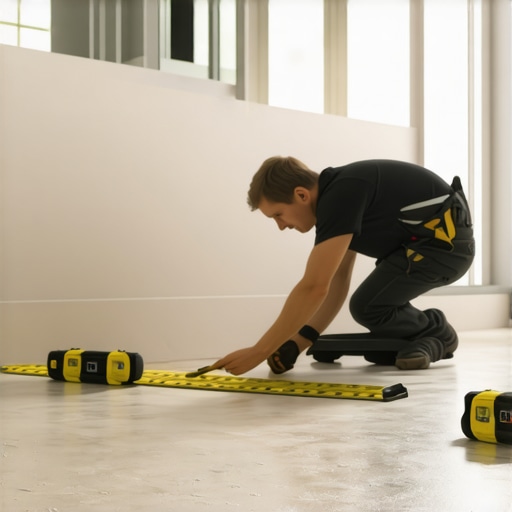
Why a Deflection Test is the Only Way to Save Your Bathroom Floor
Most guys skip the leveling compound. They think the underlayment will hide the dip. It won’t. I spent three days grinding concrete on a job last month just so the floor wouldn’t click like a castanet. That job was supposed to be a simple porcelain install, but the slab was a roller coaster. If I had just slapped tile down, the grout would have turned to powder within six months because the subfloor was flexing like a trampoline every time someone walked to the sink. You can buy the most expensive showers and the highest-grade tile, but if you do not understand the physics of deflection, you are just throwing money into a dumpster. I have been doing this for twenty-five years, and I still carry a straightedge and a moisture meter. The smell of sawdust and floor wax is my daily reality, and it has taught me that the surface is only a lie told by the structure underneath.
The physics of the invisible bounce
Deflection testing measures the vertical movement of a floor system under a concentrated load. For ceramic tile, the TCNA requires a maximum deflection of L/360, while natural stone requires L/720. This ensures the subfloor stiffness prevents grout cracking and tile delamination during bathroom renovations. If your joists are too long or too thin, the floor will flex beyond the capacity of your adhesive. Imagine a sheet of glass glued to a piece of rubber. When the rubber bends, the glass snaps. Your tile is the glass, and your subfloor is the rubber. Most installers assume that because a floor feels solid under their boots, it is ready for showers or heavy tubs. They are wrong. A static load like a cast-iron tub full of water exerts hundreds of pounds of pressure, and a dynamic load, like a person walking, adds impact force. If the joist span is even a half-inch too long for its species and grade, the resulting movement will shear the crystalline bonds of the thin-set mortar. This is why understanding eco-friendly tile solutions for sustainable homes in 2025 requires first mastering the structural foundation.
Why joist spacing dictates your grout line survival
Joist spacing and span length determine the modulus of elasticity of your flooring system. Standard 16-inch centers with 2×10 joists may meet building codes for live loads, but they often fail the L/360 deflection standard required for durable tile installations. Checking the joist species is vital for floor rigidity. If you have southern yellow pine, you have more strength than spruce or fir. You need to crawl into the basement or the crawlspace with a flashlight and a tape measure. Look at the stamps on the wood. If you see cracks or knots in the center third of the span, your deflection is going to be higher than the math suggests. When the floor moves, the grout is the first thing to fail. It turns into a fine dust that works its way out of the joints. You might think you just need a better sealer, but you actually need a stiffer floor. You can learn about grout restoration secrets for long-lasting results, but no restoration can fix a structural bounce.
“A floor is only as good as the subfloor beneath it; deflection is the enemy of every joint.” – Master Flooring Axiom
The mathematics of L over 360
The L/360 formula represents the length of the span in inches divided by 360. For a ten-foot span, this allows only one-third of an inch of vertical movement. Stiffening a subfloor involves adding blocking, sistering joists, or installing a second layer of exterior-grade plywood to reduce inter-joist flex. If your span is 12 feet, that is 144 inches. Divide that by 360 and you get 0.4 inches. That sounds like a tiny amount, but for a rigid material like porcelain, it is a tectonic shift. If you are planning showers that wow, you have to account for the weight of the mud bed and the water. A heavy shower pan can cause a localized dip that pulls the baseboards away from the wall, creating gaps that look like amateur hour. I have seen baseboards snap at the corners because the floor dropped a quarter inch under the weight of a new walk-in shower. Check your math before you buy your thin-set.
| Material Type | Required Deflection Limit | Maximum Flex (10ft Span) |
|---|---|---|
| Ceramic Tile | L/360 | 0.33 inches |
| Porcelain Tile | L/360 | 0.33 inches |
| Natural Stone | L/720 | 0.16 inches |
| Glass Tile | L/720 | 0.16 inches |
Understanding the chemistry of thin set failure
Polymer-modified thin-set is designed to handle minor shear stresses, but it cannot compensate for structural deflection. The chemical bond between the cementitious mortar and the tile backer board will break if the tensile strength is exceeded. Using C2TS1 rated adhesives provides improved deformation capabilities for modern bathrooms. When you mix that bag of thin-set, you are triggering a chemical reaction that creates microscopic crystals. These crystals grow into the pores of the tile and the substrate. If the substrate moves while those crystals are brittle, they snap. This is called debonding. You won’t see it immediately. You will just notice that your floor starts to squeak or that a tile sounds hollow when you tap it with your knuckle. If you are curious about maintenance, you can look into tile cleaning tips for a sparkling bathroom in 2025, but even the cleanest tile will pop if the chemistry fails.
The checklist for a zero movement floor
Achieving a rigid substrate requires a comprehensive inspection of the subfloor assembly. You must verify plywood thickness, ensure screw patterns follow industry standards, and use a straightedge to find low spots. This checklist ensures your tile installation remains crack-free for decades in high-moisture bathroom environments.
- Check joist span and species against the TCNA calculator.
- Verify subfloor thickness is at least 5/8 inch (3/4 inch preferred).
- Ensure all plywood edges are blocked or tongue-and-groove.
- Check for 1/8 inch expansion gaps between subfloor sheets.
- Use a 10-foot straightedge to find dips exceeding 1/8 inch.
- Inspect the crawlspace for moisture or rot in the rim joists.
If you miss even one of these, you are gambling. I always tell my clients that the pretty stuff is the easy part. The hard part is the wood and the screws. If you want chic baseboard designs that transform rooms in 2025, you need a level floor so the wood sits flush against the surface without huge caulk lines.
Why a thicker underlayment is often your enemy
Excessive underlayment thickness can actually increase deflection by creating compressive instability. While a thick pad might seem cushioned, it allows the locking mechanisms of LVP or the grout joints of tile to snap under pressure. A solid, thin substrate is always superior to a spongy, thick layer for structural integrity. This is a contrarian point that many big-box store employees get wrong. They want to sell you the most expensive, thickest foam they have. But if that foam has too much ‘give,’ the vertical movement will destroy the floor. In a bathroom, you want a 1/4 inch or 1/2 inch cement board that is glued and screwed to the plywood. The glue fills the microscopic gaps, and the screws provide the clamping pressure. This creates a monolithic slab that moves as one unit rather than separate layers rubbing against each other.
“Deflection is not just about the weight it can hold, but how much it bends while holding it.” – TCNA Handbook Commentary
The ghost in the expansion gap
Perimeter expansion gaps are required for tile and stone to prevent tenting. Without a silicone-filled movement joint at the baseboards, the thermal expansion of the subfloor will force the tile field to buckle upward. This structural requirement is often overlooked in small bathroom remodels. Wood expands and contracts with the seasons. If you live in a place with high humidity like the Gulf Coast, your subfloor will grow in the summer. If you have jammed your tile tight against the wall studs, there is nowhere for that energy to go. The floor will heave in the middle. You need to leave at least a 1/4 inch gap at the walls and cover it with your baseboards. If you need inspiration, check baseboards makeover ideas to elevate your space to see how to hide those essential gaps properly.
How regional humidity warps your structural calculations
Regional climate conditions significantly impact subfloor moisture content and deflection. In humid environments, the wood fibers swell, which can reduce stiffness or cause plywood delamination. Installers must use a pin-type moisture meter to ensure the subfloor is within 2 to 4 percent of the hardwood or tile substrate before thin-set application. If you are in the Pacific Northwest, your wood is likely holding more water than a slab in the Mojave. If you seal that moisture in with a waterproofing membrane like Schluter-Kerdi, you might trap it. This can lead to rot from the inside out. Always allow your materials to acclimate in the room where they will be installed for at least 72 hours. This is not a suggestion. It is a requirement for anyone who values their reputation. For those looking to update their existing floors without a full tear-out, learning how to refresh grout without replacing it is useful, but it won’t save a floor that was installed on wet wood.
The 1/8 inch that ruins everything
Floor flatness is not the same as floor levelness, but both are critical for tile. A 1/8 inch dip over ten feet can cause large format tiles to lippage, creating tripping hazards and aesthetic failures in modern showers. Use self-leveling underlayment (SLU) to create a planar surface that meets ANSI standards. Most homeowners think they can ‘back-butter’ their way out of a dip. They think they can just put a little extra mortar under the low tile. But mortar is not a filler. It shrinks as it cures. If one tile has a 1/2 inch of mortar and the next has 1/8 inch, they will dry at different rates and pull the tiles to different heights. You will end up with a toe-stubber. Take the time to grind the high spots and fill the low spots. It is dusty, miserable work, but it is the difference between a master and a hack. If you find yourself in a mess, you can always contact us for professional guidance, but doing it right the first time is cheaper.
Ultimately, a bathroom floor is a piece of engineering. You have plumbing penetrations, heavy fixtures, and constant moisture cycles. If you treat it like a craft project, it will fail. If you treat it like a structural challenge, it will last longer than the house. Don’t be the person who calls me in three years to fix a cracked floor because you didn’t want to spend an afternoon checking your joists. Use your level. Use your brain. Protect your grout, your tile, and your showers by respecting the physics of the bounce.