
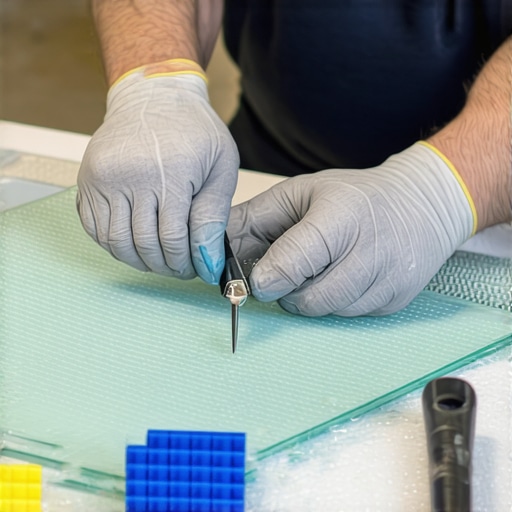
The physics of the perfect glass tile cut
I remember a job back in 2004 that still haunts me. A designer had ordered five hundred square feet of custom hand-poured glass mosaics from an artisan in Italy. The installer before me, a guy who usually slapped down subway tile for tract homes, tried to use a standard wet saw with a generic porcelain blade. He shattered nearly thirty percent of the first crate before the homeowner fired him. I walked onto that jobsite and smelled the distinct metallic tang of a scorched blade and the wet, gritty scent of pulverized glass. It was a massacre. The problem is that most people treat glass like it is just a shinier version of ceramic. It is not. Glass is an amorphous solid. It does not have a crystalline structure to guide a fracture. It is a liquid that is moving so slowly it appears solid. When you hit it with a high-speed diamond blade, you are not just cutting material, you are managing a thermal and mechanical shockwave that wants to radiate through the entire piece. If you do not respect the physics of that energy transfer, the glass will win every single time. It will chip, it will spider, or it will simply explode under the tension of the blade. I spent the next two weeks meticulously dressing my blades and calibrating the water flow to save that project. This is the level of obsession required for high-end glass work.
The amorphous solid and the physics of the fracture
To cut glass tiles without cracking you must control the heat generated by the friction of the diamond blade and the mechanical vibrations of the saw motor. Using a continuous rim glass blade with a high grit count is necessary because it minimizes the impact energy delivered to the glass edge. Glass does not behave like stone. When you cut granite, the mineral grains provide a path for stress. Glass has no such path. It is a state of matter that lacks long-range order. This means that any micro-fracture created at the point of contact can travel in any direction. When the blade rotates at 3,450 RPM, it creates a series of rapid-fire micro-impacts. If the blade is too coarse, those impacts are like hammer blows. You need a blade where the diamonds are so small they act more like sandpaper than a saw. I always look for a blade specifically labeled for glass with a grit rating of at least 200 or higher. This ensures that each pass of the diamond removes only a microscopic amount of material, reducing the torque applied to the tile body.
“Glass tile must be cut in a manner that minimizes internal stress and heat buildup; the edge must remain cool to prevent spontaneous fracture.” – TCNA Handbook for Ceramic, Glass, and Stone Tile Installation
The cooling system failure that ruins everything
Water flow is the single most important factor in maintaining the integrity of a glass tile edge during a cut. The water acts as both a lubricant to reduce friction and a heat sink to absorb the thermal energy generated at the diamond interface where temperatures can spike instantly. Most installers just turn on the pump and assume it is working. I check the nozzles every thirty minutes. If the water is not hitting both sides of the blade simultaneously, you get uneven cooling. This creates a thermal gradient across the thickness of the glass. The side of the glass that is hot expands, while the side being cooled by the water stays contracted. That internal tension is what causes the glass to crack halfway through the cut. You also need to ensure the water is clean. Recirculating water that is full of glass slurry acts like liquid sandpaper on the sides of your cut, causing chips. I prefer a fresh water feed for all glass work. It keeps the blade clean and ensures the lowest possible friction coefficient. If you are working in a region with high minerals in the water, use a filter to prevent scale buildup on your diamond edge. For those planning a full bathroom overhaul, check out showers that wow modern designs for 2025 to see how glass can be integrated with professional precision.
The truth about diamond blade grit and bonding
Choosing a blade for glass requires understanding the bond hardness of the metal matrix that holds the diamonds in place. A soft bond is required for glass because it allows new, sharp diamonds to be exposed as the old ones wear down, preventing the blade from glazing over. If you use a blade designed for concrete or hard porcelain, the bond is too tough. The diamonds get rounded off, but the metal matrix does not wear away to reveal new ones. The blade becomes dull and starts to generate massive amounts of heat. I can always tell when a blade is glazed because it starts to scream. A sharp glass blade should make a consistent, low-frequency hum. When it starts to high-pitched whistle, you are rubbing, not cutting. I keep a dressing stone, which is just a block of silicon carbide, next to my saw. Every five cuts, I run the blade through the stone to strip away a layer of metal and expose fresh diamond. This keeps the cutting action aggressive but smooth. This is especially important when dealing with eco-friendly tile solutions for sustainable homes in 2025 where recycled glass materials might have varying densities and melting points.
[image_placeholder]
Masking tape as a mechanical stabilizer
Applying a high-quality masking tape or painter’s tape along the cut line provides a mechanical dampening effect that reduces surface vibration at the point of blade entry. The tape also serves as a visual guide that prevents the glass surface from splintering as the diamond grit exits the cut. I have seen guys skip this step because they think it is for amateurs. They are wrong. Even the most expensive wet saw has a tiny amount of run-out or wobble in the arbor. That wobble translates into lateral vibration. Tape helps hold the surface tension of the glass together. I also find it helpful for marking my lines with a fine-point sharpie. A pencil line on glass is useless once the water starts spraying. I apply the tape to both the front and back of the tile. Cutting the back side of the glass is often where the most chipping occurs because the blade is exiting the material. By taping the back, you provide a sacrificial layer that the blade passes through, keeping the glass edge crisp. This technique is vital when you are trying to match the clean lines of chic baseboard designs that transform rooms in 2025 during a transition.
The back-cut method for high-end results
The back-cut technique involves cutting the last half-inch of the tile first and then flipping the tile or reversing the direction to complete the cut from the opposite end. This prevents the weight of the tile or the pressure of the blade from snapping the corner as you finish the pass. This is the secret of the masters. Most cracks happen in the last ten percent of the cut. As the blade nears the end of the tile, there is less material left to support the vibration. The glass becomes weak and the blade pressure causes it to snap prematurely. By making a small notch at the end of your cut line first, you create a point of relief. When you come back through from the other side, the two cuts meet in the middle, and the stress is dissipated into the air rather than into the glass body. It takes twice as long, but it saves the tile. If you are doing a complex layout with mosaic glass, this method is the only way to ensure you do not ruin an entire sheet just because one tile at the edge blew out.
Managing the edge with grout and trim
Proper grout selection and application are necessary to hide minor imperfections and to protect the delicate edges of glass tile from future stress fractures caused by building movement. Sanded grout should never be used with glass because the silica sand will scratch the polished surface during the floating process. Use high-performance non-sanded grout or an epoxy-based grout. Epoxy is particularly good because it adds structural strength to the assembly. It is also important to leave a proper expansion gap at the perimeter. Glass expands and contracts at a different rate than the subfloor or the wall studs. If you butt glass tile tight against a corner or a tub flange, it will eventually crack as the house settles. I always leave a sixteenth of an inch gap and fill it with a color-matched 100 percent silicone sealant. If your grout is looking tired after a few years, you should look into how to refresh grout without replacing it to keep the installation looking like new. For long-term maintenance of these delicate surfaces, following tile cleaning tips for a sparkling bathroom in 2025 will prevent abrasive damage.
| Material Type | Blade Type | Grit Rating | Cutting Speed |
|---|---|---|---|
| Glass Tile | Continuous Rim Diamond | 200-400 | Very Slow |
| Ceramic Tile | Standard Wet Blade | 80-120 | Moderate |
| Porcelain Tile | J-Slot or Mesh Rim | 120-150 | Slow |
| Natural Stone | Segmented Rim | 60-100 | Moderate |
The master installer pre-cut routine
- Inspect the saw arbor for any lateral movement or wobble before starting.
- Ensure the water reservoir is filled with clean, cold water and the pump is clear of debris.
- Dress the diamond blade with a silicon carbide stone to expose fresh cutting surfaces.
- Apply blue painter’s tape to both the face and the back of the tile along the cut line.
- Mark the cut line accurately with a waterproof fine-point marker.
- Check that the saw table is perfectly square to the blade to avoid binding.
- Make a shallow relief cut on the back end of the tile before starting the main pass.
If you find that the project is becoming too complex or you are losing too much material to breakage, do not hesitate to reach out to a professional through our contact us page. Sometimes the cost of the wasted glass tile exceeds the cost of a professional installer who has the right industrial-grade equipment. Precision is not an accident. It is the result of proper chemistry, physics, and a lot of patience on the jobsite. Never rush a glass cut. The moment you try to force the blade is the moment you lose the tile.