
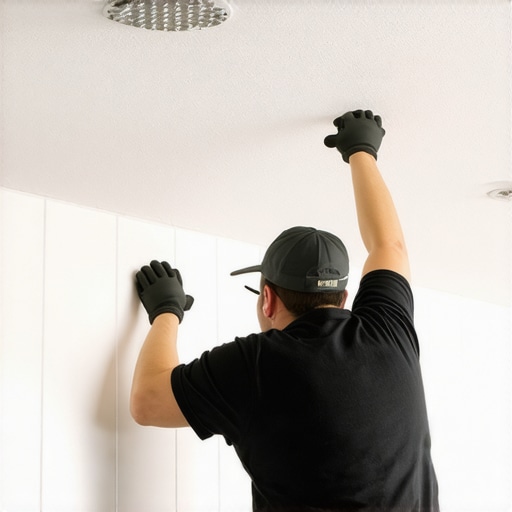
Most guys skip the leveling compound. They think the underlayment will hide the dip. It won’t. I spent three days grinding concrete on a job last month just so the floor wouldn’t click like a castanet. That same lazy logic applies to shower ceilings. If you think a few blobs of cheap thin-set will hold a twelve by twenty-four porcelain plank over your head while you are soaping up, you are in for a violent awakening. I have seen the aftermath of a ceiling failure. It is not just a mess of broken ceramic and grey mud. It is a structural failure that happens because someone ignored the basic physics of the mechanical bond. My boots have seen enough failed grout and cracked mud beds to know that gravity is the most consistent inspector in the business. He never misses a shift and he never accepts a bribe. To beat him, you have to understand the microscopic reality of what is happening between your substrate and your tile. We are talking about suction, capillary action, and the chemical cross-linking of polymers.
The myth of the flat ceiling substrate
To tile a shower ceiling successfully, you must ensure the substrate is perfectly flat within 1/8 inch over 10 feet. Use a cementitious backer board or a high-density waterproof foam board secured with specific fasteners every 6 inches. This provides the rigid foundation required for a permanent overhead bond. Most people assume their ceiling is flat because they cannot see the shadow lines. They are wrong. A ceiling is often the most neglected surface in a framing job. Joists twist and crowns vary. If you try to bridge a half-inch dip with extra mortar, you are creating a heavy pocket that will eventually pull away. This is about the dead load. Tile is heavy. Porcelain typically weighs between four and five pounds per square foot. When you add a half-inch of wet mortar, you are hanging a significant amount of weight from a surface that is fighting to let it go. You need to verify your studs are plumb and your joists are level before the first sheet of backer board goes up. If the framing is off, your tile job is doomed before you open the first bag of thin-set.
“A floor is only as good as the subfloor beneath it; deflection is the enemy of every joint.” – Master Flooring Axiom
The chemistry of suction and the vacuum effect
Achieving a gravity-defying bond requires a thixotropic polymer-modified thin-set mortar that meets ANSI A118.15 standards. This adhesive provides the high initial tack and non-sag properties necessary to hold heavy tiles in place without mechanical support. Proper mixing and back-buttering the tile are the most vital steps for overhead work. When you press a tile into a combed bed of mortar, you are not just sticking it there. You are creating thousands of tiny vacuum seals. This is the thixotropic effect. The mortar is fluid when you move it but becomes firm the moment you stop. If your mortar is too wet, the tile will drift. If it is too dry, the polymers will not wet out the back of the tile, and you will have zero bond. I always tell my crews that back-buttering is not an option for ceilings. You must apply a thin, flat coat of mortar to the entire back of the tile. This ensures one hundred percent coverage. When the ridges on the ceiling meet the flat coat on the tile, they collapse together and eliminate air pockets. This creates the suction that keeps the tile from falling on your head while you are reaching for the next piece.
Why your ceiling substrate is lying to you
A substrate that looks clean may actually be contaminated with drywall dust or oils that prevent thin-set from bonding. Always wipe down your backer board with a damp sponge to remove loose particles and prevent the board from sucking the moisture out of your mortar too quickly. This ensures a proper chemical cure. The thirst of a cement board is a real problem. If the board is dry, it acts like a sponge and pulls the water out of your thin-set. This stops the chemical reaction of the cement. You end up with a layer of dust between the tile and the ceiling instead of a crystalline bond. This is why many professional installations fail after six months. The tile stayed up initially because of the initial tack, but the bond never fully cured. You can learn more about maintaining your surfaces at tile cleaning tips for a sparkling bathroom in 2025. Proper substrate preparation is the only way to avoid the heartbreak of a falling ceiling.
| Mortar Type | Initial Tack Level | Best Use Case | Cure Time |
|---|---|---|---|
| Standard Dry-Set | Low | Floor installations only | 24 Hours |
| Polymer-Modified | Medium | General wall tiling | 12-24 Hours |
| High-Bond Non-Sag | Extreme | Ceiling and heavy stone | 8-12 Hours |
The 1/8 inch that ruins everything
Expansion joints are mandatory at every change of plane, especially where the shower ceiling meets the walls. You must leave a 1/8 inch gap and fill it with 100 percent silicone sealant rather than hard grout. This allows the house to move without cracking your tile or popping it off. Houses are living things. They breathe, they expand with humidity, and they shrink in the cold. A shower ceiling is particularly susceptible to movement because it traps the most heat and steam. If you grout the corners tight, the expansion of the wall tile will push against the ceiling tile. Something has to give. Usually, it is the bond. This results in the tile shearing off the substrate. Using silicone in the corners is the secret to a long-lasting installation. It acts as a shock absorber. While you are looking at these technical details, you might also consider showers that wow modern designs for 2025 to see how these expansion joints can be integrated into high-end aesthetics. Even the most beautiful showers with a style trendy ideas for small bathrooms will fail if you do not respect the physics of movement.
The adhesive science that prevents failure
Choosing an adhesive for overhead tile is not the place to save money. You need a mortar with high polymer content to handle the shear stress and the constant weight of the tile pulling downward. Check for ISO 13007 classifications of C2TE or better for the most reliable ceiling performance. The polymers in the thin-set are essentially liquid plastics that dry into a flexible web. This web holds the tile to the substrate even when there are minor vibrations or temperature shifts. If you use a cheap bag of mud, you are relying on simple cement crystals. Those crystals are brittle. They can snap. When they snap, the tile falls. A high-quality mortar will also have a longer open time, which is helpful when you are working on a ladder and trying to get your lines perfect. If you have older tile that is already showing its age, you can check out grout restoration secrets for long-lasting results to see how to save what you already have, but for new ceiling work, start with the best adhesive money can buy.
- Verify joist levelness with a 6-foot level
- Install 1/2 inch cement backer board with 1-1/4 inch screws
- Wipe the substrate with a damp sponge to manage moisture
- Mix thin-set to a peanut butter consistency
- Back-butter every ceiling tile for 100% coverage
- Use 100% silicone in all change-of-plane joints
Humidity and the regional climate expert
The swampy humidity of Houston or the coastal salt air of Florida means that your curing times will be significantly longer than in dry climates. In high-humidity environments, you must allow for extra ventilation to ensure the moisture leaves the mortar bed before you apply grout. If you trap moisture behind the tile by grouting too early in a humid climate, you risk a soft cure. The water has nowhere to go. This can lead to mold growth behind the tile or a bond that never reaches full strength. Conversely, if you are in the dry heat of Phoenix, your mortar might skin over in minutes. You have to work in smaller sections. Always touch the ridges of the mortar before you set a tile. If the mortar does not stick to your finger, it has skinned over and will not bond to the tile. You must scrape it off and apply fresh mud. This is the reality of environmental impact on flooring and tile work. You can also see how climate affects other parts of the room by looking at chic baseboard designs that transform rooms in 2025 or baseboards makeover ideas to elevate your space. Even your trim work reacts to the air around it.
Grout as a structural component
Grout is more than just a filler for the gaps; it acts as a stabilizing agent that distributes pressure across the entire tile assembly. For ceilings, use a high-performance grout with antimicrobial properties to prevent the growth of mildew in the highest moisture zone of the shower. Since the ceiling gets the most direct steam, the grout lines are the first place failure will show. If you see cracking grout on a ceiling, it is a sign that the tile is moving. This is a red flag. You should never just smear more grout over a crack. You need to investigate why it happened. If the grout is just old and dirty, you can find help on how to refresh grout without replacing it. But on a ceiling, structural integrity is paramount. If you are looking for more sustainable options, consider eco-friendly tile solutions for sustainable homes in 2025 which often feature advanced grout technologies that resist staining and cracking. Every component, from the thin-set to the grout, must work together to fight gravity. If one piece of the puzzle is weak, the whole system will eventually come down. Contact us if you have more questions about high-performance installations at contact us. We take our floors and our ceilings seriously because we know the science of the bond is the difference between a beautiful shower and a dangerous mess.