
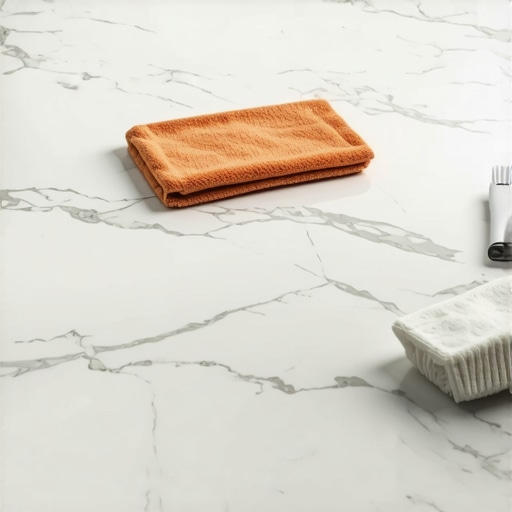
The molecular fragility of calcium carbonate
Polished marble tiles require a neutral pH cleaner because their calcium carbonate structure reacts violently with acids, leading to chemical etching and permanent loss of surface gloss. Most homeowners treat marble like ceramic, but marble is a metamorphic rock that remains chemically active. When an acidic substance touches the surface, it dissolves the top layer of the stone, leaving a dull, white mark known as an etch. This is not a stain. It is a physical change in the stone crystalline structure. To maintain a pristine finish, you must understand the bond between the stone and the light reflecting off it. If that surface is compromised even at a micron level, the mirror finish disappears. I spent three days grinding concrete on a job last month just so the floor wouldn’t click like a castanet. People ignore the subfloor, but they also ignore the chemistry of their cleaners. I once saw a client ruin a twenty thousand dollar foyer because they used a vinegar solution they found on a lifestyle blog. It ate through the factory polish in twenty minutes.
“A floor is only as good as the subfloor beneath it; deflection is the enemy of every joint.” – Master Flooring Axiom
The grit trap in your floor perimeter
Sand and silica particles act as industrial abrasives under the weight of foot traffic, meaning the cleaning of baseboards and edges is a mandatory step in stone preservation. When dust accumulates against the wall, it eventually migrates toward the center of the room. Every time you walk across the floor, these tiny rocks act like sandpaper. This is why many homeowners investigate chic baseboard designs that transform rooms to ensure they have a profile that does not trap debris. A flat, modern baseboard is easier to keep dust-free than a complex colonial profile. The goal is to minimize the amount of loose grit that can be dragged across the soft marble surface, which sits at only a three on the Mohs scale of mineral hardness.
Why your supermarket cleaner is a liquid sandblaster
Common household detergents often contain chelating agents and surfactants that are far too aggressive for the sensitive minerals found in natural marble. Most products on the shelf are designed for ceramic or porcelain, which are fired at high temperatures and are effectively glass. Marble is different. It is porous. It breathes. It reacts. If a cleaner is even slightly acidic, it will begin to dissolve the calcium. If it is too alkaline, it can leave a film that attracts more dirt, leading to a cycle of aggressive scrubbing that eventually scratches the surface. You need a dedicated stone soap or a highly diluted, pH neutral liquid. I tell my customers that if they wouldn’t wash their own eyes with it, they shouldn’t put it on their marble. This is especially true for tile cleaning tips for a sparkling bathroom where soap scum and hard water minerals often lead people to reach for the heavy chemicals. That is the moment the floor is ruined.
| Material | Mohs Hardness | Porosity Level | Acid Sensitivity |
|---|---|---|---|
| Marble | 3 | High | Extreme |
| Granite | 6-7 | Low | Low |
| Porcelain | 7-8 | Negligible | None |
| Silica Sand | 7 | N/A | N/A |
The microscopic anatomy of an etch mark
Chemical etching occurs when acetic acid or citric acid breaks the ionic bonds of the marble surface, creating a rough texture that scatters light instead of reflecting it. When you look at an etch under a microscope, the smooth, polished peaks of the stone have been melted away. It looks like a mountain range that has been leveled. No amount of wiping will fix this. It requires mechanical diamond polishing to restore the shine. This is why prevention is the only viable strategy for a homeowner. You must use distilled water for cleaning if your tap water has a high mineral content. Hard water contains magnesium and calcium salts that can deposit in the pores, eventually causing the stone to look cloudy. If you are dealing with wet areas, look at showers that wow but remember that marble in a shower requires a specific maintenance cadence that most people aren’t ready for.
- Use only microfiber mops to avoid dragging large debris.
- Blot spills immediately rather than wiping them.
- Apply a high quality impregnating sealer every six to twelve months.
- Place walk off mats at every exterior entrance.
- Never use a vacuum with a beater bar on stone floors.
The ghost in the expansion gap
Structural movement and thermal expansion can cause micro-fissures in the stone if the subfloor deflection is not managed according to TCNA standards. Marble has no flexural strength. If your subfloor bows even a fraction of an inch, the stone will crack. Many installers skip the anti-fracture membrane to save a few dollars, but that is a mistake that will haunt the home for decades. If the grout starts to crumble, it might not be a cleaning issue. It might be a structural failure. In those cases, you need to look into grout restoration secrets to stabilize the joints before the tiles themselves begin to delaminate. I have seen entire floors lift because the installer didn’t leave an expansion gap at the perimeter, hidden under the baseboards. The floor needs to breathe and move. If you lock it in, the pressure has to go somewhere, and it usually goes into the weakest point of the stone.
“Natural stone is a product of nature and will have variations in color, texture, and hardness. It must be treated with the respect due to a geological relic.” – Stone Institute Guidelines
The physics of microfiber and the grit trap
Microfiber technology uses polyester and polyamide fibers to lift microscopic debris away from the stone surface, preventing the mechanical abrasion that occurs with traditional cotton mops. Cotton mops are terrible for marble. They mostly just push the dirty water around, and the fibers are large enough that they can actually trap sand against the stone. Microfiber is split at a microscopic level, creating hooks that grab the dirt and lift it into the cloth. This is the only way to ensure that the grit is removed rather than redistributed. When cleaning, you must use a dual-bucket system. One bucket for your neutral cleaner and one for rinsing the mop. If you dip a dirty mop back into your cleaning solution, you are just washing your floor with liquid sandpaper. It sounds like a lot of work, but a polished marble floor is a luxury item. You wouldn’t take a Ferrari through a cheap automatic car wash, so don’t treat your marble like a garage floor. Keep the grit away, keep the pH neutral, and the stone will look better in fifty years than it does today.