
I have spent twenty-five years on my knees with a moisture meter and a level. I have smelled enough moldy subfloors to last ten lifetimes. My hands are stained with walnut dust and my boots usually smell like WD-40 and oak. When a homeowner calls me about a shower leak, they usually expect me to talk about the glass. They think the glass is the problem. It rarely is. I once walked into a house where a custom shower enclosure was failing because the installer ignored the physics of water tension. They thought a bead of cheap caulk would stop gravity. It did not. Most guys skip the leveling compound and ignore the pitch of the curb. They think the underlayment or the tile will hide the dip. It won’t. I spent three days grinding concrete on a job last month just so the floor wouldn’t click like a castanet, and that same level of obsessive detail is what keeps a shower dry. If you are seeing puddles on your bathroom floor, your shower is failing as a structural engineering unit. We need to look at the chemistry of the seals and the geometry of the threshold to fix it.
The physics of the sweep and seal
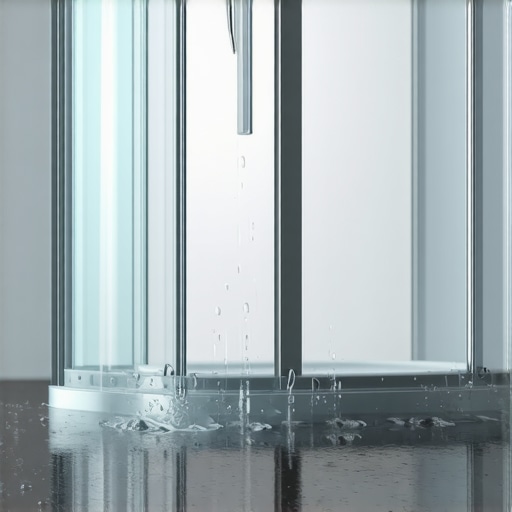
A leaking shower door at the bottom seal is caused by mechanical failure of the polycarbonate sweep, incorrect curb pitch, or capillary action through porous grout. Gravity pulls water down the vertical surface of the glass where surface tension keeps it clinging until it reaches the lowest point. If the seal is not tight or the drip rail is missing, water bypasses the threshold. I have seen hundreds of these cases where the sweep has simply become brittle. Polycarbonate is a tough polymer, but it is not immortal. Over time, the plasticizers that give the sweep its flexibility leach out. This is often accelerated by harsh cleaners. Once that material hardens, it loses its ability to compress against the curb. It leaves microscopic gaps. Water does not need a large hole to escape. It just needs a path. This path often leads directly to your expensive baseboards, which will swell and rot long before you realize there is a structural problem.
“A shower seal is only as effective as the curb pitch beneath it; capillary action is the enemy of every dry bathroom.” – Master Flooring Axiom
Why your shower curb is lying to you
The curb of a shower must have a positive pitch toward the drain to ensure that any water hitting the threshold is pulled back into the pan by gravity. According to TCNA standards, a curb should have a slope of approximately one-quarter inch per foot. I often find curbs that are dead level or, worse, pitched outward. When a curb is pitched outward, you are fighting a losing battle against the laws of physics. No amount of silicone will fix a curb that leans the wrong way. I have seen beautiful showers ruined because the framer used a piece of dimensional lumber that twisted as it dried. This twist creates a high spot in the middle and low spots at the edges. Water follows the low spots. It migrates under the glass track and finds its way to the subfloor. If you have a stone curb, check it with a small level. If the bubble is centered or leaning toward the bathroom floor, the curb is the reason your seal keeps failing.
The ghost in the expansion gap
Water often escapes through the expansion gaps where the wall tile meets the shower floor or where the curb meets the door jamb. These junctions are supposed to be filled with 100 percent silicone sealant, not cementitious grout. Grout is rigid. Houses move. When the house shifts, grout cracks. These hairline fractures act like straws, sucking water through capillary action. This is a major reason for grout restoration needs in older homes. I have seen water travel six feet along a subfloor because it got behind a cracked grout joint at the shower threshold. It is a slow, silent killer of plywood and joists. You might think you have a door leak, but you actually have a waterproofing failure at the transition. Using eco-friendly tile solutions is great, but even the best tile will not stop water if the perimeter joints are not flexible and watertight.
The drip rail and the splash zone
The drip rail is a small angled piece of plastic or metal attached to the bottom of the glass that redirects water back into the shower pan. Without this rail, water running down the inside of the glass hits the bottom sweep and sits there. If the door is opened, that water dumps onto the floor. If the door is closed, the water can build up enough hydrostatic pressure to push past the seal. Many modern minimalist designs omit the drip rail because it looks “bulky.” This is a mistake. Practicality should never be sacrificed for a clean line when water damage is the alternative. I always tell my clients that a dry floor is more beautiful than a sleek door that leaks. If your door lacks a drip rail, you are relying entirely on the compression of the bottom sweep, which is a high-risk strategy.
| Material | Durability | Water Resistance | Maintenance Need |
|---|---|---|---|
| Polycarbonate | Medium | High | Replace every 2 years |
| Silicone Gasket | High | Very High | Annual cleaning |
| Vinyl Sweep | Low | Medium | Replace every 12 months |
| Aluminum Rail | Very High | High | Check mounting screws |
The hidden damage to baseboards
When a shower door leaks, the first victim is usually the baseboard adjacent to the shower enclosure. Most residential baseboards are made of MDF or finger-jointed pine. These materials are like sponges. Once the bottom edge of the baseboard touches a puddle, it wicks the moisture upward. The paint will bubble. The wood will swell. Eventually, the drywall behind it will develop black mold. I have seen beautiful chic baseboard designs completely destroyed by a tiny leak that the homeowner ignored for six months. If you see your baseboard pulling away from the wall or the paint looks “puffy” near the shower, you have a leak. You need to pull that trim off and inspect the wall cavity immediately. It is better to replace five feet of trim than to replace a whole floor of joists.
Solving the porosity problem
Porous tile and grout can hold water long after the shower is turned off, allowing it to seep under the door seal over time. This is why tile cleaning and sealing are vital. A sealed grout joint repels water. An unsealed joint absorbs it. If your shower floor is natural stone, it is even more prone to this. The stone itself can act as a bridge, carrying water under the glass. I recommend a high-quality penetrating sealer. If the grout is too far gone, you may need to learn how to refresh grout to restore the integrity of the surface. A solid, non-porous surface is your best defense against the slow migration of moisture that leads to floor failure.
A checklist for a dry bathroom
- Check the sweep for cracks or stiffness.
- Verify that the curb slopes toward the drain.
- Inspect the silicone at the corners of the threshold.
- Ensure the drip rail is angled correctly.
- Look for water stains on the baseboards.
- Seal the grout joints every six months.
- Test the door alignment to ensure a flush close.
The chemical reality of silicone seals
Not all silicone is created equal and using the wrong type at the shower base will lead to premature seal failure. There are acetoxy-cure and neutral-cure silicones. Acetoxy-cure silicones release acetic acid as they dry. They smell like vinegar. They are great for glass but can react poorly with certain natural stones or metals. Neutral-cure silicones are better for masonry and stone. When you are sealing the bottom of a shower door track, the chemical bond is what matters. If the silicone peels away, it is because the surface was not cleaned with denatured alcohol first. I see guys just slap new caulk over old caulk. That is a crime. It will never bond. You have to scrape it back to the original surface. If you want a dry floor, you have to respect the chemistry of the bond.
“Water migration through cementitious grout is inevitable without proper hydrophobic additives or topical sealants.” – Tile Industry Technical Bulletin
The 1/8 inch that ruins everything
A shower door that is hung even one-eighth of an inch out of plumb will create a gap at the bottom seal that water will find. Heavy glass doors are held by hinges that can settle over time. If the door sags, the sweep will not hit the curb evenly. It might be tight on the hinge side but have a gap on the strike side. This is why I prefer showers with a style that uses fixed panels where possible. Fewer moving parts means fewer ways for the seal to fail. If your door is dragging on the curb or has a visible gap, you need to adjust the hinges. It is a precise task. You often need two people to keep the glass level while tightening the hex bolts. If you ignore a sagging door, you aren’t just letting water out; you are risking the glass shattering because of the stress on the hinges.