
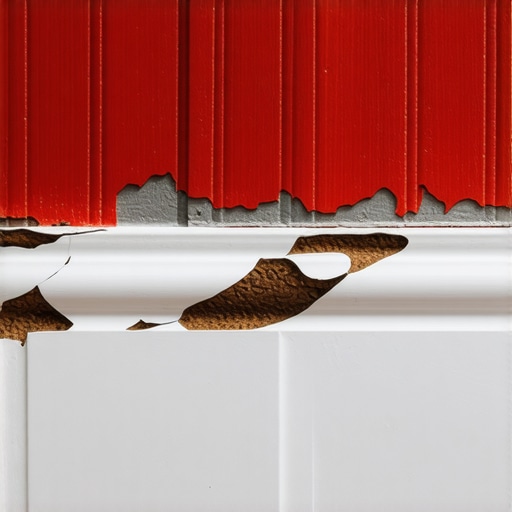
Most guys skip the leveling compound. They think the underlayment will hide the dip. It won’t. I spent three days grinding concrete on a job last month just so the floor wouldn’t click like a castanet. That same job had another problem that most installers ignore until the homeowner calls them back six months later. The baseboard nails were bleeding through the paint. Those tiny brown spots are not just an eyesore. They are a structural warning sign. When you see rust spots on a freshly painted baseboard, you are looking at the evidence of a failed moisture management system. It means your house is breathing water, and your fasteners are paying the price.
The moisture trap behind your walls
Baseboard nails rust through paint because moisture is trapped behind the wood trim, often originating from high relative humidity in the concrete subfloor or leaking plumbing near showers. This moisture condenses on the cold metal of the nail, initiating an oxidation reaction that moves through the wood grain and destroys the paint bond. It is a slow, chemical destruction of your interior finish. I have seen it in thousand-dollar bathroom remodels and million-dollar custom homes alike. The physics of it never changes. Water always finds a way to move from high pressure to low pressure. If your subfloor is wet, that moisture is going up. If your walls are not sealed, that moisture is going in. Most installers just fire the nail and walk away. They do not think about the electrochemical reaction that happens when oxygen, iron, and water meet in a dark space behind a piece of MDF or pine.
The chemical failure of cheap fasteners
Most builders use bright steel finish nails because they are cheap and easy to hide, but they lack any protective coating against oxidation. When these nails meet the moisture trapped in the wall cavity, they begin to corrode instantly. The rust, or iron oxide, expands as it forms. This expansion creates pressure. It pushes against the wood fibers and eventually cracks the paint or the wood filler covering the nail head. This is why you see a small, brown ring around the nail hole. It is not a paint defect. It is a metallurgical failure. If you are working in a high-humidity environment like a bathroom with modern showers, you should be using stainless steel fasteners. Anything less is a gamble with your reputation. I have seen guys try to cover it with more paint, but the rust just eats through the new layer in weeks. You cannot paint over a chemical reaction and expect it to stop.
“A floor is only as good as the subfloor beneath it; deflection is the enemy of every joint.” – Master Flooring Axiom
Why your subfloor is lying to you
Concrete slabs act like giant sponges that hold thousands of pounds of water long after they appear dry to the naked eye. A slab might look white and dusty on top, but the core could still be at 95 percent relative humidity. When you install chic baseboard designs over a wet slab, the baseboard acts as a cap. The moisture has nowhere to go but up into the wall plate and the baseboard itself. This is called capillary action. The wood fibers pull the water up from the bottom edge of the trim. If the back of that baseboard is not primed, it absorbs that water like a straw. Then the nails, which are driven through the trim and into the wall studs, become the primary conductors for the rust. I always tell my crew to check the slab with a calcium chloride test or an in-situ probe. If the numbers are high, we don’t install. We wait. Or we use a topical moisture barrier. People hate the delay, but they hate rusted trim and moldy walls even more.
| Fastener Type | Corrosion Resistance | Recommended Environment |
|---|---|---|
| Bright Steel | Very Low | Dry interior living areas only |
| Electro-Galvanized | Moderate | Standard residential with low humidity |
| Hot-Dipped Galvanized | High | Exterior or high-moisture laundry rooms |
| 304 Stainless Steel | Exceptional | Bathrooms, kitchens, and coastal regions |
Showers and the atmospheric assault
Bathrooms are the primary site for nail rust because the air is constantly saturated with water vapor that penetrates grout and wall gaps. When someone takes a hot shower, the steam fills the room and settles into every unsealed crack. If the grout in the shower is old or cracked, water seeps into the wall assembly. This creates a humid micro-climate behind the baseboards. I have walked into bathrooms where the homeowner thought they just needed a quick paint job. I pulled the baseboard and found the drywall was soft and the nails were almost completely disintegrated. You have to look at the whole system. Is the shower pan leaking? Is the grout failing? Is the vent fan moving enough cubic feet of air per minute? If you do not fix the source, you are just wasting money on new trim. Sometimes you can save the look by knowing how to refresh grout without replacing it, but often the damage behind the trim is too far gone.
The 1/8 inch that ruins everything
The most common installation mistake is pinning the baseboard tight against the flooring surface without leaving a small expansion gap. When the baseboard sits directly on the floor, it mops up any liquid water from cleaning or spills. It also traps the moisture vapor rising from the subfloor. I always leave a 1/8 inch gap and cover it with a shoe molding if necessary, or I leave a tiny gap that will be hidden by the carpet or tile. This allows air to circulate. If the air can move, the moisture can evaporate. If the moisture evaporates, the nails stay dry. It is a simple trick that separates the masters from the amateurs. You also need to prime the back and the bottom edge of every piece of wood trim. This creates a hydrophobic barrier. Water cannot enter the wood if the pores are already filled with primer. It takes more time, but it stops the rust before it starts.
Mandatory Pre-Installation Checklist
- Test the concrete slab moisture with a digital meter or RH probes.
- Back-prime all wood baseboards with an oil-based or high-quality acrylic primer.
- Use stainless steel finish nails for any area within ten feet of a water source.
- Check the integrity of existing tile grout and shower seals.
- Ensure the HVAC system is operational to maintain a stable interior climate.
- Verify that the subfloor is level within 1/8 inch over a 10-foot radius.
The ghost in the expansion gap
While most people want the thickest underlayment, too much cushion actually causes the locking mechanisms on LVP to snap under pressure, which also affects your baseboard stability. This is a contrarian fact that many big-box retailers won’t tell you. They want to sell you the fancy foam. But that extra movement in the floor means the baseboard is constantly being stressed. If the floor bounces, it rubs against the baseboard. This friction can wear away the paint and expose the nail heads to the air. In humid regions like the Gulf Coast or the Pacific Northwest, this is a death sentence for your trim. You need a flat, solid subfloor. If the floor is stable, the baseboard is stable. If the baseboard is stable, the paint seal on the nail heads remains intact. It all comes back to the structural engineering of the surface. You cannot build a house on sand, and you cannot put a good floor on a wavy subfloor. I have spent half my career fixing the mistakes of guys who thought they could hide a dip with a piece of plastic.
“Water is the universal solvent; it will eventually dissolve your work if you do not respect its path.” – TCNA Guidelines Commentary
Modern solutions for high moisture zones
Using PVC or composite baseboards in bathrooms is the only way to completely eliminate the risk of nail rust and rot. These materials do not absorb water. They do not have wood fibers to act as straws. However, even with PVC, you still need to use the right nails. If you use steel nails in PVC, the nail will still rust and create a brown stain on the white plastic. It looks even worse than it does on wood because the plastic is so bright. If you are looking for baseboards makeover ideas to elevate your space, consider the environment first. High-moisture areas require high-moisture materials. In a dry bedroom, solid oak is king. In a bathroom with three kids and a leaky shower, you want something that can handle the splash. Always think about the long-term chemistry of the room. The house is a living, breathing machine. Every nail is a part of that machine. If one part fails, the whole aesthetic fails. Don’t let a two-cent nail ruin a two-thousand dollar paint job. Check your moisture, prime your trim, and use the right steel for the job.