
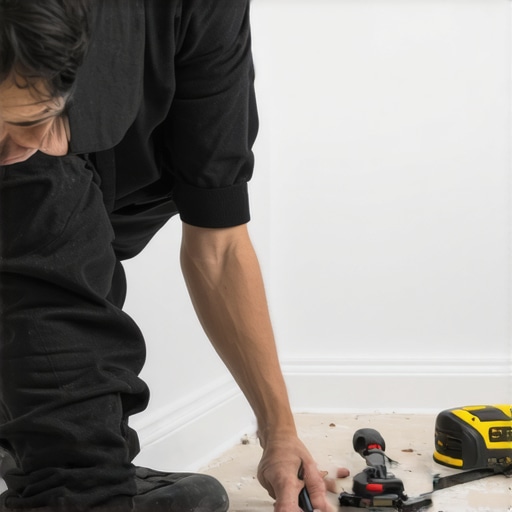
Most guys skip the leveling compound. They think the underlayment will hide the dip. It won’t. I spent three days grinding concrete on a job last month just so the floor wouldn’t click like a castanet. That level of obsession is exactly what you need when you are staring down a curved wall. If your subfloor is off by even an eighth of an inch, your baseboards will never sit flush, and that curve will highlight every mistake like a spotlight. Installing baseboards on a straight run is a basic skill, but wrapping a radius requires an understanding of material physics and chemistry that most weekend warriors simply lack. You are not just decorative trim here. You are an engineer managing the tension and compression of a polymer structure. My hands still smell like WD-40 and oak dust from the last site, and my knees tell me when rain is coming, but they also tell me when a floor is truly flat. Do not even think about pulling out the miter saw until you have checked the wall for high spots. A curved wall is a test of patience. You are fighting the natural tendency of a straight object to remain straight. If you rush the process, you will end up with snapped boards or gaps that you could lose a coin in. I have seen beautiful baseboards makeover ideas ruined by a poor installation on a simple rounded corner. Let us get into the grit of how to do this correctly.
Why cellular PVC wins the bending battle
Cellular PVC baseboards provide superior flexibility compared to wood or MDF. Its molecular density allows for radius bending without the splitting or snapping associated with grain-based materials. This polymer-based molding resists moisture, making it ideal for the junction of curved walls and floors. Unlike wood, which has a rigid cellular structure made of lignin and cellulose, PVC is a thermoplastic. This means its physical state can be manipulated with temperature. When you heat it, the long-chain molecules slide past each other more easily, allowing the board to take a shape it was never meant to hold. For anyone looking into chic baseboard designs, PVC is the only real choice for a tight radius. It does not swell when the humidity spikes, and it does not shrink when the furnace kicks on in January. In a humid environment like Miami or Houston, wood baseboards are a liability because they will cup and pull away from the curve as they absorb ambient moisture. PVC remains stable. It is a dead material, and in the world of flooring, dead is often better because it does not move.
“A floor is only as good as the subfloor beneath it; deflection is the enemy of every joint.” – Master Flooring Axiom
The heat gun and the molecular shift
Heating PVC baseboards requires an industrial heat gun to reach the glass transition temperature where the polymer becomes pliable. You must apply consistent heat across a three foot section to ensure the expansion and contraction occurs evenly without scorching the material. You are looking for that sweet spot around 150 to 170 degrees Fahrenheit. If you go too high, you will melt the finish and ruin the structural integrity of the cells. If you stay too low, you are just wasting electricity. I move the gun in a slow, sweeping motion, never stopping in one spot for more than a second. You will feel the board start to give. It is a subtle change, like a stiff noodle softening in boiling water. Once it is soft, you have a window of about ninety seconds to get it against the wall and fastened. This is where the physics of tension comes in. The outside of the curve is stretching while the inside is compressing. If you do not have enough heat, the tension on the outside will cause the PVC to