
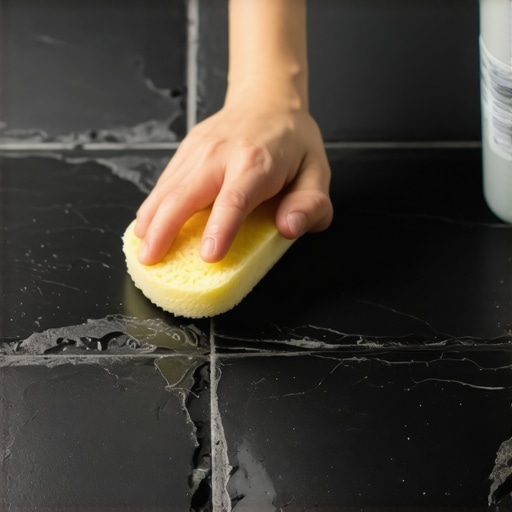
I spent three days grinding concrete on a job last month just so the floor wouldn’t click like a castanet, and that same level of obsessive detail is what you need for slate. I have seen homeowners walk into my shop with tears in their eyes because they used a generic lime-scale remover on their natural slate. They thought it was just a rock. They treated it like a piece of plastic. By the time they were done, the acid had eaten through the top layer of the stone, turning a beautiful dark cleft surface into a milky, etched mess. You do not just clean slate; you manage its mineralogy. I have been in this game for twenty-five years, and if there is one thing I have learned, it is that the chemistry of your water is often more aggressive than the feet walking on your floor. Hard water is not just wetness. It is a delivery system for dissolved minerals like calcium and magnesium. When that water evaporates in your bathroom or entryway, it leaves behind a crystalline structure that bonds to the porous surface of the stone at a molecular level. It is a battle of the minerals, and if you use the wrong weapon, the stone loses every single time.
The metamorphic reality of natural stone
Slate tiles are metamorphic rocks formed from shale and clay minerals that trap calcium carbonate and magnesium ions from hard water within their cleft surfaces. Removing these mineral deposits requires a neutral pH balance to avoid acid etching while breaking the ionic bond of the limescale buildup on the stone surface. Slate is characterized by its foliation, a physical property that allows it to be split into thin, flat layers. This very texture, which gives the stone its aesthetic appeal, provides a vast surface area for minerals to latch onto. Unlike ceramic tile, which has a glass-like glaze, slate is a network of microscopic peaks and valleys. When hard water sits on these tiles, the water molecules depart through evaporation, but the heavier minerals stay behind, nesting in the fissures. If you understand the geological origin of your floor, you understand why you cannot scrub it with a wire brush or douse it in lemon juice. You are dealing with a material that took millions of years to form under tectonic pressure. Your cleaning approach must respect that history. For broader maintenance strategies, you should review tile cleaning tips for a sparkling bathroom in 2025 to ensure you are not making basic errors.
The chemical bond of calcium and magnesium
Hard water stains occur when dissolved minerals precipitate out of solution and form a calcified crust known as limescale or white film. This process is driven by the evaporation of aqueous solutions containing high concentrations of calcium carbonate, which creates a tenacious bond with the slate substrate that resists standard wiping. The science here is simple yet devastating for a floor. Calcium and magnesium are cations, meaning they carry a positive charge. The surface of most natural stones carries a slightly different charge, and the minerals effectively weld themselves to the slate. This is not dirt. It is not something you can just wipe away with a damp cloth. You are dealing with a mineral-to-mineral interface. The bond is chemical. To break it, you need to introduce a surfactant that can get under the mineral layer without reacting with the stone itself. This is where most people fail. They want a shortcut. They want a magic spray. But the only real magic is understanding solubility and the way surfactants lower the surface tension of water to lift the mineral crust away from the foliation of the slate.
| Mineral Component | Mohs Hardness Scale | Reaction to Acid | Porosity Level |
|---|---|---|---|
| Natural Slate | 2.5 to 4.0 | High Sensitivity | Medium to High |
| Calcium Carbonate | 3.0 | Violent Dissolution | N/A |
| Quartz (in slate) | 7.0 | None | Low |
| Magnesium | 2.5 | High Sensitivity | N/A |
The danger of acidic cleaning agents
Acidic cleaners like vinegar, lemon juice, or commercial descalers will chemically react with the calcium minerals in the slate, leading to irreversible etching and surface pitting. These products might remove the hard water stain, but they do so by dissolving the stone surface itself, leaving behind a dull, white mark that can only be fixed by professional honing. People think vinegar is a natural wonder. In my shop, vinegar is the enemy. It is an acetic acid. When it touches slate, it does not just look for the hard water stains. It looks for any calcium carbonate within the stone structure. It eats it. It leaves the floor looking bleached. Once that happens, the protective seal is gone, and the stone is even more vulnerable to the next round of hard water. You must use pH-neutral cleaners specifically formulated for natural stone. These cleaners are designed to be inert when they touch the slate but active when they touch the grease and mineral film on top. It is a surgical strike instead of a carpet bomb. You can find more about specialized care in our guide on grout restoration secrets for long lasting results which covers how to handle the edges where these minerals like to hide.
“A floor is only as good as the subfloor beneath it; deflection is the enemy of every joint.” – Master Flooring Axiom
Mechanical removal of mineral crust
Mechanical cleaning of slate requires a soft-bristled brush and distilled water to gently agitate the mineral deposits without scratching the natural cleft of the stone. Using abrasive pads or steel wool will strip away the natural patina and create micro-scratches that trap even more limescale in the future, making the problem progressively worse over time. I tell my customers to think of it like brushing their teeth. You do not use a sandpaper block on your enamel. You use a brush that can get into the grooves. For slate, the process involves saturating the area with a neutral cleaner, letting it dwell for at least ten minutes, and then using a circular motion to break the physical grip of the calcium. The dwell time is the part everyone skips. They want to spray and wipe. The chemistry needs time to work. It needs time to penetrate the mineral shell. If the stain is particularly thick, you might need a stone poultice. This is a paste that draws the minerals out of the stone as it dries. It is slow work, but it is the only way to save a floor that has been neglected for years. If your grout is also looking rough, check out how to refresh grout without replacing it to keep the whole surface uniform.
Restoring the grout lines around the slate
Grout lines are the most porous part of a slate floor, acting as a capillary system that sucks in hard water and concentrates mineral salts at the edges of the tiles. Cleaning the grout joints requires a specialized grout brush and a neutral oxygenated cleaner that lifts the embedded stains without degrading the cementitious bond of the mixture. Grout is basically a sponge. When you wash your slate tiles, the dirty, mineral-heavy water naturally flows into the lower grout lines. There, it sits and evaporates, leaving behind a concentrated line of white crust. This is often where the most stubborn stains live. If you ignore the grout, the whole floor looks dirty, no matter how clean the slate is. You have to work the grout lines separately. Do not use a mop for this. A mop just pushes the minerals around. You need to get down there and physically extract the slurry once the cleaner has done its job. This is the grit I was talking about. It is manual labor, but it prevents the need for a full rip-out and replacement in five years.
Protecting your baseboards during deep cleaning
Baseboards serve as the perimeter moisture barrier for your flooring, and they must be properly protected with painter’s tape or a physical shield when applying liquid stone cleaners. Excess moisture at the wall-to-floor junction can cause MDF baseboards to swell or wood trim to rot, creating an environment for mold growth behind the finishing materials. When you are scrubbing slate, you are using a lot of water. That water wants to go somewhere. It follows the slope of the floor right to the edges. If your baseboards are not sealed or if they are made of cheap composite material, they will soak up that water like a wick. I have seen beautiful tile jobs ruined by water-damaged trim. You should look into chic baseboard designs that transform rooms in 2025 to see how to properly integrate high-quality, moisture-resistant options into your bathroom or kitchen. A good baseboard is not just for looks; it is the final defense for your subfloor and your drywall.
- Inspect the slate for existing cracks or loose flakes before applying any liquids.
- Use only distilled water for the final rinse to prevent new mineral deposits from forming.
- Apply a pH-neutral stone soap and allow a 10-minute dwell time.
- Gently scrub the surface with a nylon brush, following the natural grain of the stone.
- Vacuum up the dirty slurry using a wet-vac rather than wiping it with a towel.
- Dry the floor completely with a microfiber cloth to prevent water spots.
- Re-seal the stone with a high-quality impregnating sealer once it is dry.
The long term strategy for slate maintenance
Slate maintenance relies on the application of sealers that penetrate the sub-surface pores to create a hydrophobic barrier against hard water penetration. These impregnating sealers do not sit on top of the stone like a wax; they live inside the mineral structure, preventing calcium ions from finding a mechanical anchor within the tile. While most people want the thickest underlayment, too much cushion actually causes the locking mechanisms on LVP to snap under pressure, and a similar logic applies to stone sealers. You do not want a thick, topical coating that will peel. You want a sealer that disappears into the stone. If water is not beading on your slate, it is not protected. You are just waiting for the next hard water stain to move in and pay rent. I tell my customers to test their seal every six months. Drop a tablespoon of water on the tile. If it disappears in less than a minute, your floor is thirsty. Feed it sealer, or you will be back in my shop buying more cleaner and complaining about white spots again. Taking care of slate is a marathon, not a sprint. It is about consistent, gentle care and understanding that you are the caretaker of a piece of the earth’s crust. Treat it with respect, and it will outlast the house it is sitting in.