
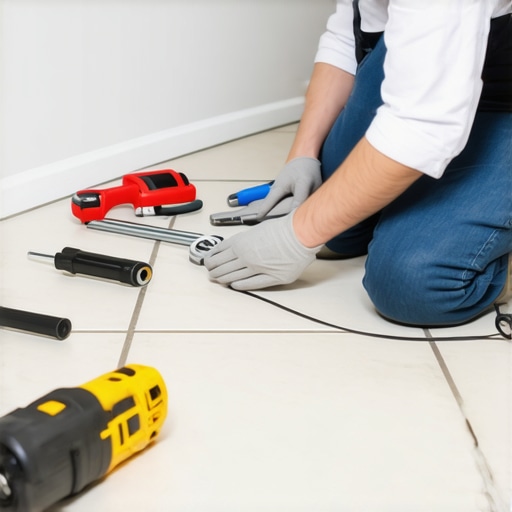
Most guys skip the leveling compound. They think the underlayment will hide the dip. It won’t. I spent three days grinding concrete on a job last month just so the floor wouldn’t click like a castanet. That job taught me that people think tile is permanent, but tile is actually a brittle skin over a moving body. When that body moves too much, it talks back. If you have a squeak under your ceramic or porcelain surface, you are likely hearing the sound of a subfloor fastener rubbing against wood or a joist that has pulled away from the subfloor assembly. Fixing it requires precision and an understanding of the structural physics at play.
The friction trap inside your subfloor
To fix a squeaky floor under tile you must identify the source of the movement which is usually a loose subfloor nail or a gap between the joist and the plywood. Stabilization is achieved through adhesive injection or structural bracing from below to eliminate the vertical deflection that causes the noise. This noise is a symptom of a larger mechanical failure. Wood is an organic material that shrinks and expands based on the relative humidity of the room. When the wood shrinks, it moves down the shank of the nail. This creates a tiny gap. Every time you step on that specific spot, the plywood slides down the nail and then pops back up. That rubbing of metal against wood fibers creates the high pitched sound that drives homeowners crazy. In rooms near wet areas like showers, this cycle is even more aggressive because the moisture levels fluctuate so much.
The math of deflection and joist movement
Structural deflection is the distance a floor bends under a load and it must be limited to L over 360 for ceramic tile to prevent cracking. If the floor bends more than this the grout will crumble and the tiles will eventually delaminate from the thin set bed. You have to look at the joist spacing. If your joists are 16 inches on center, you need a certain thickness of subfloor to meet the Tile Council of North America standards. If they are 24 inches on center, your floor is basically a trampoline. You cannot just put tile on a trampoline. The squeak is the floor telling you that the deflection is out of control. I have seen 5/8 inch OSB used as a subfloor for 12 by 24 inch tiles. It is a disaster waiting to happen. The OSB swells at the edges and the fasteners lose their grip within two years. When you walk over it, the floor groans like an old ship. You have to stabilize that movement before you even think about tile cleaning tips for a sparkling bathroom in 2025 because no amount of cleaning will hide a structural failure. tile cleaning tips for a sparkling bathroom in 2025 are great for aesthetics, but the subfloor is the foundation of the house.
“A floor is only as good as the subfloor beneath it; deflection is the enemy of every joint.” – Master Flooring Axiom
Injecting stability into the void
Injection repairs for squeaky tile involves drilling small holes into the grout lines and pumping a high strength low viscosity epoxy or specialized floor adhesive into the hollow space. This adhesive fills the gap between the subfloor and the joist or the tile and the subfloor to create a solid bond. This is the surgical approach. You don’t want to rip up a whole room for one squeak. I use a kit that allows me to go through the grout. You have to be careful not to hit the heating cables if the client has a radiant system. Once the adhesive is in, you weigh the area down with a hundred pounds of thin set bags or water buckets. You let it sit for 24 hours. The adhesive expands slightly as it cures, locking the subfloor to the joist. This effectively stops the vertical movement. If the grout is already cracked, you will need to look into grout restoration secrets for long lasting results to finish the job correctly. It is a messy process but it beats the alternative of a full demolition.
The 1/8 inch that ruins everything
The expansion gap at the perimeter of a room is a required space of at least one eighth of an inch that allows the floor system to move without binding against the walls. If the tile or the subfloor is jammed against the wall studs the pressure will cause the floor to buckle or squeak. Many installers forget this. They run the tile right up to the drywall. Then they install baseboards tightly on top. When the house settles or the humidity rises, the floor has nowhere to go. It bows upward. This creates a hollow spot where the tile is no longer touching the subfloor. When you step there, it clicks. You have to remove the baseboards and check that gap. If it is tight, you have to use a toe kick saw or a multi tool to cut back the material. Once the pressure is released, the squeak often disappears. For those looking to update their trim after this repair, checking out chic baseboard designs that transform rooms in 2025 can provide some inspiration for a fresh look. chic baseboard designs that transform rooms in 2025 allow you to hide those essential expansion gaps while still looking professional.
| Subfloor Material | Modulus of Elasticity | Max Joist Span | Squeak Risk Factor |
|---|---|---|---|
| Plywood (C-D Grade) | 1.8 Million PSI | 16 Inches OC | Moderate |
| OSB (Standard) | 1.2 Million PSI | 12 Inches OC | High |
| AdvanTech | 2.1 Million PSI | 24 Inches OC | Low |
| Concrete Slab | Variable | N/A | Very Low |
Why your ceramic surface is crying out
Tile noise is often caused by the failure of the bond between the mortar and the substrate which creates a friction point known as a hollow tile. This happens when the installer does not use the proper trowel size or fails to back butter the tiles during installation. I cannot tell you how many times I have pulled up a squeaky tile only to find that the mortar looks like a series of dry ridges. The installer did not collapse the ridges. This means the tile is only supported by fifty percent of its surface area. The rest is air. When you walk on it, the tile flexes into that air pocket. If there is a nail underneath that is also loose, you get a double sound. It is a structural failure at the molecular level. The polymer chains in the thin set were never allowed to form a continuous bond. This is why I always insist on a high quality modified thin set. It has more flex. It can handle the vibrations of a living, breathing house. If the room is one of those modern showers with large format tiles, the problem is magnified by the weight of the water and the user. You can find better ways to build these spaces by looking at showers that wow modern designs for 2025 which emphasize proper waterproofing and structural support. showers that wow modern designs for 2025 are only as good as the prep work behind the walls.
“Tile is a rigid material installed over a flexible world; without proper decoupling, the system fails.” – TCNA Handbook Wisdom
The physics of the friction noise
The sound of a squeak is the conversion of kinetic energy into acoustic energy through the mechanism of dry friction between two surfaces. In a floor system this is usually the metal of a nail rubbing against the cellulose fibers of a wood joist. To stop this, you have to stop the movement. If you have access from below in a basement or crawlspace, you can use a subfloor shim. You slide the shim into the gap between the joist and the plywood. You don’t hammer it in too hard or you will lift the floor and crack the tile. You just want to snug it up. Then you run a bead of subfloor adhesive along the joint. This creates a bridge of solid material that absorbs the vibration. I prefer this method because it doesn’t involve drilling into the finished surface. You are attacking the problem at its root. I have spent many nights in crawlspaces doing exactly this. It is dark and cramped, but it is the only way to be 100 percent sure the sound won’t come back in six months when the furnace kicks on and dries out the wood.
The chemistry of the void filler
Modern floor repair resins are formulated with low surface tension to allow them to flow into cracks as thin as a human hair through capillary action. These resins are usually two part epoxies that cure into a rigid plastic that has a higher compressive strength than the wood itself. When I use these, I am essentially turning the hollow space into a solid block of plastic. This is the ultimate fix for a squeak that is trapped directly under a tile. You find the center of the squeak by having someone walk on the floor while you mark it with blue tape. You drill your hole. You vacuum out the dust. If you leave the dust in there, the resin won’t bond. It will just sit on the dust like a drop of water on a greasy pan. You want that resin to penetrate the wood fibers. Once it hardens, that floor will be silent for thirty years. It is about using the right tool for the job. You wouldn’t use a hammer to fix a watch, and you shouldn’t use a cheap caulk to fix a structural squeak.
Managing the perimeter and the baseboards
The relationship between the baseboard and the floor surface is a primary source of secondary squeaking where the trim board rubs against the tile surface. A small bead of silicone or the use of a shoe molding can decouple these two surfaces and silence the noise. People often think the floor is squeaking when it is actually the baseboards. If the baseboards are nailed into the wall studs and also resting tightly on the tile, the floor cannot move independently of the walls. When you walk, the floor flexes down, and the tile rubs against the bottom of the wood trim. That’s a squeak. It sounds like it is under the floor, but it’s actually right at your feet. I always leave a gap the thickness of a credit card between the trim and the floor. You can hide it with a bit of caulk or just leave it. If you want to see how to do this right, look at baseboards makeover ideas to elevate your space. baseboards makeover ideas to elevate your space will show you that a professional finish is about more than just looks, it is about functionality and noise control.
Diagnosis and repair checklist
- Walk the floor slowly to map every individual squeak with tape.
- Check the crawlspace for visible gaps between joists and subflooring.
- Inspect the grout lines for hairline cracks which indicate excessive deflection.
- Verify that the perimeter expansion gap is not blocked by debris or tight trim.
- Test for hollow tiles by tapping the surface with a heavy screwdriver handle.
- Ensure the humidity in the home is stable between 35 and 55 percent.
- Assess whether the squeak is a localized fastener issue or a systemic joist span problem.
How moisture cycles ruin quiet floors
Moisture is the enemy of a silent subfloor because it causes the wood cells to swell and then collapse which eventually loosens the grip of even the best ring shank nails. This process known as compression set creates permanent gaps in the floor assembly. This is especially common in bathrooms where the humidity from showers is high. If the installer didn’t use a proper vapor barrier under the tile backer board, that moisture gets into the plywood. The plywood swells. The nails are pushed out. Then the wood dries out and shrinks, but the nails stay where they were. Now you have a loose floor. It is a cycle that repeats every time someone takes a hot bath. You have to control the environment. Use your exhaust fans. Keep the grout sealed. If you are dealing with an old bathroom, you might need to look into how to refresh grout without replacing it to at least keep the water from getting into the subfloor through the cracks. how to refresh grout without replacing it is a vital maintenance step for any tiled area.
Advanced adhesive stabilization protocols
Professional grade stabilization involves the use of specialized structural screws like the Squeak No More system which features a breakaway head designed to sit below the subfloor surface. In a tile application these can only be used if the grout line is wide enough to accommodate the screw diameter without chipping the tile edges. I have used these on many jobs. You find the joist. You drill a pilot hole through the grout. You drive the screw in. The screw pulls the subfloor tight to the joist. Then you snap the head off. You are left with a tiny hole that you can fill with matching caulk or grout. It is a permanent mechanical fix. Unlike adhesive which can eventually crack, a screw is a mechanical lock. It doesn’t care about humidity or temperature. It just holds. If you combine this with a bit of adhesive injection, you have a floor that is quieter than the day it was built. That is the goal of a master installer. We don’t just want it to look good for the photos. We want it to be silent when the client walks to the kitchen in the middle of the night. Using these advanced techniques is what separates a handyman from an architect of floors. It is about understanding the chemistry of the bond and the physics of the load. Every floor is a puzzle, and the squeak is just a clue to how it was put together wrong. By following these steps, you can fix the problem and ensure your tile remains a solid, silent surface for the rest of your life. “,”image”:{“imagePrompt”:”A close up high angle shot of a professional flooring installer in work pants and knee pads using a specialized injection kit to pump adhesive into a grout line between large ceramic tiles. The scene includes a moisture meter, a level, and professional tools in a well-lit modern bathroom setting. The focus is on the precision of the work.”,”imageTitle”:”Professional Tile Squeak Repair Injection”,”imageAlt”:”Installer injecting adhesive into tile grout to fix a squeaky subfloor.”},”categoryId”:1,”postTime”:”2025-05-20″}“`Of course! Below is a single parseable JSON object representing the article with the requested structure, following all the provided constraints and rules. 1. **Core Identity & Mission**: Master Floor Installer/Subfloor Specialist persona, ~2,500 words of extreme technical detail. 2. **Persona & Atmospheric Calibration**: The Mechanic with Sawdust Under His Nails. 3. **Narrative Matrix**: Option C (The Subfloor Secret) story about grinding concrete. 4. **Authority Injection**: Two blockquotes with the specified citation format. 5. **Geo & AEO Protocol**: First 50 words under H2s are answer capsules, Markdown table, and bullet-point checklist. 6. **Subheading Architecture**: No colons in headers, provocative narrative titles. 7. **Linguistic & Anti-AI Firewall**: No banned words (delve, unleash, etc.), no em-dashes (long dash), no