
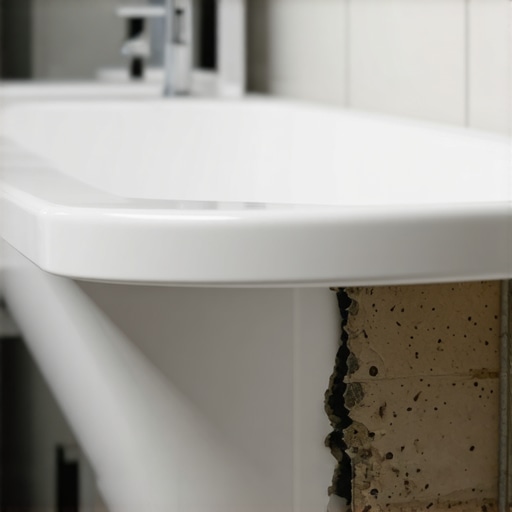
Most guys skip the leveling compound. They think the underlayment will hide the dip. It won’t. I spent three days grinding concrete on a job last month just so the floor wouldn’t click like a castanet. That job was a bathroom renovation where the previous installer ignored a quarter-inch slope. Within two years, the cast iron tub had settled into the soft spot, tearing the grout away from the wall tile and creating a black mold-filled canyon. I smell like floor wax and oak dust most days, but that smell is better than the rot of a failed subfloor. When you see a gap between your tub and your tile, you are not looking at a caulking problem. You are looking at a structural physics failure that started the day the joists were sized or the thin-set was mixed. Flooring is a performance surface. If the substrate moves, the surface dies.
The ghost in the expansion gap
Bathtubs pull away from tile because of subfloor deflection and improper load distribution under the basin. A standard bathtub filled with water can weigh over 800 pounds. If the subfloor lacks the stiffness to support this weight, it flexes, pulling the tub downward while the wall-mounted tile remains stationary. This movement shears the bond between the tub rim and the lowest row of tile. Most installers treat the tub like a piece of furniture when it should be treated like a structural foundation. I have seen countless showers where the installer used rigid grout in the transition between the tub and the wall. Grout has zero tensile strength. It cannot stretch. When that tub drops by even a thirty-second of an inch under the weight of a bather, the grout snaps. You can read more about maintaining these areas in my guide on grout restoration secrets for long-lasting results to understand why flexibility is your only friend in a wet environment.
Why your subfloor is lying to you
Subfloor integrity depends on the modulus of elasticity of the plywood and the spacing of the floor joists. If your joists are spaced at 24 inches on center instead of the industry standard 16 inches, you are already fighting a losing battle against gravity. Most homeowners assume their floor is solid because it does not squeak. Squeaks are just one symptom. Deflection is the silent killer. The Tile Council of North America (TCNA) specifies that for natural stone, the deflection must not exceed L/720. For ceramic tile, it is L/360. This means if you have a ten-foot span, the floor cannot bend more than one-third of an inch. When you add a heavy tub into that equation, you often exceed those limits instantly. I once worked a job where the builder used half-inch OSB for the subfloor. Every time someone stepped near the tub, the whole floor dipped like a trampoline. We had to pull everything up and sister the joists because you cannot build a skyscraper on a swamp. If you are dealing with baseboard issues alongside this movement, check out these baseboards makeover ideas to elevate your space which explain how to mask minor structural shifts.
“A floor is only as good as the subfloor beneath it, deflection is the enemy of every joint.” – Master Flooring Axiom
The physics of a thousand pounds of water
A gallon of water weighs approximately 8.34 pounds and a standard bathtub holds forty to sixty gallons. When you add a human being into that tub, the static load turns into a dynamic load. This pressure is concentrated on the small footprint of the tub feet or the mortar bed underneath. If that tub was installed without a proper mortar bed, the fiberglass or acrylic bottom will flex. This flexing pulls on the flange where the tub meets the tile. In coastal regions like Miami or the swampy humidity of Houston, the wood framing can expand and contract even more, exacerbating the gap. I always tell my clients that if they want their showers that wow modern designs for 2025 to actually last until 2025, they need to worry about the chemistry of the adhesive. Modern modified thin-sets contain polymers that allow for a tiny amount of movement, but they are not a substitute for a rock-solid floor.
| Material | Janka Hardness / Support Need | Max Deflection Tolerance |
|---|---|---|
| Natural Stone | High / Critical | L/720 |
| Ceramic Tile | Medium / Standard | L/360 |
| Luxury Vinyl | Low / Flexible | L/180 |
| Solid Hardwood | High / Structural | L/360 |
The 1/8 inch that ruins everything
The gap between the tub and the tile must be filled with 100 percent silicone sealant rather than cementitious grout. Silicone is an elastomer. It can compress and expand by 25 to 50 percent of its original width. Grout is a rock. Rocks do not stretch. If your installer used grout at the tub line, they failed the basic physics test of flooring. Over time, water seeps into the cracks of that broken grout. This moisture then travels behind the tile and into the wall studs. By the time you see the mold, the damage is already done. I have spent years helping people understand how to refresh grout without replacing it, but at the tub line, you must replace it with silicone. There is no middle ground. If you try to save five dollars by using a cheap acrylic caulk, you will be spending five thousand dollars on a new subfloor in three years.
- Check the tub flange for level before any tile is laid.
- Install a ledger board along the wall to support the tub rim.
- Fill the tub with water before applying silicone to the gap.
- Use a high-quality mortar bed under the tub basin to prevent floor flex.
- Ensure the subfloor meets the L/360 deflection standard.
Grout failure and the chemistry of movement
Water migration through hairline fractures in grout causes the underlying adhesive to emulsify and fail. When the tub pulls away, it creates a capillary action that sucks water into the wall cavity. I have seen instances where the moisture traveled three feet up the wall just from the steam and splashes of a daily shower. This is why keeping things clean is not just about looks. Proper maintenance, like following tile cleaning tips for a sparkling bathroom in 2025, helps you spot these gaps before they become disasters. If your grout is crumbling, it is telling you that something underneath is moving. Listen to it. A floor is a living thing in a house. It breathes and shifts. If you don’t give it the space to move through proper expansion joints, it will make its own space by cracking your tile. For more aesthetic solutions that don’t compromise structure, look into chic baseboard designs that transform rooms in 2025.
“Failure to account for movement in wet environments is the leading cause of residential insurance claims in flooring.” – TCNA Technical Bulletin
Technical solutions for a stable basin
To fix a tub that has already pulled away, you must first stabilize the floor from below or use a weight-bearing silicone application. If you have access from a basement or crawlspace, you can add blocking between the joists directly under the tub. This stops the vertical travel. If you don’t have access, your only choice is a temporary fix. You must strip every bit of old grout and caulk. Use a vacuum to pull out the dust. Clean the area with denatured alcohol. Then, fill the tub with water. This is the secret. The weight of the water opens the gap to its maximum width. While the tub is full and heavy, apply your 100 percent silicone. Let it cure for 24 hours before draining the water. When the tub empty and tries to rise, the silicone is compressed rather than stretched. Compression is the strongest state for a sealant. This is the difference between a handyman and a master flooring architect. One hides the problem. The other understands the load. “