
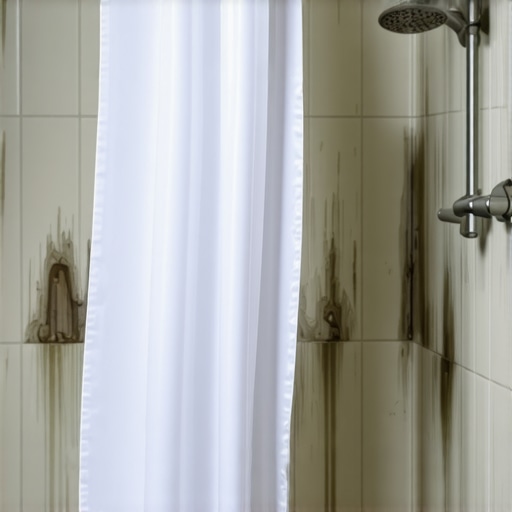
The hidden physics of shower curtains
Shower curtains contribute to grout mold by restricting airflow and creating a high-humidity micro-environment where water remains trapped in the porous structure of cementitious grout for extended periods. This lack of evaporation allows fungal spores to anchor into the grout and feed on organic soap residue. I spent three days grinding concrete on a job last month just so the floor wouldn’t click like a castanet. That job taught me that moisture control is not just about the slab; it is about the environment above it. When you pull a plastic or fabric curtain across a wet shower, you are effectively building a terrarium. The air inside stays saturated. The water on the tile has nowhere to go. It sits there and begins its slow journey into the microscopic pores of your installation. I have seen million-dollar bathrooms ruined because the owner wanted a pretty fabric curtain instead of a properly ventilated glass enclosure. The curtain clings to the edge of the tub or the tile. It seals the edges. This prevents the natural convection that would otherwise pull dry air into the space. Without that air movement, the relative humidity in the shower stall stays near 100 percent for hours after you step out. This is the perfect breeding ground for mold.
Why cement grout is a thirsty sponge
Cement grout is a naturally porous material composed of a network of microscopic voids that pull liquid water deep into the substrate through capillary action. This chemical reality means that any water sitting on the surface will eventually be absorbed unless the grout is perfectly sealed with a high-quality impregnator. When I talk about grout, I am talking about a cementitious matrix. It is basically a very fine concrete. Think about a sidewalk after a rainstorm. It stays dark and damp for a long time. Your shower grout does the same thing. If you want to understand the scale of the problem, look at the technical specifications for standard sanded grout. It can absorb a significant percentage of its weight in water. This is why grout restoration secrets for long-lasting results are so vital for homeowners. You have to break that cycle of absorption. If the moisture stays in the grout, the mold grows from the inside out. By the time you see a black spot, the colony is already established deep within the joint.
“Cementitious grout is a porous material that requires a hydrophobic barrier to prevent liquid ingress.” – Master Flooring Axiom
This axiom is the foundation of every durable shower. You cannot ignore the chemistry of the materials you choose.
The 1/8 inch slope that saves your home
The structural slope of your shower pan determines how quickly water moves toward the drain and away from the vulnerable grout lines and baseboards at the perimeter. If the installer did not achieve a minimum 1/4 inch per foot slope, water will pool in the corners and saturate the transition between the floor and the wall. This is where most mold problems begin. I have seen guys skip the leveling compound and try to eyeball the pitch. It never works. If the water stays on the tile for more than twenty minutes after the shower is off, your slope is failing. This pooling water eventually migrates behind the tile. It hits the waterproofing membrane. If that membrane has even a tiny pinhole, the water gets into the subfloor. This is why I always tell people that showers that wow modern designs for 2025 must prioritize the pre-slope and the pan liner over the color of the marble. You are building a vessel to hold water. If that vessel leaks or holds onto water, the aesthetic does not matter. The moisture will eventually reach your baseboards makeover ideas to elevate your space and rot the wood from the back side. It starts with a little mold in the grout and ends with a structural repair in the crawlspace.
Comparing grout performance and moisture resistance
| Grout Type | Porosity Level | Moisture Resistance | Best Use Case |
|---|---|---|---|
| Sanded Cement | High | Low | Large joints, heavy traffic |
| Unsanded Cement | High | Low | Thin joints, polished stone |
| High Performance | Medium | Moderate | Commercial applications |
| Epoxy Grout | Zero | High | Showers, steam rooms |
The table above shows why your material choice dictates your maintenance schedule. If you use a high-porosity cement grout and then trap it behind a wet shower curtain, you are inviting failure. Epoxy grout is the gold standard because it is non-porous. It does not need a sealer. It does not absorb water. It is a chemical bond that acts like plastic. Most builders avoid it because it is difficult to work with. It is sticky. It has a short pot life. But if you want a shower that stays clean, epoxy is the answer. If you are stuck with cement grout, you must learn how to refresh grout without replacing it to keep the surface dense and protected. A dense grout line is a mold-resistant grout line.
The chemistry of soap scum and spores
Soap scum acts as a nutrient-rich adhesive that traps fungal spores against the grout surface, providing the food source necessary for mold to thrive in damp environments. Most people think mold eats the grout. It does not. Mold eats the skin cells, body oils, and soap residue that get stuck in the texture of the grout. When you use a shower curtain, the bottom edge often drags across the floor or sits in a puddle. This creates a concentrated zone of organic matter. The curtain itself becomes a delivery system for bacteria and fungi. Every time the curtain moves, it releases spores into the humid air. Those spores land on the wet grout. Because the curtain prevents the grout from drying out, the spores have everything they need: water, food, and warmth. This is why tile cleaning tips for a sparkling bathroom in 2025 always emphasize removing the organic film. You have to scrub, not just spray. Chemical cleaners often fail because they cannot penetrate the waxy layer of soap scum that protects the mold colony. You need mechanical agitation. You need to get into the pores and pull that dirt out. I once spent a whole afternoon explaining to a client that their expensive ‘anti-mold’ spray was useless because they never actually rinsed the soap off the walls. The mold was living under the soap, safe from the bleach.
A 10 point checklist for a mold free shower
- Install a high-CFM exhaust fan and run it for 30 minutes post-shower.
- Swap the fabric curtain for a glass door or a non-porous liner.
- Squeegee the walls and floor after every single use.
- Apply a high-quality penetrating sealer to cement grout every year.
- Ensure the shower pan has a minimum 2 percent slope toward the drain.
- Clean the bottom of the shower curtain weekly with a mild bleach solution.
- Use an antimicrobial grout additive during the initial installation.
- Keep the bathroom door open when the shower is not in use to facilitate airflow.
- Check the perimeter caulking for cracks where water can hide.
- Inspect the baseboards outside the shower for signs of moisture migration.
Following this list will save you thousands in remediation costs. It is about discipline. A floor is a system. If you neglect one part of the system, the whole thing fails.
“The maximum allowable deflection for a floor system intended to receive ceramic tile is L/360 under total load.” – TCNA Handbook
While that quote refers to structural movement, the same logic applies to moisture. There is a limit to what the materials can handle. If you exceed the moisture capacity of your grout by trapping it behind a curtain, the system breaks. You get mold. You get rot. You get a bill for a new bathroom. If you are noticing persistent issues, you might need to look at tile cleaning tips for a sparkling bathroom in 2025 to get ahead of the damage. Do not wait until the grout turns black. By then, the water has likely reached the wall studs.
Why your baseboards are rotting from the inside
Moisture from a poorly ventilated shower often travels through the wall cavity or along the floor-to-wall transition, causing baseboards to rot before the mold even becomes visible on the tile surface. This is the ghost in the expansion gap. When you have a shower curtain that allows water to splash onto the bathroom floor, that water finds the edge of the tile. It seeps under the baseboard. Wood baseboards act like a wick. They pull that water up. Because the back of the baseboard is unpainted and unsealed, it absorbs moisture rapidly. This leads to swelling and decay. I have pulled off baseboards that looked fine from the front, only to find a forest of black mold growing against the drywall. This is why chic baseboard designs that transform rooms in 2025 are shifting toward waterproof materials like PVC or high-density polymers in wet areas. If you insist on wood, you must seal every edge. You must caulk the gap between the floor and the board with a high-grade silicone. Do not use cheap painter’s caulk. It will shrink. It will crack. The water will find a way in. I have seen the same thing happen with subfloors. Water creeps out of the shower, hits the plywood, and starts the delamination process. It is a slow-motion disaster. You can avoid it by ensuring your shower curtain stays inside the basin and that you have a proper transition strip at the door. If you need professional advice on these transitions, you can always contact us for a consultation. We see these failures every day and we know how to stop them before they require a full tear-out.