
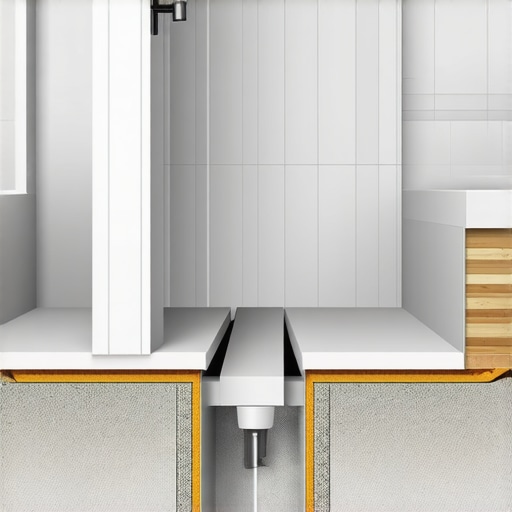
Most guys skip the leveling compound. They think the underlayment will hide the dip. It won’t. I spent three days grinding concrete on a job last month just so the floor wouldn’t click like a castanet. That job was a wake up call for the homeowner who thought their expensive tile was a shield. It was not. Tile is just the face. The real work happens in the layers you never see. I have spent twenty five years on my knees with a moisture meter and I can tell you that a bathroom without a dedicated waterproof membrane is a ticking time bomb. Most people look at a beautiful porcelain floor and see a finished product. I look at it and see a porous network of grout lines and potential fracture points. If you do not respect the physics of water migration, your subfloor will eventually turn into a mushroom farm. It does not matter how much you spent on the stone. Water finds the path of least resistance. It travels through the grout, sits on the thin set, and eventually saturates the plywood or concrete below. This is not a matter of if, but when.
The myth of the waterproof tile surface
Tile and grout are not waterproof materials. Water molecules move through cementitious grout and microscopic cracks in the glaze or stone at a steady rate. Without a membrane, this moisture saturates the subfloor, leading to structural rot and mold colonies that thrive in dark spaces behind the vanity. People assume that because tile feels hard like glass, it must be impenetrable. This is a dangerous lie. Cementitious grout is essentially a hard sponge. It has a high rate of absorption. Even if you use a sealer, that sealer eventually breaks down. When you step out of one of those showers that wow in a modern magazine, you are often standing on a surface that is slowly drinking the puddles. The moisture moves via capillary action. It gets sucked into the grout joints and stays there. In a standard installation without a membrane, that water sits against the subfloor. If you have a wood subfloor, the fibers start to swell. This swelling causes the wood to move, which puts stress on the bond between the tile and the thin set. Eventually, the tile pops loose or the grout cracks. Now you have a bigger hole for more water to enter. It is a cycle of destruction that only stops when the floor is ripped out.
The physics of subfloor deflection and moisture
Subfloor deflection is the measurable movement of a floor system under a load. When moisture enters the subfloor, it softens the wood fibers and increases this movement significantly. A waterproof membrane acts as an uncoupling layer that protects the tile from the structural shifts caused by moisture.
“A floor is only as good as the subfloor beneath it; deflection is the enemy of every joint.” – Master Flooring Axiom
Moisture does more than just rot the wood. It changes the geometry of the entire room. When plywood gets wet, it expands. When it dries, it shrinks. This constant cycle of expansion and contraction is death for a rigid surface like tile. Tile has zero flexibility. If the ground beneath it moves even a fraction of an inch, the tile must either move with it or break. Since the thin set is supposed to hold it tight, the weakest link usually gives way. This is why you see cracked grout in bathrooms that are only a few years old. By installing a membrane, you create a physical break. Most modern membranes are made of polyethylene or similar polymers that are completely impervious to liquid. They also allow for a small amount of independent movement. This is called uncoupling. It means if the subfloor moves slightly due to seasonal humidity, the tile stays still.
How liquid and sheet membranes compare
Liquid membranes are applied with a roller and create a continuous rubberized coating. Sheet membranes are manufactured in controlled environments to ensure consistent thickness and are bonded to the subfloor with thin set. Both options provide a superior moisture barrier compared to traditional cement board alone.
| Feature | Liquid Membrane | Sheet Membrane | Cement Board Only |
|---|---|---|---|
| Application Method | Roller or Brush | Thin-set Bonded | Screwed Down |
| Drying Time | 12 to 24 Hours | Immediate | None |
| Crack Isolation | Moderate | High | Low |
| Perm Rating | Low | Very Low | High |
Sheet membranes are my personal favorite because they offer a guaranteed thickness. When you roll on a liquid, you might go too thin in one spot and too thick in another. A sheet membrane like those used in high end showers with a style for small bathrooms ensures that every square inch of the floor has the same level of protection. This is especially vital in regions like the Pacific Northwest or the humid Southeast. In those climates, the air is already heavy with water. The subfloor is already under stress. You cannot afford a weak spot in your defense.
The role of grout in moisture management
Grout is the most vulnerable part of any tile installation because it is the primary entry point for liquid and vapor. Proper grout selection and maintenance are required to slow down the rate of water penetration into the assembly layers. Many homeowners ask me about how to refresh grout without replacing it when they see stains. Stains are often a sign that the grout is saturated. If the grout is failing, the moisture is already deep in the system. While epoxy grouts are much more resistant to water, they are difficult to install and very expensive. Most residential jobs use standard sand or unsanded grout. These are porous. Over time, the minerals in the water and the chemicals in your soap break down the structure of the grout. This increases its permeability. If you have a membrane underneath, this isn’t a disaster. The water hits the membrane and eventually evaporates back out through the grout once the room dries. Without the membrane, that water has nowhere to go but down.
Chemical bonding and adhesive chemistry
The bond between the tile and the membrane depends on the chemical composition of the thin set mortar. Modified thin sets contain polymers that increase bond strength and flexibility, allowing the entire assembly to resist hydrostatic pressure. You have to understand the chemistry of the