
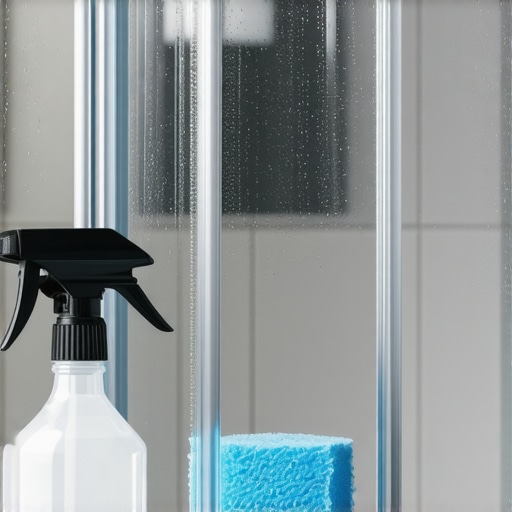
Professional Methods to Remove Calcium Deposits from Glass Shower Doors
I once walked into a house where a fifty thousand dollar master bathroom renovation was being torn apart because the homeowner used an industrial acid to clean their shower glass. The acid was so aggressive it did more than just clear the haze. It ate through the silicone seals, trickled behind the tile, and started a slow rot in the subfloor that nobody noticed until the floor felt like a wet sponge under their feet. I spent three days grinding concrete on a job last month just so the floor wouldn’t click like a castanet because the moisture from a leaking shower door had saturated the slab and caused the leveling compound to spall. People treat glass shower doors as a minor cosmetic detail, but they are a critical water management component. When calcium deposits take over, you are not just looking at an aesthetic problem. You are looking at the degradation of the entire structural system. Hard water minerals act like a slow-moving epoxy, bonding to the glass at a molecular level and eventually creating a bridge that allows water to wick into areas it was never meant to reach, like your baseboards and the grout lines near the threshold.
The chemical reality of mineral bonding
Removing calcium deposits requires breaking the ionic bond between minerals and the silica surface of the glass door. Professional cleaners utilize mild acids to dissolve calcium carbonate without etching the tempered glass. Proper maintenance involves neutralizing the pH level of the surface after cleaning to prevent long-term structural damage to the grout and tile. Many homeowners assume that the white haze on their glass is just a surface stain. It is actually a crystalline lattice of calcium and magnesium that has filled the microscopic pits in the glass. Glass might look smooth to the naked eye, but under a microscope, it is a mountain range of peaks and valleys. When hard water evaporates, the minerals stay behind, settling into those valleys. Over time, these minerals undergo a process called calcification, where they harden into a stone-like layer. If you ignore this for too long, the calcium becomes part of the glass. You cannot just wipe it away. You need a chemical reaction. White vinegar, which contains acetic acid, is the standard for most residential applications because its low pH effectively dissolves the alkaline calcium deposits. However, the concentration matters. A 5 percent acidity vinegar is the baseline, but professional restorers often use a more concentrated solution, heated to approximately 130 degrees Fahrenheit, to accelerate the molecular breakdown of the mineral scale.
Why your subfloor is lying to you about shower leaks
Subfloor integrity is often compromised by the very cleaners used to maintain shower glass and tile surfaces. Overly saturated grout lines allow moisture to migrate through the thin-set and into the wooden or concrete substrate below. Ensuring the shower glass is sealed and free of calcium buildup prevents this capillary action from occurring. When you are scrubbing those glass doors, you are likely spraying a lot of liquid onto the floor. If your grout is not sealed properly, that water is going straight into the floor assembly. I have seen countless cases where a beautifully tiled floor starts to cup or buckle because the owner was obsessed with cleaning the glass but ignored the grout restoration secrets required to keep the assembly waterproof. The water used for cleaning, often laden with the very calcium you are trying to remove, sits at the base of the door. It enters the expansion gap between the tile and the baseboard. If you have installed chic baseboard designs without a proper silicone bead at the bottom, that water is wicking into the drywall or the wall studs. This is why flooring professionals focus on the entire system. A clean glass door is useless if the cleaning process is destroying the subfloor. You must ensure that the transition between the glass, the tile, and the baseboard is impenetrable to the liquids you are using.
“A floor is only as good as the subfloor beneath it; deflection is the enemy of every joint.” – Master Flooring Axiom
The war against calcium carbonate and magnesium
Calcium carbonate removal relies on the application of acidic solvents that safely liquefy mineral buildup for easy mechanical removal. Using a non-abrasive scrubbing pad is essential to protect the factory-applied hydrophobic coatings on modern tempered glass. Always rinse with deionized water to prevent immediate re-mineralization. The physics of this process are straightforward but often ignored. When you apply a cleaner, you are performing a liquid-phase extraction. The calcium must be suspended in the liquid so it can be wiped away. If you don’t use enough liquid, you are just moving the minerals around. This is where most people fail. They spray a mist and wipe. You need to saturate the glass and give the acid time to work. In the flooring world, we call this dwell time. If you are dealing with years of buildup, you might need to soak paper towels in vinegar and stick them to the glass for several hours. This allows the acetic acid to penetrate the full thickness of the calcium layer. For those looking for tile cleaning tips that actually work, this dwell time principle applies to your grout as well. However, be careful. Acid is the enemy of cement-based grout. If you let vinegar sit on your grout lines, it will slowly dissolve the binder and lead to crumbling joints. This is the delicate balance of the master installer. You must clean the glass while protecting the surrounding masonry.
| Cleaning Agent | pH Level | Efficacy on Calcium | Risk to Tile/Grout |
|---|---|---|---|
| White Vinegar | 2.4 | High (with time) | Moderate |
| Lemon Juice | 2.0 | Medium | Low |
| Phosphoric Acid | 1.5 | Very High | Extreme |
| Baking Soda Paste | 8.3 | Low (Mechanical only) | Very Low |
Protecting the tile and grout ecosystem
Maintaining a healthy tile and grout ecosystem requires understanding the porous nature of ceramic and stone surfaces. Calcium deposits on glass often indicate a high mineral content in the water that can also clog grout pores and discolor baseboards. Sealing these surfaces is the only way to prevent permanent staining. If you are interested in eco-friendly tile solutions, you should know that the best way to clean is to not have to clean at all. Hydrophobic coatings for glass act like a wax on a car. They fill the microscopic valleys I mentioned earlier so the water beads up and rolls off, taking the minerals with it. This prevents the calcium from ever getting a foothold. The same logic applies to your baseboards makeover ideas. If you use a high-quality semi-gloss paint or a PVC-based baseboard in the bathroom, you are creating a non-porous barrier. In high-humidity environments like a bathroom, moisture is your constant adversary. Every time you shower, the air is saturated. As that air cools, the moisture condenses on the coldest surfaces, which are usually the glass and the tile. If that moisture is hard water, you are depositing minerals every single day. Over a year, that adds up to a significant amount of rock being built up on your surfaces.
Professional techniques for glass restoration
Restoration techniques for glass involve a combination of chemical dissolution and mechanical polishing using cerium oxide or specialized glass pads. Professionals avoid steel wool or abrasive powders that can create micro-scratches which trap more minerals in the future. Always finish with a pH-neutral cleaner to stabilize the surface. Sometimes, the calcium is so thick that vinegar won’t touch it. In these cases, we look at mechanical removal. But you have to be smart. If you use a razor blade, you risk scratching the tempered glass, which can lead to a spontaneous shatter. Tempered glass is under incredible internal tension. A deep scratch can compromise that tension and cause the whole door to explode. Instead, use a fine-grade polishing paste. You want something with a Mohs hardness lower than glass but higher than calcium. Calcium carbonate has a Mohs hardness of 3, while glass is around 5.5 to 6. If you find a polishing compound in that 4 range, you can scrub away the minerals without touching the glass. This is the same logic we use when choosing underlayments. While most people want the thickest underlayment, too much cushion actually causes the locking mechanisms on LVP to snap under pressure. You need the right hardness for the job.
- Check the pH of your cleaning solution before applying to large areas.
- Use a squeegee after every shower to remove 90 percent of the mineral-laden water.
- Inspect the silicone seals at the base of the glass door every six months.
- Apply a hydrophobic glass treatment every ninety days for maximum protection.
- Ensure the bathroom has adequate ventilation to lower the condensation rate.
- Clean any spray-over on the tile and grout immediately with a neutral cleaner.
Regional climate impacts on mineral buildup
Local water chemistry varies significantly by region, with some areas exhibiting extreme levels of dissolved calcium and magnesium. In dry climates like Phoenix, the rapid evaporation of water leaves behind denser mineral deposits that require more aggressive treatment. Coastal areas may also contend with salt spray that compounds the issue. If you live in a region with high humidity, your shower glass will stay wet longer, which actually gives the minerals more time to bond. In a dry climate, the water flashes off the glass quickly, leaving the minerals behind in a very hard, dry crust. Both scenarios require a specific approach. In the flooring industry, we always adapt to the local climate. The dry heat of Phoenix will shrink your baseboards until they show a gap, while the swampy humidity of Houston means solid wood is a death wish. The same goes for your shower. You have to understand what your local water is doing to your home. If you have hard water, a whole-house water softener is the only real long-term solution. It replaces the calcium and magnesium ions with sodium ions, which do not form the same hard crystalline structures. This protects your glass, your showers with a style designs, and even your plumbing fixtures from internal scaling.
Final thoughts on structural maintenance
The goal is to preserve the integrity of the bathroom as a whole. Every time you clean your shower glass, you are interacting with a complex system of tile, grout, and subfloor. Do not let a simple task like removing calcium deposits lead to a structural failure. By understanding the chemistry of your cleaners and the physics of your surfaces, you can maintain a beautiful, functional space. If you are looking for more inspiration, check out these showers that wow to see how modern engineering is making these maintenance tasks easier. Remember that a floor is more than just a surface. It is the foundation of your daily life. Treat it with the respect that 25 years of experience tells me it deserves. Stop using the wrong chemicals and start paying attention to the details that matter. If you are unsure about a product, test it in a small, inconspicuous area first. And for heaven’s sake, stop ignoring your grout. If you want to know more about how to keep your bathroom looking new, how to refresh grout without replacing it is a great place to start your journey into professional-grade home maintenance.