
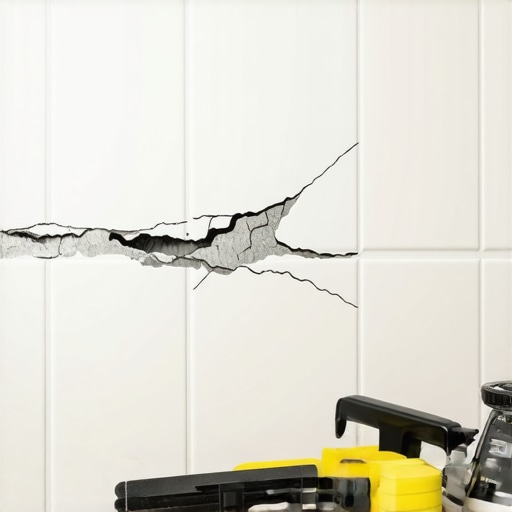
I spent three days grinding concrete on a job last month just so the floor wouldn’t click like a castanet. Most guys skip the leveling compound. They think the underlayment will hide the dip. It won’t. I walked into that bathroom and saw the previous installer had just buttered the back of the tiles and hoped for the best over a slab that looked like the surface of the moon. Within six months, those tiles were snapping like dry twigs. When you see a crack in your bathroom floor, you aren’t looking at a bad tile. You are looking at a failed foundation. Stopping those cracks from spreading requires a deep dive into the structural physics of your home and the chemical bond of your mortar.
The ghost in the expansion gap
To stop tile cracks from spreading, you must verify that the perimeter of the room has a proper expansion gap of at least 1/4 inch. If the tile is butt-jointed against the wall, thermal expansion will cause the floor to heave or crack. Use flexible caulk at changes of plane. Most homeowners and cut-rate contractors make the mistake of grouting the corner where the floor meets the wall. Grout is rigid. Buildings move. When the wood framing in your walls swells during a humid summer, it pushes down on the floor. If there is no gap, that energy has nowhere to go but through the tile. This is where your baseboards become more than just a decoration. They are the mask for the essential structural gap that keeps your floor from exploding under pressure. If you want to see how to integrate these gaps into a high-end look, check out these chic baseboard designs that transform rooms.
Why your subfloor is lying to you
Tile cracks spread because of subfloor deflection which is the vertical movement of the floor joists under a load. Ceramic and porcelain require a deflection rating of L/360, meaning the floor should not bend more than 1/360th of its span. Natural stone requires a much stiffer L/720 rating. I have seen people spend thousands on Italian marble only to put it over a single layer of 5/8 inch plywood. That is a recipe for a disaster. You need to understand the Young’s Modulus of the materials involved. Ceramic is incredibly strong under compression but has almost zero tensile strength. If the wood beneath it bows even a millimeter, the tile cannot stretch to accommodate that movement. It snaps.
“A floor is only as good as the subfloor beneath it; deflection is the enemy of every joint.” – Master Flooring Axiom
The molecular reality of the uncoupling membrane
Uncoupling membranes like Ditra or Stratamat are the primary defense against spreading cracks because they allow for independent movement between the subfloor and the tile. These plastic mats have a hollow structure that lets the subfloor shift horizontally without transferring that shear stress to the tile layer. Think of it like a shock absorber for your bathroom. If your concrete slab develops a settlement crack, an uncoupling membrane ensures that the crack stays in the concrete and does not telegraph through to your porcelain. This is a non-negotiable step for any modern bathroom renovation, especially in showers that wow.
Comparison of subfloor stability for tile installations
| Subfloor Material | Expansion Rate | Deflection Risk | Required Underlayment |
|---|---|---|---|
| Concrete Slab | Low | Low (Settlement only) | Uncoupling Membrane |
| Plywood (Single Layer) | High | Extreme | Cement Backer Board + Plywood |
| OSB (Oriented Strand Board) | Moderate | High | Modified Thin-set + Membrane |
| Existing Vinyl | High | High | Full Removal Recommended |
The chemistry of the bond line
The bond between your tile and the subfloor relies on the polymer content of your thin-set mortar. High-performance mortars contain liquid latex or dry polymers that create a flexible crystalline structure. Using a cheap, unmodified mortar in a bathroom leads to bond failure and spreading hairline fractures. When you mix a bag of thin-set, you are initiating a chemical reaction called hydration. If the subfloor is too dry, it will suck the water out of the mortar before the crystals can grow into the pores of the tile. This creates a weak bond. I always tell people to damp the concrete or plywood first. It sounds like a small detail, but it is the difference between a floor that lasts forty years and one that fails in four. If your grout is already showing signs of this failure, you might need to look into grout restoration secrets to stabilize the system.
Checklist for stopping the spread of tile damage
- Remove the cracked tile and the old mortar down to the subfloor.
- Inspect the subfloor for rot or loose screws.
- Install a crack suppression membrane over the affected area.
- Use a premium modified thin-set with a high polymer count.
- Ensure 95 percent mortar coverage on the back of the tile in wet areas.
- Leave a 1/8 inch gap between tiles for grout to act as a buffer.
- Replace grout with color-matched 100 percent silicone at all corners.
The regional climate factor in Houston and Phoenix
In humid regions like Houston, moisture vapor transmission through concrete can push tiles up, while in dry areas like Phoenix, the rapid shrinkage of wood framing pulls tiles apart. You must select an adhesive and moisture barrier that matches your local atmospheric conditions. If you are building a shower in a swampy climate, you need a topical waterproofing membrane. If you do not, the moisture will stay in the mud bed and eventually rot the framing, leading to structural shifts that crack your tile. For those looking for long-term sustainability, consider eco-friendly tile solutions that handle temperature swings better than standard ceramics.
Grout as a sacrificial lamb
Grout is designed to be the weakest point of the floor so that it absorbs minor stresses before the tile does. If your grout is falling out, it is often a sign that the floor is moving too much. You can refresh grout, but you must fix the movement first. I have seen guys try to use epoxy grout to “glue” a moving floor together. It does not work. The epoxy is so strong that instead of the grout cracking, the tile itself will shatter. You are better off using a high-quality cementitious grout and maintaining it. If your grout is just dirty or minorly cracked, you can learn how to refresh grout without replacing it to save time.
“Tile is a finish, not a structure; it lives and dies by the rigidity of its foundation.” – Flooring Physics Manual
Baseboards and the perimeter secret
The interaction between baseboards and tile is the most overlooked aspect of crack prevention. Baseboards must be pinned to the wall, not the floor, to allow the tile to slide underneath during seasonal shifts. If you nail your baseboard through the tile or into the subfloor, you are locking the floor in place. When the house settles, that tile has nowhere to move. It will buckle in the center of the room. Always leave that small gap. If you are looking to upgrade your trim during this repair, explore some baseboards makeover ideas.
The anatomy of a shower failure
Tile cracks in showers often spread due to the saturation of the sub-pan or the lack of pre-slope on the liner. Water sits under the tile, softens the thin-set, and allows the tile to move and crack. This is the most expensive repair in the business. If you see a crack on a shower floor, stop using it immediately. Water is getting into your framing. You need a system that manages moisture from the surface down. For inspiration on how to rebuild it right, look at showers with a style for small spaces. Regular maintenance is also vital. Use tile cleaning tips to ensure that mold doesn’t eat away at your grout’s structural integrity. If you need professional help, you can always contact us for an assessment.