
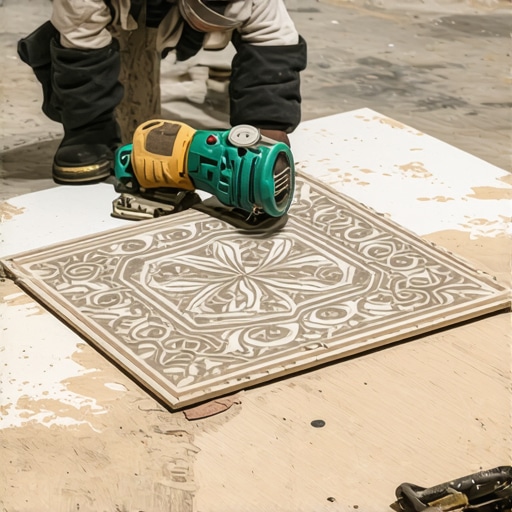
How to cut intricate shapes in floor tile using a jigsaw
Most guys skip the leveling compound. They think the underlayment will hide the dip. It won’t. I spent three days grinding concrete on a job last month just so the floor wouldn’t click like a castanet. That level of obsession with the substrate is what separates a master from a handyman. When you are about to attempt complex radius cuts or intricate notches in high-fired porcelain, the stability of your work surface is the first law of physics you have to respect. If the tile vibrates because it is not fully supported, it will shatter long before the blade finishes its journey. I have seen fifteen dollar slabs of ceramic turn into trash because an installer thought they could shortcut the support phase.
The diamond grit reality
To cut intricate shapes in floor tile with a jigsaw, you must use a diamond-grit T-shank blade, set the tool to a non-orbital setting, and maintain a constant water drip to prevent thermal cracking. This method is superior for U-cuts around pipes and L-cuts at door jambs where a standard wet saw cannot reach. Most people reach for an angle grinder for these tasks, but the jigsaw offers a level of precision and control that a spinning wheel simply cannot match. You are trading speed for accuracy. The physics of a diamond-grit blade involves abrasive erosion rather than traditional sawing. The industrial diamonds embedded in the metal matrix of the blade grind away the silicate and clay particles at a microscopic level. If you push too hard, you create heat. Heat is the enemy of the crystalline structure of the tile. It causes the glaze to expand at a different rate than the biscuit, leading to edge chipping that even the thickest grout cannot hide.
“A floor is only as good as the subfloor beneath it; deflection is the enemy of every joint.” – Master Flooring Axiom
Why your subfloor is lying to you
The success of an intricate cut depends on the structural integrity of the subfloor and the deflection rating of the joist system. If you are working in showers or near baseboards, any movement in the slab will cause the tile to snap during the cutting process. I once walked onto a job where the subfloor was so bouncy the tiles were literally jumping off the thin-set. You cannot cut a radius into a tile that is moving. You need a solid workbench with a sacrificial piece of plywood underneath. This plywood acts as a shock absorber. It dampens the high-frequency vibrations generated by the jigsaw motor. Without this damping, the tile acts like a tuning fork. When the vibration hits the resonant frequency of the ceramic, a stress crack will propagate from the point of contact to the nearest edge. This is why many installers fail at showers with a style trendy ideas for small bathrooms because they underestimate the vibration of the jigsaw on thinner porcelain products. You can find more about bathroom layouts at showers with a style trendy ideas for small bathrooms which requires precise tile work around drains.
The chemistry of the cut
Cutting tile is a battle between the Mohs hardness scale and frictional heat. A standard jigsaw blade meant for wood will be destroyed in seconds because it lacks the thermal conductivity to dissipate the energy. Diamond blades for jigsaws are usually coated with a vacuum-brazed diamond grit. This grit must be kept cool. While you do not need a full submersible tank, a steady stream of water from a sponge or a spray bottle is required. The water serves two purposes. First, it acts as a lubricant to reduce the friction coefficient between the diamond matrix and the tile body. Second, it captures the silica dust. Silica dust is a health hazard that stays in the air for hours. By using a wet cutting technique with your jigsaw, you keep the particles heavy and grounded. This is especially important when you are working near baseboards makeover ideas to elevate your space where dust can settle into the grain of the wood. For more on finishing these edges, see baseboards makeover ideas to elevate your space for professional tips.
| Tool Component | Material Requirement | Purpose | Performance Metric |
|---|---|---|---|
| Blade Shank | T-Shank Steel | Power Transfer | Zero Slip |
| Edge Matrix | Vacuum Brazed Diamond | Abrasive Cutting | 60-80 Grit |
| Motor Setting | Variable Speed | Heat Management | Low RPM |
| Oscillation | Zero / Off | Vibration Control | Stroke Stability |
The ghost in the expansion gap
Every intricate cut must account for the coefficient of thermal expansion in the finished floor. If you cut a hole for a pipe that is too tight, the tile will eventually crack as the house settles or the temperature changes. You need a minimum of a 1/8 inch gap around any vertical obstruction. This gap is later covered by baseboards or escutcheon plates. I have seen beautiful custom showers ruined because the installer cut the tile flush against the plumbing. When the hot water runs, the pipe expands, puts pressure on the tile, and pop. There goes your afternoon. You also have to consider the grout. Modern high-performance grouts have a higher polymer content, but they still cannot handle the structural load of a shifting house. If you are interested in keeping those joints clean after the installation, check out tile cleaning tips for a sparkling bathroom in 2025 for maintenance advice.
“Bond strength is the result of the physical interlocking of the thin-set into the microscopic pores of the tile and the substrate.” – TCNA Technical Bulletin
The 1/8 inch that ruins everything
Precision in cutting is worthless if you do not understand grout joint geometry. When you use a jigsaw to cut a curve, the kerf of the blade must be factored into your measurements. A standard diamond jigsaw blade has a kerf of about 1/16 to 3/32 of an inch. If you cut exactly on your line, your tile will be too small. You must cut on the waste side of the line. This is the difference between a floor that looks professional and one that looks like a DIY disaster. After the cut is made, the edges will be sharp. I always use a diamond hand pad to hone the edge of the cut. This removes the micro-fractures that could lead to larger cracks later. A smooth edge allows the grout to bond better to the tile surface. If you are dealing with old grout that needs attention during a renovation, you might want to look at how to refresh grout without replacing it to save time on the project.
Preparation and safety protocols
Before the first spark flies, you need a rigid checklist to ensure the tile survives the process. The jigsaw is a high-vibration tool. If the tile is not clamped properly, it will chatter. Chattering is the primary cause of blade breakage and tile snapping. I use a piece of 1/4 inch foam under the tile to provide a uniform pressure surface while still allowing the blade to pass through. This also protects the finished surface of the tile from being scratched by the metal baseplate of the jigsaw. You should also cover the baseplate with blue painter’s tape to provide an extra layer of protection. This is a trick I learned after scratching a very expensive set of natural stone tiles on a custom hearth job. If you are looking for more sustainable options for your next project, read about eco-friendly tile solutions for sustainable homes in 2025 to see how materials are evolving.
- Verify subfloor deflection ratings before starting any installation.
- Select a diamond grit density appropriate for the hardness of your tile.
- Set the jigsaw to a zero-orbital oscillation setting to prevent upward thrust.
- Use blue painter’s tape on the cut line to prevent glaze chipping.
- Prepare a spray bottle with water and a small amount of dish soap for lubrication.
The contrarian data point on speed
While most people believe that high-speed cutting is efficient, the excessive heat generated in a jigsaw cut actually creates microscopic fractures in the glaze that will eventually absorb moisture and lead to discoloration. You want to run your jigsaw at about 50 to 60 percent of its maximum speed. This slower pace allows the diamond grit to actually work through the material without turning the blade red hot. If you see smoke, you are going too fast. If the water on the tile starts to boil, you are going too fast. This patience is what ensures the longevity of the installation. For those looking to finish their rooms with modern accents, chic baseboard designs that transform rooms in 2025 offers great insight into the latest trends. Proper cutting techniques ensure these transitions look perfect. If the grout does eventually fail or stain, you can find grout restoration secrets for long-lasting results to bring the floor back to life. For any questions on specific materials, feel free to visit our contact us page.