
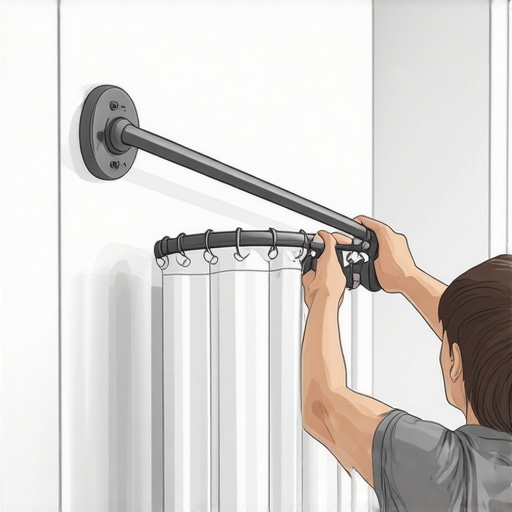
I spent three days grinding concrete on a job last month just so the floor wouldn’t click like a castanet. That job was a wake-up call for the homeowner. Most guys skip the leveling compound and they think the underlayment will hide the dip. It won’t. I was there because their floor was failing. While I was packing up my grinders, the homeowner asked me why their shower curtain rod kept hitting the floor. I looked at the wall and saw the problem immediately. It wasn’t the rod. It was the structural integrity of the substrate and the lack of friction on the tile. You see, I have spent 25 years on my knees with a moisture meter. I smell like WD-40 and oak dust most days. To me, a shower isn’t just a place to wash up. It is a high-moisture structural envelope where physics and chemistry are constantly at war. If your rod is falling, you are losing that war. This guide is about winning it through engineering rather than hope.
The physics of tension and friction loss
Shower curtain rods fail when the axial force exerted by the internal spring is overcome by the vertical load of the curtain and gravitational pull. This happens because of a reduction in the static friction coefficient between the rubber end caps and the non-porous tile surface or slick grout lines. Most rods rely on simple compression. When steam enters the room, it creates a microscopic layer of lubrication. That water film acts as a mechanical separator. It breaks the bond. You are essentially trying to hold a heavy metal pipe against a sheet of ice. Most people think they just need to twist the rod tighter. They are wrong. Overtightening can lead to wall deflection. If the wall moves even a fraction of a millimeter, the tension drops to zero instantly. It will buckle. This is why understanding the substrate is vital. If you have hollow walls without proper blocking, no amount of twisting will save you.
“A floor is only as good as the subfloor beneath it; deflection is the enemy of every joint.” – Master Flooring Axiom
The ghost in the expansion gap
Wall deflection and substrate instability are the primary reasons tension rods slip on ceramic tile or porous stone. When I install a floor, I worry about the subfloor. When you install a rod, you must worry about what is behind the tile. If the builder used thin drywall instead of cement backer board, the wall has too much flex. Every time you pull the curtain, the wall bows out. This increases the distance between the two contact points. When the distance increases, the compression of the internal spring decreases. It is a simple matter of Hooke’s Law. Once the compression drops below the threshold required to maintain friction, gravity wins. You need a surface that does not move. This is why I always check for studs or solid blocking before I blame the hardware. If you are dealing with moisture issues that affect the walls, you might want to look at grout restoration secrets for long-lasting results to ensure the moisture isn’t rotting the studs behind the tile.
The chemical breakdown of rubber end caps
Elastomeric polymers used in shower rod end caps degrade over time due to oxidation and surfactant exposure from soaps and shampoos. These end caps are supposed to provide grip. However, the chemical environment of a bathroom is harsh. Over months, the rubber loses its plasticizers. It becomes brittle. Once it loses its elasticity, it cannot conform to the microscopic irregularities of the tile. It becomes a hard plastic-on-hard-tile scenario. There is no grip. I often see people trying to fix this with tape. That is a temporary fix. You need to restore the friction. I recommend cleaning the area with a high-strength degreaser. If the tile is too smooth, you are fighting a losing battle. You can find better materials by looking into eco-friendly tile solutions for sustainable homes in 2025 which often feature textures that provide better mechanical grip for hardware.
Grout lines and the path of least resistance
Grout joints create irregular surface planes that interfere with the load distribution of a shower rod end cap. If the edge of your rod sits halfway on a grout line and halfway on a tile, you have a pressure imbalance. This causes the rod to tilt. Once the rod is no longer perfectly perpendicular to the wall, the force vector shifts. Part of the tension is now pushing the rod down rather than against the wall. I always tell people to align the rod center with the center of a tile. Avoid the grout lines if possible. If your grout is recessed or crumbling, it provides even less support. You should learn how to refresh grout without replacing it to create a more level surface for your bathroom fixtures. A flat surface is a stable surface.
Baseboards and the structural height connection
Vertical alignment and plumb walls are essential for keeping a shower rod from migrating toward the floor. I spend a lot of time thinking about how walls meet the floor. If your baseboards makeover projects have taught you anything, it should be that nothing in a house is truly square. If the walls of your shower taper outward as they go up, the rod will naturally want to slide down to the narrower point. This is basic geometry. You must use a level to ensure the rod is perfectly horizontal. If one side is even an eighth of an inch lower than the other, the vibration of sliding the curtain will cause it to walk down the wall. This is the same principle I use when installing chic baseboard designs. Alignment is everything.
“Precision in the foundation prevents failure in the finish.” – Master Flooring Axiom
Regional climate and the condensation factor
Ambient humidity in regions like Florida or Louisiana increases the dew point inside the bathroom, leading to surface condensation on tile walls. In a dry climate like Phoenix, your rod might stay up for years. In a humid climate, the walls are always slightly damp. This moisture acts as a lubricant. If you live in a high-humidity area, a tension rod is a gamble. You are better off using a permanent mount that screws into the substrate. The heat also causes the metal rod to expand and contract. This thermal cycling can loosen the internal spring mechanism over time. If you are designing showers that wow in a humid environment, always opt for mechanical fasteners over tension systems.
The 1/8 inch that ruins everything
Micrometer measurements show that a displacement of 0.125 inches is enough to cause most spring-loaded mechanisms to lose 40 percent of their clamping force. This displacement happens when the shower curtain is pulled too hard. It happens when someone hangs a wet towel on the rod. It happens when the house settles. You have to treat the rod like a structural beam. It has a weight limit. If you exceed that limit, you are stretching the spring beyond its elastic limit. Once the spring is deformed, it will never hold the same tension again. It is junk. Throw it away and buy a rod with a locking nut rather than just a spring. If you need help with your bathroom layout, you should contact us for professional advice on hardware selection.
Technical comparison of shower rod systems
| Feature | Tension Rod | Screw-In Bracket | Dual-Tension Lock |
|---|---|---|---|
| Max Load Capacity | 10-15 lbs | 40-60 lbs | 20-25 lbs |
| Surface Requirement | Non-porous/Flat | Any Substrate | Semi-Porous |
| Installation Time | 2 Minutes | 20 Minutes | 5 Minutes |
| Wall Damage Risk | Low (Compression) | Medium (Drilling) | Low (Compression) |
| Failure Rate | High | Low | Medium |
The checklist for a rod that never moves
- Check the wall for plumb and squareness using a 4-foot level.
- Clean the tile surface with isopropyl alcohol to remove soap scum and oils.
- Inspect the rubber end caps for signs of dry rot or cracking.
- Ensure the rod is positioned on the flat face of the tile, avoiding grout lines.
- Apply a thin layer of silicone adhesive to the end caps if you want a semi-permanent grip.
- Use a rod with a mechanical locking screw rather than a simple internal spring.
- Verify that the wall substrate is solid and not flexing under pressure.
Maintaining the structural bond
Regular maintenance involves re-tensioning the rod every three months and cleaning the contact points to prevent biofilm buildup. If you ignore the rod, it will ignore its job. The accumulation of hairspray, steam, and dust creates a slick film. I see this all the time. People spend thousands on showers with a style but then use a five-dollar rod and never clean it. Use tile cleaning tips to keep the entire area pristine. If the surface is clean and the tension is checked regularly, the rod will stay. If you treat it like a ‘set and forget’ item, expect to find it on the floor. I don’t care how expensive your tile is. Gravity doesn’t care about your budget. It only cares about friction and force. Keep the friction high and the force balanced. That is the only way to keep your bathroom from becoming a construction site. Check your privacy policy if you are worried about contractors in your home, but the best way to keep them out is to do the job right the first time.