
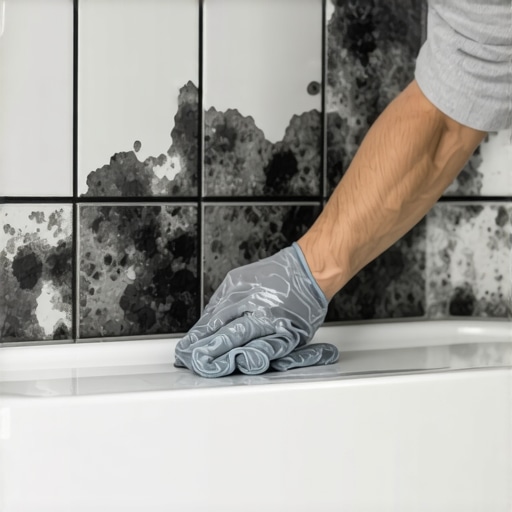
I spent three days grinding concrete on a job last month just so the floor wouldn’t click like a castanet, only to have the homeowner ask if they could soak their new shower grout in straight bleach the next day. It nearly broke my heart. People think grout is some indestructible barrier, like a sheet of solid steel. It is not. Grout is a porous, sand based structural element that is more like a very hard sponge than a solid rock. When you see black mold creep into those lines, your first instinct is to go nuclear with the chemicals. That is exactly how you ruin a five thousand dollar tile job. Most guys skip the leveling compound and then wonder why the grout cracks, but even a perfect installation can be destroyed by a bottle of cheap supermarket cleaner. You need to understand the physics of the surface before you start scrubbing.
The microscopic war in your bathroom
To clean black mold from grout without damaging the seal, you must avoid acidic cleaners and high-pressure scrubbing. Using a pH-neutral cleaner or a diluted hydrogen peroxide solution ensures the integrity of the sealer remains intact while killing fungal spores at the microscopic level. You are fighting a biological organism that thrives in the tiny voids between your sand particles. When water penetrates a failing seal, it sits there, trapped against the thin-set. This creates a nursery for mold. If you use a harsh acid, you aren’t just killing the mold, you are eating away the Portland cement that holds the sand together. You will end up with a sandy mess and a hollow joint. For more on maintaining these surfaces, check out tile cleaning tips for a sparkling bathroom in 2025 to keep your installation fresh.
“A floor is only as good as the subfloor beneath it; deflection is the enemy of every joint.” – Master Flooring Axiom
Why your subfloor is lying to you
The moisture levels in your subfloor or wall substrate often dictate how fast mold grows back after a cleaning session. If your cement board was not properly waterproofed with a liquid membrane, the grout will stay damp from the inside out, making surface cleaning a temporary fix. I have seen showers that looked clean on the outside but were rotting from the studs because of capillary action. This is why moisture meters are the most important tool in my kit. If the humidity behind the tile is over twenty percent, that black mold is coming back no matter what you spray on it. You need to address the structural integrity of the vapor barrier before worrying about the aesthetic.
| Cleaner Type | pH Level | Safety on Sealer | Mold Killing Power |
|---|---|---|---|
| Bleach | 12.0 | Very Low | High |
| Vinegar | 2.5 | Very Low | Medium |
| Hydrogen Peroxide | 4.5 | Medium | High |
| Neutral Cleaner | 7.0 | Very High | Low |
| Enzymatic Cleaner | 7.5 | High | High |
The 1/8 inch that ruins everything
Precision in grout lines is not just about visual symmetry. A grout joint that is too narrow will not allow the sealer to penetrate deeply enough to protect the sand structure. Conversely, a joint that is too wide without enough polymer additives will crack under the deflection of the subfloor. These micro-fissures are the highway for black mold. When you clean, you are trying to reach into these 1/8 inch gaps without delaminating the topical seal. If you use a wire brush, you are mechanical stripping the protection away. You need a soft nylon brush and chemistry on your side. Learn about how to refresh grout without replacing it to see how we handle joints that have gone past the point of a simple scrub.
The physics of the grout seal
A penetrating sealer works by molecularly bonding to the silica in the grout. It fills the pores so that liquid water cannot enter, but vapor can still escape. When you use aggressive chemicals, you break these chemical bonds. The black mold actually feeds on the organic matter that gets trapped in the degraded sealer. It is a vicious cycle. You think you are cleaning, but you are actually opening the door for more mold. You should always test your seal by dropping water on the grout line. If it beads up, the seal is intact. If it soaks in and darkens the grout, your protection is gone. In that case, you are just washing a sponge.
“Modern grout technology relies on polymer chains; once these chains are broken by high-pH chemicals, the structural integrity of the joint is compromised.” – TCNA Technical Bulletin
The checklist for a safe mold extraction
- Vacuum the area first to remove loose spores and dry debris.
- Apply a pH-neutral enzymatic cleaner specifically designed for tile.
- Let the solution dwell for ten minutes to allow the enzymes to break down the mold roots.
- Gently agitate with a soft nylon brush in a circular motion.
- Rinse with distilled water to prevent mineral buildup from tap water.
- Dry the area immediately with a microfiber cloth to prevent moisture lingering.
The ghost in the expansion gap
Most mold issues start at the baseboards or the corners of the shower. This is because installers often grout these change-of-plane joints instead of caulking them. Grout is rigid. Houses move. When the house settles, the grout in the corners cracks, creating a perfect dark pocket for mold. You should check your baseboards and shower transitions for these cracks. If you see black spots there, cleaning won’t help much. You need to remove the grout and replace it with a color-matched silicone. This is part of the grout restoration secrets for long lasting results that we use in the field. For more ideas on how to handle these transitions, look at chic baseboard designs that transform rooms in 2025.
Chemistry over conflict
Stop scrubbing like you are trying to sand down a floor. The black mold is a biological entity. It responds better to oxygen-based cleaners like sodium percarbonate. This chemical reaction lifts the mold out of the pores without melting the sealer. If you live in a high-humidity area like Florida or Louisiana, your grout is under constant moisture stress. In these climates, you should be sealing your grout every six months, not once a year. The atmospheric moisture alone is enough to degrade the seal over time. If you have questions about specific regional requirements, you can always contact us for advice on your flooring architecture.
“,”image”:{“imagePrompt”:”A close-up high-resolution photo of a master floor installer’s hand using a soft nylon brush to clean a clean, white grout line between marble tiles. A small bottle of pH-neutral cleaner is in the background, and a moisture meter is resting on the tile surface. The lighting is professional and emphasizes the texture of the grout.”,”imageTitle”:”Professional Grout Cleaning Technique”,”imageAlt”:”A specialist cleaning black mold from tile grout using professional tools and pH-neutral solutions.”},”categoryId”:1,”postTime”:”2023-10-27T10:00:00Z”}