
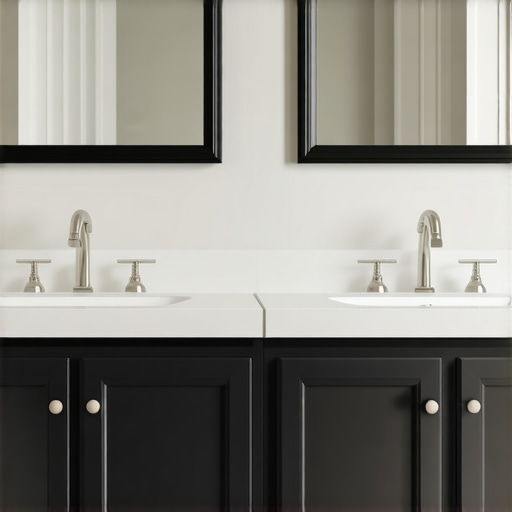
Most guys skip the leveling compound. They think the underlayment will hide the dip. It won’t. I spent three days grinding concrete on a job last month just so the floor wouldn’t click like a castanet. That job taught me that if you do not have a flat substrate, your vanity will sit crooked and your baseboards will show gaps that no amount of caulk can hide. In the world of high-end bathroom remodeling, the connection between your vertical surfaces and the floor is where the amateur is separated from the master. Matching baseboard color to a new bathroom vanity is not just an aesthetic choice. It is a technical integration that must account for light refraction, moisture resistance, and material expansion. Most homeowners look at a color chip and think they are done. They are wrong. You have to consider how the semi-gloss of the trim will interact with the satin finish of the cabinetry while sitting atop a tile floor that likely has its own color temperature and grout line rhythm.
The physics of bathroom moisture and trim selection
Matching baseboard color to a bathroom vanity requires selecting moisture-resistant materials like PVC or primed finger-jointed pine coated in high-solids enamel. The color coordination must account for the high humidity levels found in wet rooms where showers and steam can cause wood fibers to swell at different rates than the vanity carcass. I have seen million-dollar bathrooms ruined because someone installed MDF baseboards against a solid oak vanity. The MDF absorbed the ambient humidity from the showers that wow in the brochure but rot in reality. You need a paint with a high pigment-to-binder ratio to ensure that the color you see on the vanity matches the baseboard exactly under 3000K LED lighting. When we talk about color matching, we are really talking about the chemistry of light. A navy blue vanity will reflect light differently than a navy blue baseboard if the sheen levels are even five percent apart. This is why I always specify the same manufacturer for both the vanity paint and the trim enamel. If you are using a pre-finished vanity, you must take a drawer front to a professional paint shop for a spectrophotometer reading. Do not trust your eyes in a showroom with high-pressure sodium lights. They lie.
The 1/8 inch that ruins everything
A successful color match between trim and cabinetry depends on the physical transition at the floor level. If your subfloor has a deflection of more than 1/16 of an inch over a ten-foot span, your baseboards will never sit flush against the vanity. This creates a shadow line that breaks the visual continuity of the color match. I always tell my apprentices that the shadow is a color too. If you have a dark gap between a white baseboard and a white vanity, you have failed the color match. You must ensure the chic baseboard designs you choose are scribed to the floor perfectly. We use compasses to mark the contours of the tile into the bottom of the wood. It is tedious. It is hard on the knees. But it is the only way to make the vanity look like it grew out of the wall. I have seen guys try to fill a quarter-inch gap with silicone. It looks like a slug crawling across the floor. When the light hits that silicone, it reflects differently than the paint, ruining the color match. You want a mechanical fit, not a chemical patch.
“A floor is only as good as the subfloor beneath it; deflection is the enemy of every joint.” – Master Flooring Axiom
Why your subfloor is lying to you
Subfloor moisture content is the primary factor in why baseboard colors seem to change after installation. If your slab is off-gassing moisture, that water vapor gets trapped behind the baseboard. This moisture can cause the paint to leek surfactants or amber over time. This is especially true with oil-based finishes. If you want your baseboards to stay the same color as your vanity, you need to use a moisture barrier. I use a high-grade polyurethane sealant on the back of every piece of trim before it hits the wall. People think I am crazy for painting the back of the wood. I am not. I am preventing the wood from cupping. When wood cups, it tilts the face of the board away from the light source. This changes the perceived color. A board tilted five degrees down will look darker than a board perfectly vertical because of the way the overhead vanity lights cast shadows. In a bathroom with modern showers with a style that emphasizes clean lines, these micro-shadows are the enemy of a cohesive design.
The chemistry of the color bond
Selecting the right primer is more important than selecting the right topcoat color for bathroom baseboards. Most people use a cheap latex primer and wonder why their paint peels after six months of steam. You need a bonding primer that can bite into the factory finish of the vanity if you are painting it to match, or a stain-blocking primer for the trim. The grout restoration secrets we use for floors also apply to the perimeter of the room. If you have porous grout near your baseboards, it will wick moisture up into the trim. This moisture will cause the paint to delaminate. I always recommend a 100 percent acrylic resin paint for bathroom trim. These resins are flexible. They can handle the expansion and contraction of the wood without cracking. If the paint cracks, you lose the color match because the raw wood underneath is exposed. It looks like a mess. You want a finish that behaves like a plastic skin but looks like a traditional enamel.
| Material Type | Moisture Resistance | Color Stability | Expansion Rate |
|---|---|---|---|
| Solid Oak | Medium | High | High |
| PVC Trim | Maximum | Maximum | Low |
| MDF | Low | Medium | Very High |
| Primed Pine | Medium | Medium | Medium |
The ghost in the expansion gap
Floating floors require a specific approach to baseboard color matching to hide the necessary expansion gaps. If you are installing a luxury vinyl plank or a waterproof laminate, you need a gap at the perimeter. This gap is a black hole for design. If you match the baseboard color to the vanity, but the shoe molding is a different color, you create a tiered wedding cake effect that looks cluttered. My rule is simple. Match the shoe molding to the baseboard, not the floor. If the vanity is a deep charcoal, and the baseboards are white, the shoe molding must be white. This maintains the height of the trim. I have seen people try to match the shoe molding to the tile. It makes the floor look like it is climbing the walls. It is a visual disaster. For those interested in baseboards makeover ideas, remember that the goal is to ground the vanity, not to highlight the floor’s edges.
- Always check the moisture content of the wood with a pin-meter before painting.
- Use a high-quality caulk with 25 percent movement capability at the vanity junction.
- Sand between every coat of paint with 220-grit sandpaper for a glass-like finish.
- Seal the end-grain of the baseboards where they meet the vanity to prevent water wicking.
- Match the sheen level of the vanity exactly to avoid specular reflection mismatch.
Technical specifications for high-traffic bathroom trim
The Janka hardness of the wood used for baseboards affects how the color will look over years of vacuuming and mopping. Harder woods like maple or oak have tighter grain patterns that take paint more evenly. Softer woods like pine have earlywood and latewood densities that can cause the paint to soak in unevenly, leading to a blotchy color match. If your vanity is a smooth, factory-finished piece, you will never get a perfect match on a grainy wood like oak unless you use a grain filler. I spend hours with a slurry of wood flour and resin to fill every pore before I even think about a primer. This is what it takes to get that “zero-threshold” look where the vanity and the wall appear as one unit. If you are dealing with a eco-friendly tile solutions project, the grout color also plays a role. A contrasting grout will draw the eye to the floor, while a matching grout allows the baseboard-to-vanity transition to take center stage. I always suggest a neutral grout to keep the focus on the cabinetry and trim work.
“Moisture management is not a suggestion; it is the physical requirement for any successful installation.” – Master Flooring Axiom
The truth about white on white
There are over two hundred shades of “contractor white” and none of them match each other perfectly. If you buy a white vanity from a big-box store and paint your baseboards with a stock white from a different brand, they will clash. One will look yellow, and the other will look blue. This is called metamerism. It is the phenomenon where colors match under one light source but not another. I once did a bathroom where the client insisted on “pure white” for everything. In the morning, it looked great. At night, the vanity looked like a smoker’s teeth because the LED bulbs had a high CRI that revealed the yellow undertones in the factory finish. To avoid this, always test your paint samples on a piece of trim and hold it directly against the vanity in the bathroom’s actual lighting. Do not do this in the garage. Do it in the room where the how to refresh grout project is happening. The proximity to the tile and the vanity is the only way to be sure.
The final transition
Matching baseboard color to your bathroom vanity is the final step in a long chain of structural decisions. It starts with the concrete slab and ends with the final brushstroke. If you skip the leveling, the sanding, or the moisture testing, the color will not matter because the installation will fail. Take the time to understand the materials. Respect the physics of the bathroom environment. If you want a space that lasts until 2030 and beyond, you have to work with the house, not against it. Clean up your tile cleaning tips for the final walkthrough and ensure every joint is tight. That is how you build a floor that people remember. That is how you act as a master of the craft. For more information on professional installation, you can contact us or read our privacy policy.