
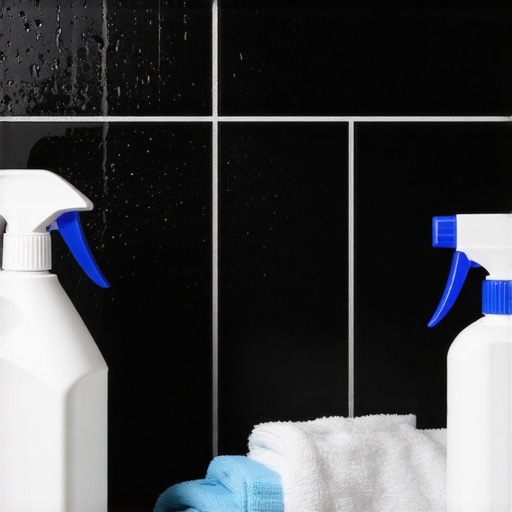
The Molecular Battle Against Hard Water Stains on Dark Surfaces
I spent three days last month grinding a concrete subfloor just so a large-format porcelain tile wouldn’t click like a castanet, and that experience reminded me of a fundamental truth. A floor, whether it is under your feet or on your shower wall, is a performance surface. When you install dark tile, you are choosing a high-maintenance aesthetic that demands technical respect. Most homeowners see a white haze on their charcoal slate or midnight porcelain and think it is just dirt. It is not. It is a geological event happening in your bathroom. Hard water stains are primarily composed of calcium and magnesium carbonates that have chemically bonded to the microscopic pits in your tile surface. If you do not understand the pH scale or the structural porosity of your grout, you will destroy your finish long before you get it clean. We are going to look at the chemistry of dissolution and the physics of surface tension to restore your shower to its intended architectural state.
The Mineral Assault on Dark Surfaces
Hard water stains on dark shower tiles are mineral deposits left behind when water evaporates, leaving calcium and magnesium solids bonded to the surface. Removing these requires an acidic solution to break the ionic bonds of the minerals without etching the tile or degrading the cementitious grout. Darker pigments in ceramic and natural stone highlight these white crystalline structures, making even thin deposits visible to the naked eye. To handle this, you must apply a controlled chemical reaction that dissolves the scale while protecting the integrity of the tile glazing.
I once walked into a luxury penthouse where the owner had installed $40-per-square-foot basalt tiles in the master bath. Within six months, the bottom three feet of the shower looked like it had been spray-painted with chalk. The installer had failed to mention that their local water had a grain hardness of 15, which is essentially liquid rock. They tried to scrub it with a generic abrasive, which just scratched the soft volcanic stone. This is why we focus on the chemistry first. You need to understand that calcium carbonate is a base. To neutralize and dissolve it, you need a safe acid. But if you go too strong, you eat the lime in your grout, and then you are looking at grout restoration secrets for long-lasting results rather than a simple cleaning job.
“A floor is only as good as the subfloor beneath it; deflection is the enemy of every joint, and mineral accumulation is the enemy of every finish.” – Master Flooring Axiom
Why Your Tile Pores Are Trapping Minerals
Tile porosity determines how deeply hard water minerals can anchor into the surface and how difficult they are to extract. While porcelain has a water absorption rate of less than 0.5 percent, natural stones like slate or travertine are incredibly thirsty, allowing mineral-rich water to penetrate the sub-surface. When the water evaporates, the minerals remain trapped in the internal matrix of the stone. This creates a ghosting effect where the tile looks clean when wet but reveals white haze as soon as it dries. You have to reach into those pores with the right surfactant to lift the minerals out.
The Chemistry of the Acetic Acid Solution
We use a 50-50 mix of distilled white vinegar and water for most ceramic and porcelain jobs. The acetic acid reacts with the calcium carbonate to produce carbon dioxide gas and water-soluble calcium acetate. This is a basic chemical displacement. However, you cannot use this on natural stone. If you put vinegar on marble or limestone, you are performing a controlled demolition of the tile surface. For dark porcelain, the acidity is your friend. You apply the solution, let it dwell for exactly ten minutes to allow the reaction to reach equilibrium, and then agitate with a non-marring synthetic pad. If you want to see what professional results look like, check out tile cleaning tips for a sparkling bathroom in 2025 for more nuanced approaches.
The Physics of Grout Degradation
Grout is essentially a thin ribbon of concrete. It is porous and alkaline. Every time you use an acid to clean your tile, you are slightly weakening the grout’s molecular structure. This is why I always tell people to seal their grout lines with a high-quality penetrating sealer. If you don’t, the hard water minerals will grow inside the grout, and eventually, they will expand and cause the grout to crumble. If your grout is already looking rough, you might need to know how to refresh grout without replacing it before you start the heavy cleaning process.
[IMAGE_PLACEHOLDER]
The Ph Scale of Common Cleaning Agents
Understanding the pH level of your cleaning agents is the difference between a clean shower and a ruined installation. Neutral cleaners sit at 7.0, while acidic cleaners used for mineral removal sit between 2.0 and 4.0. Alkaline cleaners, which are great for soap scum and body oils, sit between 8.0 and 12.0. You must never mix these, or you risk creating toxic fumes or neutralizing the cleaning power of both. For dark tiles, you usually need a two-stage approach: alkaline first to strip the oils, then acidic to dissolve the minerals.
| Cleaning Agent | pH Level | Best For | Risk Factor |
|---|---|---|---|
| White Vinegar | 2.5 | Calcium Deposits | High for Marble |
| Citric Acid | 2.2 | Heavy Scaling | Moderate Etching |
| Neutral Cleaner | 7.0 | Daily Maintenance | Very Low |
| Baking Soda Paste | 9.0 | Soap Scum | Abrasive Scratching |
| Sulfamic Acid | 1.2 | Industrial Scale | Extremely High |
The Expansion Gap and Your Baseboards
Moisture wicking from shower runoff can destroy the baseboards adjacent to the enclosure if the transition is not handled with structural foresight. In many of the showers that wow modern designs for 2025, we see zero-entry transitions. This looks great but creates a massive risk for water migration. If you are cleaning your tiles with heavy volumes of water and acidic solutions, you must ensure your chic baseboard designs are protected with a proper bead of 100 percent silicone caulk. Wood baseboards will soak up that acidic runoff and begin to rot from the backside where you cannot see it. I have replaced miles of baseboards because a homeowner was too aggressive with a shower sprayer while trying to rinse off cleaning chemicals.
The Mechanical Abrasion Protocol
Sometimes chemistry isn’t enough. You might need a mechanical assist. I recommend using a white nylon scrub pad or a dedicated tile brush. Never use steel wool on dark tile. Steel is harder than the glazing on many ceramic tiles and will leave microscopic grey scratches that are impossible to remove. For dark porcelain, you can sometimes use a pumice stone, but you must keep it incredibly wet. A dry pumice stone on a dark tile is a recipe for a $5,000 replacement bill. It is all about the Mohs scale of mineral hardness. Your cleaning tool must be softer than the tile but harder than the calcium deposit.
- Test a small inconspicuous area first to check for pigment lifting.
- Apply the acidic solution and let it sit for 10 minutes.
- Scrub in a circular motion to lift the dissolved minerals.
- Rinse with distilled water to prevent new spots from forming.
- Dry the surface immediately with a microfiber towel.
- Inspect for any remaining haze and repeat if necessary.
The Ghost in the Expansion Gap
The most common failure in tile maintenance is the neglect of the expansion joints where the wall meets the floor. These joints should never be filled with hard grout. They must be filled with color-matched caulk. Hard water loves to sit in these corners, and if the caulk is failing, the mineral-rich water will seep behind the tile. This leads to efflorescence, which is a white powdery substance that looks like hard water but actually comes from the mortar bed itself. If you see white crust coming out of your corners, you don’t have a cleaning problem; you have a structural moisture problem. You might want to look into showers with a style trendy ideas for small bathrooms to see how modern waterproof systems prevent this.
“Efflorescence is the subfloor’s way of telling you that water has found a path where it does not belong.” – Master Flooring Axiom
The Final Polish and Long Term Protection
Once you have successfully removed the minerals, you cannot just leave the tile naked. For dark tiles, I recommend a high-quality tile polish or a stone enhancer if you are working with natural materials. These products fill the microscopic pores so that water beads off rather than sitting and evaporating. It is the same logic as waxing a car. You are creating a sacrificial layer. If you use a squeegee after every shower, you can extend the life of this protection significantly. People hate hearing that. They want a permanent fix. But in the world of flooring and tile, there is no such thing as a maintenance-free surface. There is only a surface you haven’t neglected yet.
If you are planning a renovation, consider eco-friendly tile solutions for sustainable homes in 2025 that feature pre-sealed surfaces. These are becoming more common and can save you hours of labor down the line. Remember, the goal of cleaning dark tile is to preserve the architectural intent. You want that deep, moody aesthetic without the distraction of geological buildup. Take your time, respect the chemistry, and always keep your baseboards dry. If you run into issues you can’t solve, feel free to contact us for professional guidance on your specific flooring or tile challenge.