
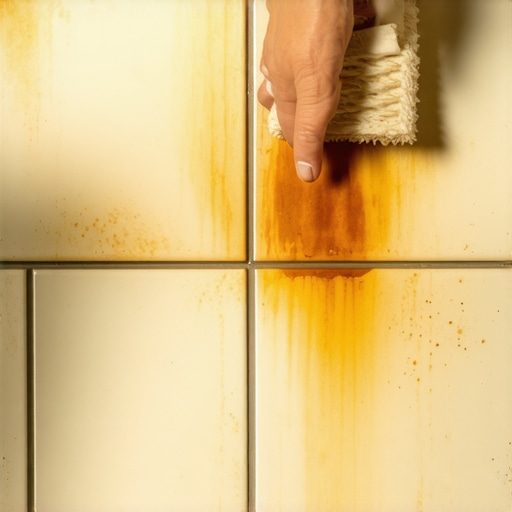
The physics of oxidation on ceramic surfaces
Rust stains on bathroom tiles are not just surface blemishes. They represent a complex chemical interaction between iron oxide and the silicate structures of your flooring. Most homeowners treat rust like a simple spill, but a master installer knows that iron particles can bond at a molecular level with the microscopic pores of the tile. To truly remove these stains, you must understand the redox reactions taking place. When moisture from your showers meets iron-rich metal or mineral-heavy water, the resulting oxidation creates a stubborn bond. I spent three days grinding concrete on a job last month just so the floor wouldn’t click like a castanet, and I learned that ignoring the source of the problem is the quickest way to failure. Rust is no different. If you do not stop the moisture source, the orange ghost will return within weeks. This is a structural challenge, not a cosmetic one.
The hidden moisture trap behind your baseboards
Baseboards often act as a dam for moisture that feeds rust growth in the corners of a bathroom. When water seeps behind the perimeter, it sits against the wall studs and the subfloor, creating a high-humidity microclimate. This environment accelerates the corrosion of any metal fasteners or plumbing fixtures. If you are seeing rust at the edges of your floor, the problem is likely structural. Check the integrity of your perimeter seals. You might find that baseboards makeover ideas to elevate your space include not just aesthetic upgrades but also the installation of moisture-resistant materials that prevent this specific type of decay. High humidity in areas like Houston or the coastal regions of Florida makes this an absolute necessity for floor longevity.
“A floor is only as good as the subfloor beneath it; deflection is the enemy of every joint.” – Master Flooring Axiom
The chemistry of acid neutralization on ceramic
Removing iron oxide requires an acidic intervention to break the ionic bond between the rust and the tile. However, the pH level of your cleaner is a dangerous variable. Use an acid that is too strong, and you will etch the glaze of the tile or dissolve the calcium carbonate in your grout. Oxalic acid is the industry standard because it acts as a chelating agent. It surrounds the iron ions and makes them water-soluble. This is far more effective than abrasive scrubbing which often just scratches the surface and creates more hiding places for future stains. You should follow established tile cleaning tips for a sparkling bathroom in 2025 to ensure you are using the correct concentrations. A 5 percent solution of oxalic acid is usually sufficient for most ceramic and porcelain surfaces without causing structural damage to the silicate matrix.
| Cleaning Agent | pH Level | Effectiveness on Rust | Risk to Grout |
|---|---|---|---|
| White Vinegar | 2.5 | Low | Moderate |
| Oxalic Acid | 1.3 | High | High if not neutralized |
| Lemon Juice | 2.2 | Low | Low |
| Commercial Rust Remover | 1.1 | Very High | Significant |
Why your subfloor is lying to you
If you see rust blooming in the center of a tile floor with no metal objects nearby, your subfloor is the culprit. Moisture rising through a concrete slab or a damp crawlspace can carry minerals and metallic salts through the capillary pores of the grout. This is known as efflorescence, but when iron is present, it manifests as rust. I once walked into a house where a homeowner thought their tiles were defective, but the reality was a pinhole leak in a copper pipe beneath the slab. The water was reacting with the rebar in the concrete and leaching rust up through the floor. No amount of scrubbing will fix a subfloor that is actively breathing moisture. You must ensure your moisture barrier is intact and that your grout is properly sealed. For those looking at long term health, understanding grout restoration secrets for long lasting results is the only way to block these subterranean stains.
The 1/8 inch that ruins everything
Precision in grout lines is about more than just straight rows. A narrow grout joint, typically 1/8 inch or less, reduces the surface area available for moisture absorption and stain penetration. When grout is too wide or poorly packed, it becomes a sponge for rust-laden water. In modern showers that wow modern designs for 2025, we see a trend toward large format tiles with minimal joints. This is a technical advantage. Less grout means fewer opportunities for iron to settle. If your current grout is already compromised by deep-set rust, you might need to learn how to refresh grout without replacing it to strip away the oxidized layer and reseal the surface with a high-solids penetrant. Always remember that grout is the most vulnerable part of your floor assembly.
- Identify the metal source creating the rust stain
- Test a small area with a mild acid solution
- Apply the cleaner and allow for dwell time of five minutes
- Scrub with a soft nylon brush to avoid scratching the glaze
- Neutralize the area with a baking soda and water mixture
- Rinse thoroughly with distilled water to remove mineral residue
- Seal the grout once the area is completely dry
“The presence of moisture is the single most common cause of flooring failure, whether through expansion or chemical staining.” – NWFA Technical Guidelines
Tools that actually penetrate the silicate matrix
You cannot use a standard mop to fight rust. You need tools that can reach into the texture of the tile. A stiff-bristled nylon brush or a specialized grout saw for physical removal may be required if the stain is deep. Avoid steel wool at all costs. Steel wool leaves behind microscopic shards of iron that will eventually rust, creating a cycle of staining that is impossible to break. This is the kind of mistake that amateurs make because they want a quick result. If you are dealing with delicate materials, consider eco friendly tile solutions for sustainable homes in 2025 which often feature denser glazes that resist penetration. The tools you choose must respect the MOHS hardness scale of your tile. Porcelain is much harder than ceramic and can withstand more aggressive mechanical cleaning, but even it has its limits. Always verify the PEI rating of your floor before applying heavy pressure.