
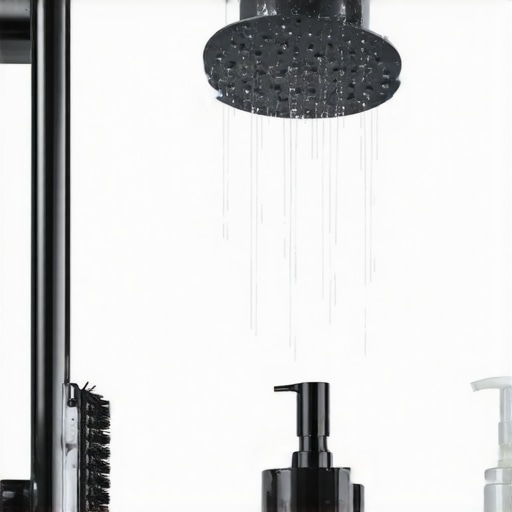
The hidden cost of the modern aesthetic
To clean hard water from a matte black shower head effectively you must use a diluted white vinegar solution or a pH-neutral cleaner specifically formulated for PVD finishes. Avoiding abrasive pads and harsh chemicals like bleach is essential to prevent permanent etching of the delicate surface texture. I spent three days grinding concrete on a job last month just so the floor wouldn’t click like a castanet, and that same level of obsessive attention to detail is required when you touch a matte black fixture. Most people treat their shower heads like a piece of industrial plumbing. In reality, a matte black finish is a sophisticated engineering achievement. It is usually created through Physical Vapor Deposition or a high-grade powder coating. When calcium carbonate from your water supply hits that surface, it does not just sit there. It bonds at a molecular level into the microscopic topography that gives the fixture its flat, non-reflective look. If you go in with a scrub brush, you are essentially sandpapering the finish. I have seen thousand-dollar primary suites ruined because a homeowner thought a little bit of steel wool would speed things up. It did. It sped up the replacement process. You need to understand the chemistry of the water and the physics of the finish before you pick up a spray bottle. Hard water contains high concentrations of dissolved minerals, primarily calcium and magnesium. As water evaporates from the shower head, these minerals precipitate and form a hard, crusty lattice. On a chrome fixture, you might not notice it immediately. On matte black, it looks like a white, chalky disease. It ruins the visual weight of the room and eventually clogs the neoprene nozzles, leading to pressure imbalances that can stress your internal valves.
The physics of the matte black surface
A matte black shower head achieves its signature look by scattering light across a textured surface rather than reflecting it back in a single direction. This texture consists of microscopic peaks and valleys that are incredibly sensitive to oils, acids, and mechanical friction. When we talk about grout and tile, we often focus on the sealant, but the shower head is the most vulnerable point of the entire wet zone. I once walked into a house where the homeowner had used a heavy-duty descaler on their hardware. The minerals were gone, but the black finish had turned a sickly, iridescent gray. The acid had eaten into the PVD layer. You have to treat these surfaces with the same respect you would give a high-end engineered hardwood floor. You do not just drench it and hope for the best. You apply science. The bond between the mineral scale and the fixture is an ionic attraction. To break it without destroying the substrate, you need a mild acid that can dissolve the calcium without reacting with the metallic coating. This is why the concentration of your cleaning agent is more important than the brand name on the bottle. If you are also dealing with bathroom maintenance, checking tile cleaning tips for a sparkling bathroom in 2025 can provide a broader context for your cleaning regime. The goal is to soften the mineral deposits so they can be wiped away with a microfiber cloth, which has a fiber density high enough to lift the debris without scratching the peaks of the matte finish.
The 50/50 vinegar myth that ruins hardware
Using undiluted or high-concentration vinegar can strip the protective topcoat of a matte black shower head if left to soak for too long. The acetic acid in vinegar is an effective solvent for calcium carbonate, but it is also a corrosive agent that can interact with the binders in powder coatings. For showers with high-end fixtures, a 1:3 ratio of vinegar to distilled water is the safest starting point. Distilled water is vital because it contains no minerals of its own, allowing the vinegar to focus entirely on the scale. When you soak a shower head, you are initiating a chemical reaction. The acetic acid reacts with the calcium carbonate to produce calcium acetate, carbon dioxide, and water. If you leave the fixture submerged for hours, the acid begins to look for the next thing to dissolve. In many cases, that is the very finish you paid a premium for. This is similar to how over-wetting a subfloor leads to rot. It is about controlled exposure. If your shower head is fixed to the wall, you can use a plastic bag and a rubber band, but you must set a timer. Fifteen minutes is usually the limit for a matte finish. Anything longer and you are gambling with the integrity of the PVD layer. Once the time is up, you must neutralize the acid by rinsing with fresh water and drying the fixture completely. Water left to sit will just create new spots.
“A floor is only as good as the subfloor beneath it; deflection is the enemy of every joint.” – Master Flooring Axiom
Grout and the porous perimeter problem
Water that drips from a scaled shower head often carries dissolved minerals into the grout lines, causing localized staining and structural weakening of the cementitious bond. Because grout is naturally porous, it acts like a wick for any mineral-laden water that hits the floor or walls. If you are trying to keep a clean bathroom, you cannot ignore the relationship between the hardware and the surrounding surfaces. If your shower head is spraying at an odd angle due to mineral buildup, it might be hitting the transition between the wall and the pan where the caulk is starting to fail. This is a recipe for disaster. I have seen subfloors rotted through because a clogged shower head diverted water behind the escutcheon plate and into the wall cavity. It is all connected. You should look into grout restoration secrets for long-lasting results to ensure your entire enclosure is as resilient as your hardware. When cleaning the shower head, be careful not to let the runoff sit on your tile. The acidic cleaning solution that dissolves the scale on the shower head can also eat away at your grout if it is not properly sealed. It is a delicate balance of chemistry. You are trying to kill the minerals on the metal without killing the minerals in the grout. This is why a targeted application is always better than a general spray-and-pray approach.
Baseboards that survive the splash zone
Standard MDF baseboards will swell and disintegrate if exposed to the humidity and overspray common in bathrooms with poorly maintained shower heads. In the world of high-end flooring, we always check the moisture barriers and the expansion gaps around the perimeter. For bathrooms, your baseboards need to be either PVC or a highly sealed hardwood to resist the constant cycle of wetting and drying. If your matte black shower head is spraying erratically, you are increasing the ambient humidity in the room, which can cause wood components to expand and contract. This leads to gaps where mold can take hold. If you are planning a renovation, looking at chic baseboard designs that transform rooms in 2025 will show you materials that handle moisture better than the cheap builder-grade stuff. A well-functioning shower head keeps the water where it belongs, in the pan and down the drain. When the nozzles are clear, the stream is laminar and predictable. When they are clogged, the water atomizes into a fine mist that settles on every surface, including the top edge of your baseboards and the back of your vanity. This is how