
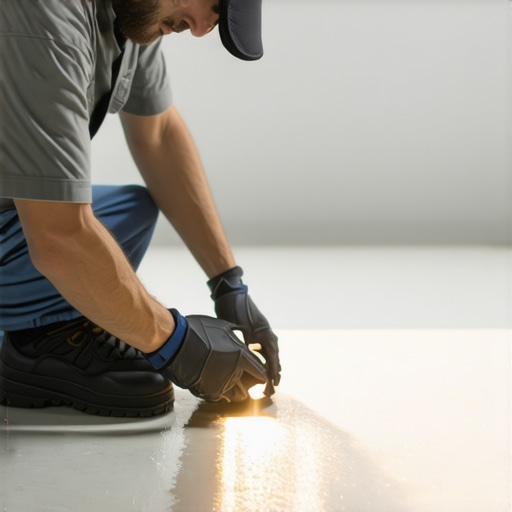
The anatomy of a shower curb failure
A shower curb leak occurs when water penetrates the waterproof membrane and rots the wood framing, often caused by improper flashing at the junction of the curb and the wall. Most failures start at the corners where installers take shortcuts with the liner. I spent three days grinding concrete on a job last month just so the floor would not click like a castanet, and it reminded me of how many guys skip the leveling compound. They think the underlayment will hide the dip. It will not. In the world of high-end showers, the subfloor and the curb framing must be perfect before the first drop of water ever hits the drain. If the subfloor is out of level by even 1/8 inch, the water will pool in the corners of the curb rather than flowing toward the pre-slope. This creates a constant hydrostatic pressure against the grout and the flashing. Water is a patient destroyer. It does not care about your expensive marble or your fancy fixtures. It only cares about gravity and finding the weakest point in your armor. If you do not understand the physics of a capillary break, your bathroom floor is a ticking clock. This guide breaks down the structural engineering required to build a curb that lasts decades.
Why your subfloor is lying to you
Subfloor levelness is the foundation of a waterproof shower because any deflection in the joists will eventually crack the grout joints and compromise the membrane. Most installers assume a plywood subfloor is ready for tile. It rarely is. You must check for deflection ratings. For natural stone, you need an L/720 rating, while ceramic and porcelain require L/360. If your floor bounces when you walk on it, the shower curb will eventually pull away from the wall. This creates a microscopic gap. Water enters that gap via capillary action. Capillary action is the ability of a liquid to flow in narrow spaces without the assistance of, or even in opposition to, external forces like gravity. This means water can actually travel upward behind your tile if the bond is not solid. I once saw a $15,000 project fail because the installer did not account for the moisture vapor transmission rate of the concrete slab below. The moisture pushed up through the slab, hit the waterproof liner, and had nowhere to go but out into the hallway carpet. This is why a proper moisture barrier and a level subfloor are not suggestions. They are requirements for survival.
“A floor is only as good as the subfloor beneath it; deflection is the enemy of every joint.” – Master Flooring Axiom
The flashing trick that saves your floor
The flashing trick involves using pre-formed waterproofing corners and a continuous U-shaped membrane over the curb to eliminate the need for screws on the top or inside of the dam. The most common mistake is a contractor driving a screw through the top of the curb to hold the cement board in place. Every screw hole is a leak waiting to happen. Instead, you should wrap the liner over the curb and secure it only on the outside face. This ensures that even if water gets past the tile, it stays trapped within the shower pan and drains toward the weep holes. You also need to integrate the curb flashing with the showers that wow modern designs for 2025 that utilize linear drains. Linear drains require a one-way slope, which puts even more pressure on the curb flashing. I prefer using a liquid-applied membrane like RedGard or Laticrete Hydro Ban over a traditional PVC liner. These products create a monolithic bond with the substrate. This means there are no seams. No seams means no leaks. When you are working with tile cleaning tips for a sparkling bathroom in 2025, you will realize that a well-sloped, well-flashed curb is much easier to maintain because it does not hold stagnant water in the grout lines.
| Membrane Type | Thickness (mils) | Vapor Permeance | Application Method |
|---|---|---|---|
| PVC Sheet Liner | 40 | Low | Mechanical/Adhesive |
| Liquid Membrane | 30 (dry) | Very Low | Roller/Brush |
| Bonded Sheet | 20 | Extremely Low | Thin-set mortar |
| CPE Liner | 40 | Low | Mechanical/Adhesive |
Molecular bonds in thin set mortars
Modified thin-set mortars use polymers to create a flexible chemical bond that can withstand the expansion and contraction of a shower environment without shearing. Unmodified thin-set is just sand and cement. It is brittle. In a shower, the temperature changes from 60 degrees to 105 degrees in minutes. This causes thermal expansion. If your curb is built with wood, the wood expands at a different rate than the tile. This is called the coefficient of thermal expansion. Polymer-modified mortars act like a shock absorber. They allow for a tiny amount of movement without the bond breaking. You must also ensure 95% coverage on the back of the tile. Most guys just ‘spot bond’ or ‘dot’ the tile. This leaves air pockets. Air pockets collect water. Water in air pockets grows mold. If you want grout restoration secrets for long lasting results, start by ensuring your tiles are fully collapsed into the mortar bed. Use a notched trowel and back-butter every single piece of tile that goes on that curb. The bond must be absolute. Any void is a potential failure point where moisture can collect and begin the slow rot of your subfloor.
The 1/8 inch slope that matters
The top of a shower curb must always be sloped toward the drain at a minimum of 1/8 inch per foot to prevent standing water from penetrating the grout. A flat curb is a failed curb. Even if your waterproofing is perfect, standing water will eventually degrade the grout and cause efflorescence. Efflorescence is that white, powdery mineral deposit that grows out of grout lines. It happens when water dissolves minerals in the mortar and brings them to the surface as it evaporates. If you slope the curb correctly, the water runs off immediately. This is also vital for the longevity of your baseboards makeover ideas to elevate your space that sit just outside the shower. If the curb is flat, water will wick out and rot the bottom of your baseboards. I have seen beautiful chic baseboard designs that transform rooms in 2025 get destroyed in six months because a shower curb was 1/16th of an inch out of level. You must use a small torpedo level during the mud-set phase to verify the pitch. Do not trust your eye. Your eye will lie to you. The level will not.
- Verify the pre-slope is 1/4 inch per foot toward the drain.
- Apply a secondary waterproofing layer over the curb and up the walls 6 inches.
- Use alkali-resistant mesh tape on all curb corners before liquid waterproofing.
- Perform a 24-hour flood test before installing any tile.
- Ensure the curb wrap overlaps the pan liner by at least 2 inches.
Why grout is not a waterproof barrier
Grout is a porous material that slows down water penetration but does not stop it, making the underlying flashing and membrane the only true protection for your home. Many homeowners believe that sealing grout makes it waterproof. This is a myth. Sealer is a stain inhibitor, not a water barrier. Water will eventually pass through the grout. This is why the ‘flashing trick’ at the curb is so vital. When the water passes through the grout on the curb, it hits the membrane and flows back into the pan. If your flashing is wrong, that water hits the wood 2x4s. Wood is a sponge. It will soak up that water and swell. This swelling cracks more grout, which lets in more water. It is a feedback loop of destruction. If you are looking to how to refresh grout without replacing it, you must first ensure the structure behind it is dry. Grout colorant can hide stains, but it cannot hide a rotting curb. Always use a high-quality epoxy or high-performance cement grout like Mapei Ultracolor Plus FA in wet areas. These grouts have lower absorption rates and higher compressive strengths than standard sanded grout.
“Waterproofing is not about keeping the tile dry; it is about managing the water that inevitably gets behind the tile.” – TCNA Handbook Principle
The final inspection
Building a shower that lasts is about respecting the chemistry of the materials and the physics of water. You cannot rush a curb. You cannot skip the flood test. The flashing trick of using a continuous membrane without penetrations is the difference between a bathroom that lasts 30 years and one that needs a total gut job in five. I always tell my clients that they can pick the cheapest tile in the world, but they should never pick the cheapest installer. The money is in the prep. It is in the grinding of the concrete, the leveling of the joists, and the meticulous application of the flashing. When you sit down to plan your next renovation, look at showers with a style trendy ideas for small bathrooms and remember that the beauty is only skin deep. Underneath that tile is a structural engineering challenge that requires precision. If you treat your floor like a performance surface and follow these NWFA and TCNA standards, you will never have to worry about a leak again. Take the time to do it right, or take the time to do it twice. The choice is yours.