
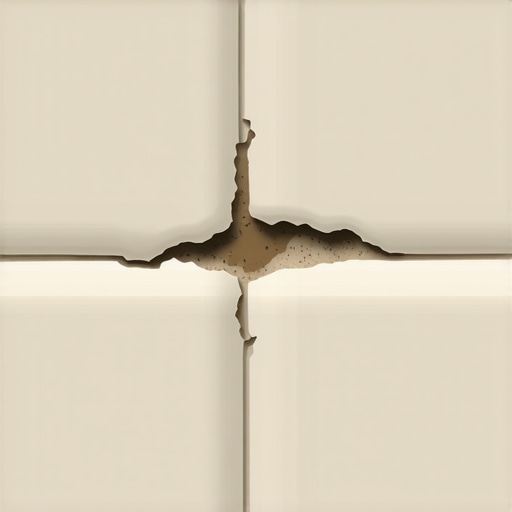
The moisture lock that rots your walls
Grout sealant is designed to protect your tile installation from stains and water infiltration, but applying it too early or using the wrong chemical composition creates a vapor barrier that traps moisture against the substrate. This trapped humidity becomes a breeding ground for mildew and mold that grows invisible to the naked eye. When moisture is locked beneath a topical sealer, it cannot evaporate, leading to a breakdown of the adhesive bond and the eventual structural failure of the wall or floor. I spent twenty-five years on my knees looking at grout lines. Most people see a decorative color. I see a chemical highway that either allows a building to breathe or causes it to choke. I once spent four hours chipping away at a shower pan that looked fine on top but smelled like a deep swamp because an installer sealed the grout while the thin-set was still off-gassing. The homeowner had spent fifteen thousand dollars on a custom marble shower, but because the sealer was applied forty-eight hours after the tile was set in a high-humidity environment, the water was trapped. The mildew had colonized the entire mortar bed. It was a total loss. This is the reality of the sealant trap. Most guys skip the moisture meter. They think if the grout looks dry to the touch, it is ready for a plastic coat. It is not. Cementitious grout is a porous network of portland cement and sand. It contains microscopic capillaries. If those capillaries are full of water when you apply a film-forming sealer, you are not protecting the floor. You are sealing in its destruction.
The physics of capillary action in cementitious grout
Portland cement grout is a naturally breathable material that functions through capillary action, allowing vapor to move from the substrate through the grout joints to the surface for evaporation. When you understand the molecular structure of cement, you realize it is more like a hard sponge than a solid rock. If the substrate behind the tile, such as a cement backer board or a mortar bed, contains any residual moisture, that moisture must escape. In many modern showers, the waterproofing layer is directly behind the tile. This creates a sandwich effect. If the grout is sealed with a non-breathable topical sealer, the moisture has nowhere to go. It sits against the tile edges. It sits against the thin-set. Eventually, this leads to efflorescence, where mineral salts are pushed to the surface, creating a white, chalky crust under the sealer. This is often the first sign of a sealant trap. You can learn more about maintaining these surfaces at tile cleaning tips for a sparkling bathroom in 2025. Many installers use topical sealers because they provide a high-gloss finish that looks great for the first week. These sealers are essentially liquid plastic. They create a film that sits on top of the grout rather than penetrating the pores. This film is a death sentence for a wet shower. It prevents the natural drying cycle. Without that cycle, microbial life like aspergillus and stachybotrys find the perfect dark, damp environment. They feed on the organic dust and skin cells that wash into the grout lines before the sealer is applied. By the time you see the black spots under the clear coat, the mold is already deep in your wall assembly.
“A floor is only as good as the subfloor beneath it; deflection is the enemy of every joint.” – Master Flooring Axiom
Why your sealant is a plastic cage
Topical sealers create a non-permeable layer that prevents the transmission of water vapor, which is the primary cause of sub-surface mildew growth in wet areas. I always tell my clients that they should favor penetrating sealers, also known as impregnators, over topical coatings. Penetrating sealers work at the molecular level. They line the walls of the grout pores with silanes or siloxanes. This makes the grout hydrophobic, meaning it repels liquid water, but it remains vapor-permeable. This means the grout can still breathe. If moisture gets behind the tile through a hairline crack or a corner joint, it can still evaporate out. If you use a cheap topical sealer from a big-box store, you are essentially shrink-wrapping your shower. This is why many people find that their grout looks darker or blotchy after sealing. That blotchiness is often trapped water that cannot get out. If you are dealing with old, compromised grout, you might want to look at how to refresh grout without replacing it before you commit to a new sealer. The chemical bond of a topical sealer is also weaker than a penetrating one. As you walk on the floor or scrub the shower, the film begins to flake. These microscopic flakes allow water to enter but still prevent it from leaving. It is a one-way valve for rot. When I inspect a failing bathroom, I look for these peeling edges. They are the red flags of a bad install.
The breakdown of sealer performance data
| Sealer Type | Vapor Permeability | Best Use Case | Risk Factor |
|---|---|---|---|
| Penetrating (Impregnating) | High | Showers and natural stone | Requires precise application |
| Topical (Film-forming) | Low to Zero | Dry indoor decorative floors | Peeling and moisture trapping |
| Solvent-Based Impregnator | Moderate | Dense tiles and outdoor stone | High VOCs and strong odor |
| Water-Based Impregnator | High | General residential use | Lower durability than solvent |
How to spot the invisible bloom
Identifying mildew trapped under grout sealant requires a close inspection for dark discolorations that do not disappear when scrubbed with traditional cleaners. If you scrub your grout and the black or green spots remain unchanged, the mold is likely beneath the sealer. This is the invisible bloom. It is protected from your cleaning chemicals by the very sealer meant to keep the grout clean. To fix this, you have to chemically strip the sealer. It is a nightmare of a job. You have to use heavy solvents to melt the plastic film, then use an antimicrobial wash to kill the mold, and then wait days for the grout to fully dry. Most people don’t have the patience for that, so they just paint over it with grout colorant. That is just adding another layer to the cage. It is better to do it right the first time. You can find more advice on long-term care at grout restoration secrets for long-lasting results. Another sign is the smell. If your bathroom always smells a bit like a damp basement no matter how much you clean, the moisture is trapped. It is saturating the drywall or the wood studs behind the tile. This is where baseboards come into play. If the moisture is high enough, it will wick into the bottom of your baseboards, causing them to swell and the paint to peel. This is a sign that the tile assembly is holding water.
The proper way to dry a wet substrate
Before any sealer is applied to grout, the substrate must be tested with a moisture meter to ensure the moisture content is below five percent. I never trust the calendar. I don’t care if the thin-set bag says it cures in twenty-four hours. If you are in a place like New Orleans or Seattle, the humidity in the air slows down the evaporation process. You need to use a non-invasive moisture meter. You press it against the grout lines. If the needle jumps, you wait. I have waited as long as ten days before sealing a shower in a coastal home. You can also use a simple plastic sheet test. Tape a small square of clear plastic over a section of the grout. If condensation appears under the plastic after twenty-four hours, the floor is still wet. Do not seal it. If you are looking to finish your room after the floor is done, consider your options for chic baseboard designs that transform rooms in 2025, but make sure the wall-to-floor transition is dry before installing them. Proper airflow is essential. I often bring in industrial fans and dehumidifiers to speed up the process. It seems like overkill to most homeowners, but it is the difference between a floor that lasts forty years and a floor that fails in four.
Steps for a failure proof grout seal
- Wait a minimum of 72 hours after grouting before testing for moisture.
- Perform the water drop test to see if the grout is already dense enough to resist water.
- Clean the grout with a pH neutral cleaner to remove any construction dust.
- Ensure the room temperature is between sixty and eighty degrees Fahrenheit.
- Apply a high-quality penetrating impregnator sealer rather than a topical film.
- Wipe away all excess sealer from the tile surface within ten minutes.
- Allow the sealer to cure for forty-eight hours before using the shower.
“A grout joint is a structural relief valve; if you plug it with plastic, the pressure will find another way out.” – TCNA Installation Manual Commentary
Baseboards and the silent moisture bridge
Baseboards act as a visual finish but often serve as a bridge that pulls trapped moisture from a poorly sealed floor into the wall cavity. If you have a tile floor where the grout was sealed incorrectly, the water that cannot evaporate will travel horizontally. It moves toward the edges of the room. When it reaches the perimeter, it hits the baseboards. Most modern baseboards are made of MDF or finger-jointed pine. These materials are like sponges for moisture. If your grout is holding water, your baseboards will be the first thing to rot. This is why I always leave a small expansion gap between the tile and the wall, which is then covered by the baseboard. But I never caulk the bottom of the baseboard to the tile in a way that creates an airtight seal. You need a way for air to move. If you want to see how to properly integrate these elements, check out baseboards makeover ideas to elevate your space. The goal is an integrated system where every component can handle the moisture levels of the environment. In high-humidity regions like Florida, I suggest using PVC or composite baseboards that won’t rot, but even then, the moisture trapped behind them can lead to mold on the drywall. It is a chain reaction that starts with a simple bottle of cheap grout sealer.
Reclaiming a compromised shower floor
To fix a floor where mildew is trapped under the sealer, you must remove the existing coating entirely using a chemical stripper or mechanical abrasion. This is the hard truth. You cannot just put more sealer on it. You have to go back to the original porous state of the grout. I use a heavy-duty floor stripper and a stiff nylon brush. You have to work in small sections. Once the sealer is gone, you treat the area with a mixture of hydrogen peroxide and water. This kills the spores without leaving a residue like bleach does. Bleach is mostly water anyway, and adding more water to a moisture problem is like putting out a fire with gasoline. After the antimicrobial treatment, you must let the floor dry for a week. Use a dehumidifier. Get the moisture content down to a point where the meter won’t even move. Only then can you apply a high-quality penetrating sealer. This process is tedious and messy, but it is the only way to save the installation. If the mold has already reached the wall studs, you are looking at a full tear-out. This is why I am so militant about the drying phase. A little patience in the beginning saves a massive headache at the end. For those looking for more modern design ideas that avoid these pitfalls, showers that wow modern designs for 2025 offers great insights into better material choices. Don’t let a ten-dollar bottle of sealer ruin a ten-thousand-dollar bathroom. Respect the chemistry of the materials and give the water a way out. It is the only way to build a floor that actually lasts a lifetime. “
Comments
One response to “The Hidden Grout Sealant Trap That’s Actually Trapping Mildew Under the Surface”
This is such a thorough and insightful post. I especially appreciated the emphasis on real scientific principles like capillary action and the importance of proper curing time before sealing. In my recent renovation project, I encountered similar issues with mold after sealing too early without proper moisture testing. It made me realize how critical it is to use a moisture meter and to understand the materials’ breathability. I’ve also noticed that many homeowners overlook the significance of adequate drying time, especially in high-humidity areas like Florida. I wonder, how often do you recommend re-testing the moisture levels in the grout after a few days of air drying before applying a sealer? Also, do you have any practical tips for homeowners who want to ensure their grout stays healthy long-term without exhaustive maintenance? Thanks for sharing your expertise — it’s inspiring to see such a detailed approach to avoiding future problems.