
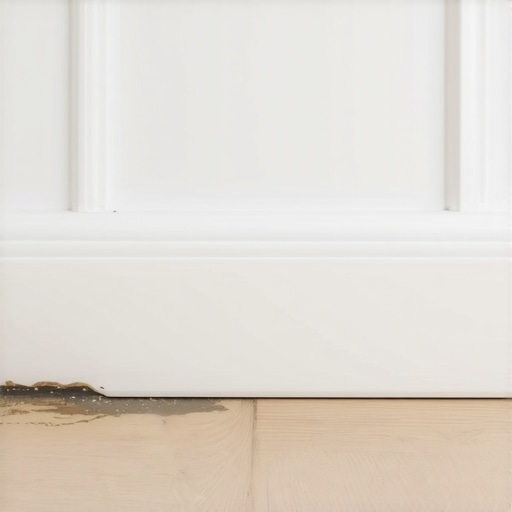
The microscopic trap in your trim
Baseboard dirt accumulation occurs when static electricity, filtration soiling, and low-grade latex paint create a surface that actively captures particulate matter. If your trim looks grey despite scrubbing, you likely have air leaks behind the molding or a sticky polymer residue from cleaning agents. Identifying the root cause requires looking past the surface at the structural interface between the wall and the flooring system. I once walked into a luxury penthouse where the owner had spent thousands on professional cleaning. The baseboards still looked like they were coated in soot. After pulling one piece of molding, I found that the installer had skipped the caulk bead at the bottom of the drywall. The home was literally breathing through the baseboards. Every time the HVAC kicked on, it pulled dust and insulation fibers from the wall cavity and deposited them right on the white paint. It was a filtration soiling nightmare that no amount of soap could fix. I spent three days sealing those gaps just so the homeowner could finally have a clean-looking room. It taught me that dirt is often a symptom of a failing building envelope rather than poor housekeeping. To understand why your home is fighting you, we have to look at the physics of the floor.
“A floor is only as good as the subfloor beneath it, deflection is the enemy of every joint.” – Master Flooring Axiom
The physics of air movement and dust filtration
Filtration soiling is a process where the carpet or baseboard acts as a filter for airborne pollutants passing through structural gaps. This phenomenon creates a dark line or shadow effect that is chemically bonded to the paint fibers or grout lines. When air moves from high-pressure areas to low-pressure areas, it carries micro-particulates that get trapped in the first porous surface they hit. Your baseboards are at the front lines of this battle. If there is a gap between your subfloor and your drywall, the baseboard is the only thing standing in the way of the dust inside your walls. Because most installers use a pneumatic nailer and move on, they leave a micro-void behind the wood. This creates a vacuum effect. If you have showers nearby, the moisture in the air makes these particles even stickier. For those struggling with bathroom trim, reading about tile cleaning tips for a sparkling bathroom in 2025 can offer some relief, but the structural leak must be addressed. I recommend a high-performance acoustical sealant behind the baseboard to stop the air movement. Without that seal, you are just cleaning the same dust every twenty four hours.
Why cheap caulk is a magnet for dust
Caulk chemistry dictates how much atmospheric debris will adhere to the perimeter seal of your flooring. Standard painter’s caulk is often high in plasticizers which remain tacky or sticky long after the product has dried. This tackiness attracts pet dander, skin cells, and carbon particulates from candles or cooking. When you look at your baseboards and see a dark line right at the top edge, you are looking at failed polymer science. The dirt isn’t just sitting on top. It is integrated into the molecular structure of the caulk. To fix this, you need to transition to a 100 percent silicone or a high-grade tri-polymer sealant that has a fast tack-free time. Many people try to hide these issues with grout, but that is a mistake. Grout is rigid. It will crack at the change of plane. If you are dealing with bathroom transitions, check out grout restoration secrets for long-lasting results to understand why flexibility matters. The Janka Hardness Scale of your flooring also plays a role. Harder woods move less, which puts less stress on the caulk. Softwoods like pine, often used for baseboards, expand and contract with the seasons, constantly tearing the sealant and creating new sticky surfaces for dust to call home.
| Material Type | Static Charge Level | Porosity Rating | Recommended Sealant |
|---|---|---|---|
| Solid Oak Trim | Low | Medium | Acrylic Siliconized |
| MDF Baseboards | Medium | High | High-Gloss Enamel |
| PVC Molding | High | Low | Anti-Static Acrylic |
| Primed Pine | Medium | High | Urethane Alkyd |
The humidity war in your drywall
Relative humidity levels in the home significantly impact wood fiber expansion and the static attraction of baseboard surfaces. When the air is dry, static electricity builds up on synthetic finishes, turning your trim into a dust magnet. In regions like Phoenix or the high desert, this is a constant battle. In humid climates like Houston, the moisture makes the dust heavy and damp, causing it to clump in the grain of the wood. The interaction between your baseboards and the subfloor is a mechanical system that reacts to the local climate. If your baseboards are constantly dirty, check your hygrometer. Keeping your home between 30 and 50 percent humidity is the NWFA standard for a reason.
“Wood is hygroscopic, meaning it gains or loses moisture to remain in equilibrium with its environment.” – Hardwood Installation Manual
If you want to change the look entirely because the maintenance is too high, consider baseboards makeover ideas to elevate your space. A smoother profile with a semi-gloss finish will always be easier to keep clean than a complex colonial profile with multiple dust-catching ledges. High-quality paint with a harder cured finish will also resist the molecular bonding of household grime.
How subfloor deflection creates a shadow line
Subfloor deflection refers to the vertical movement of the floor under a live load, which often causes the baseboard gap to open and close. This movement acts like a bellows, puffing out fine dust every time someone walks across the room. If your joists are undersized or your subfloor is only half inch plywood, the floor will flex. This flex breaks the seal between the baseboard and the finished floor. This is why you see that persistent grey line at the bottom of the wall. It is not dirt from your shoes. It is subfloor debris and pulverized underlayment being forced out through the gap. To stop this, you have to address the structural integrity of the floor or use a shoe molding that is nailed to the floor rather than the wall. This allows the molding to move with the floor, maintaining a tighter seal. If you are planning a renovation, look into chic baseboard designs that transform rooms in 2025 for options that handle movement better. A contrarian data point to remember is that a thicker underlayment often makes this problem worse. Too much cushion allows for more vertical travel, which increases the bellows effect and pulls more dirt from the crawlspace or slab.
Maintenance checklist for cleaner trim
- Inspect the caulk line for cracks and adhesive failure once per year.
- Use an anti-static spray on PVC baseboards to reduce dust attraction.
- Seal the gap between the drywall and subfloor during any renovation.
- Replace flat paint on trim with semi-gloss or high-gloss enamel for easier wiping.
- Check HVAC filters to reduce the particulate load in the home’s air.
- Apply a high-quality wax to hardwood baseboards to fill micro-pores.
If you are still struggling with dirty transitions in wet areas, you might need to look at how to refresh grout without replacing it to ensure the moisture isn’t wicking into your baseboard substrate. Moisture is the catalyst for almost every flooring failure I have seen in twenty five years. Whether it is grout, tile, or showers, the interface must be impermeable. For more information on professional solutions, you can always visit the contact us page for expert advice on your specific installation challenges. Stop fighting the dirt and start fixing the physics of your home. A clean baseboard starts in the subfloor, not in the cleaning bucket. Make sure you understand your warranty by reviewing the privacy policy and installation guidelines before making major structural changes to your molding systems.