
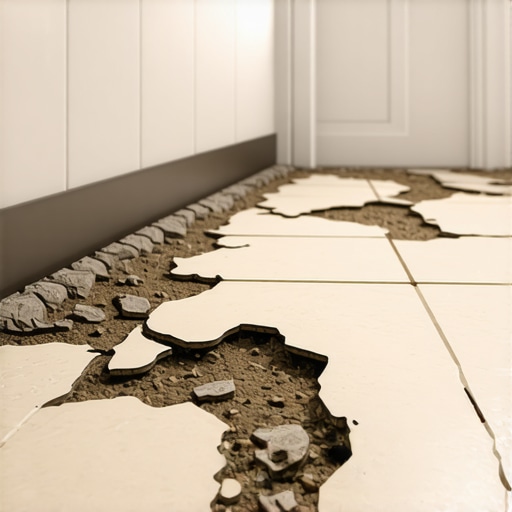
Most guys skip the leveling compound. They think the underlayment will hide the dip. It won’t. I spent three days grinding concrete on a job last month just so the floor wouldn’t click like a castanet. When I walked into that bathroom, the owner was baffled. Her porcelain was literally tenting in the middle of the room, peaking like a mountain range. This is the reality of modern tile work when people ignore the structural engineering required for a wet environment. A floor is not a rug. It is a rigid assembly that must withstand humidity, foot traffic, and the slow movement of the earth itself.
The mechanics of a hollow floor
Tented bathroom tiles occur when the bond between the substrate and the tile fails, usually due to expansion and contraction stress that exceeds the shear strength of the adhesive. This phenomenon happens because tiles grow slightly in humid environments while concrete slabs or wooden subfloors shrink. If there is no expansion gap at the perimeter, the pressure has nowhere to go but up. It is basic physics. You are essentially building a bridge that has no room to breathe. When I see tiles popping, the first thing I check is the baseboards. If the tile is tucked tight against the wall with no gap, that floor was doomed from day one. You can find more about making your edges look professional at baseboards makeover ideas to elevate your space but remember that the gap behind that wood is your best friend. It is the lungs of your floor.
“A floor is only as good as the subfloor beneath it; deflection is the enemy of every joint.” – Master Flooring Axiom
The concrete slab mystery
Concrete slabs are a living material that continues to release moisture for years after the initial pour, creating a vapor drive that can delaminate thinset. Many installers think that because a house is ten years old, the slab is dry. They are wrong. If you are in a high-humidity area like the Gulf Coast, that slab is a sponge. If you do not use a moisture vapor barrier, that water moves upward and hits the bottom of your tile. It carries minerals that crystallize and physically push the tile away from the mortar. This is why grout restoration secrets for long-lasting results often start with checking what is happening underneath the surface. If the grout is cracking, the tile is moving. If the tile is moving, your bond is dead.
Why your thinset lost its grip
Chemical bonding failures in tile installations often stem from improper mortar selection or site conditions that cause the adhesive to skin over before the tile is set. High-performance modified thinsets require specific open times. If the installer spreads too much mud at once, the surface dries. He sets the tile on top, and it looks fine for six months. Then, the first winter hit, the house shifts, and the tile pops off clean. If you look at the back of a popped tile and it is smooth, you have a bond failure. This usually happens in showers that wow modern designs for 2025 because people prioritize the look of large format tiles without using the right C2 category mortars. Large tiles need more support, not less. [image_1]
| Substrate Type | Deflection Limit | Acclimation Time | Bond Strength Requirement |
|---|---|---|---|
| Plywood | L/360 | 48 Hours | High Polymer |
| Concrete Slab | N/A | 28 Days | Standard ANSI |
| Backer Board | L/720 for Stone | None | Modified Thinset |
The 1/8 inch that ruins everything
Expansion gaps are the most overlooked part of a tile installation, yet they are the primary reason why floors buckle or tent. According to TCNA guidelines, every tile installation needs a movement joint every 20 to 25 feet. In a bathroom, your perimeter is your movement joint. If you jam the tile against the wall, you are creating a ticking time bomb. The grout cannot handle the compression. It will crack, and then the tile will lift. If you are struggling with aesthetic issues from these failures, you might need how to refresh grout without replacing it but only after you have addressed the structural pressure. Also, keep your surfaces clean with tile cleaning tips for a sparkling bathroom in 2025 to ensure no caustic chemicals are eating away at your sealer.
The hidden failure of uncoupling membranes
Uncoupling membranes are designed to allow the substrate and the tile to move independently, but they fail if the wrong mortar is used to attach them to the subfloor. Most installers use a modified thinset to stick the membrane to the wood, which is correct. But they then use the same modified thinset to stick the tile to the membrane. On certain types of membranes, you need unmodified thinset for the top layer so it can hydrate properly. If you trap a polymer-modified mortar between a non-porous tile and a plastic membrane, it will stay wet for weeks. It never reaches its full structural strength. It is a molecular mess that leads to hollow-sounding floors and eventual popping.
“Ensure 95 percent mortar coverage in all wet areas to prevent water accumulation behind the tile surface.” – TCNA Handbook
- Check for bond-breakers like wax, paint, or old adhesive.
- Verify moisture vapor emission rate using a calcium chloride test.
- Ensure 95 percent mortar coverage for large format tiles.
- Leave 1/4 inch expansion gap at all vertical surfaces.
- Use an uncoupling membrane for any floor over 100 square feet.
The ghost in the expansion gap
The presence of moisture in the subfloor causes wood to swell and concrete to undergo carbonation, both of which apply lateral pressure to your tile. This is the ghost that haunts bad installations. You cannot see it. You can only feel it when the tile starts to crunch under your feet. Many homeowners try to hide these gaps with bulky moldings, but chic baseboard designs that transform rooms in 2025 can provide a sleek look while still allowing the floor to move. It is about balance. You need the structural room to breathe without sacrificing the visual lines of the room. If you ignore this, no amount of high-end tile will save your bathroom from a total failure.
Comments
One response to “Why Your Bathroom Tiles Are Popping Up Randomly”
This was a really insightful piece that highlights the importance of proper subfloor preparation when installing tile. I’ve seen so many cases where overlooked expansion gaps or ignoring moisture levels lead to costly repairs down the line. Personally, I learned the hard way that sealing the substrate and including movement joints can save a lot of headaches later. The part about moisture continually migrating up from concrete slabs especially resonated with me since I live in a humid area. Using a vapor barrier is such a small step but makes a significant difference in the longevity of tile installations. Have others here tried different moisture control methods in high-humidity climates, and what worked best for you? Also, I wonder how much of an impact proper acclimation and testing have on preventing these issues in the first place. Would love to hear some successful case studies or additional tips on managing moisture and movement in challenging environments.